QUESTION IMAGE
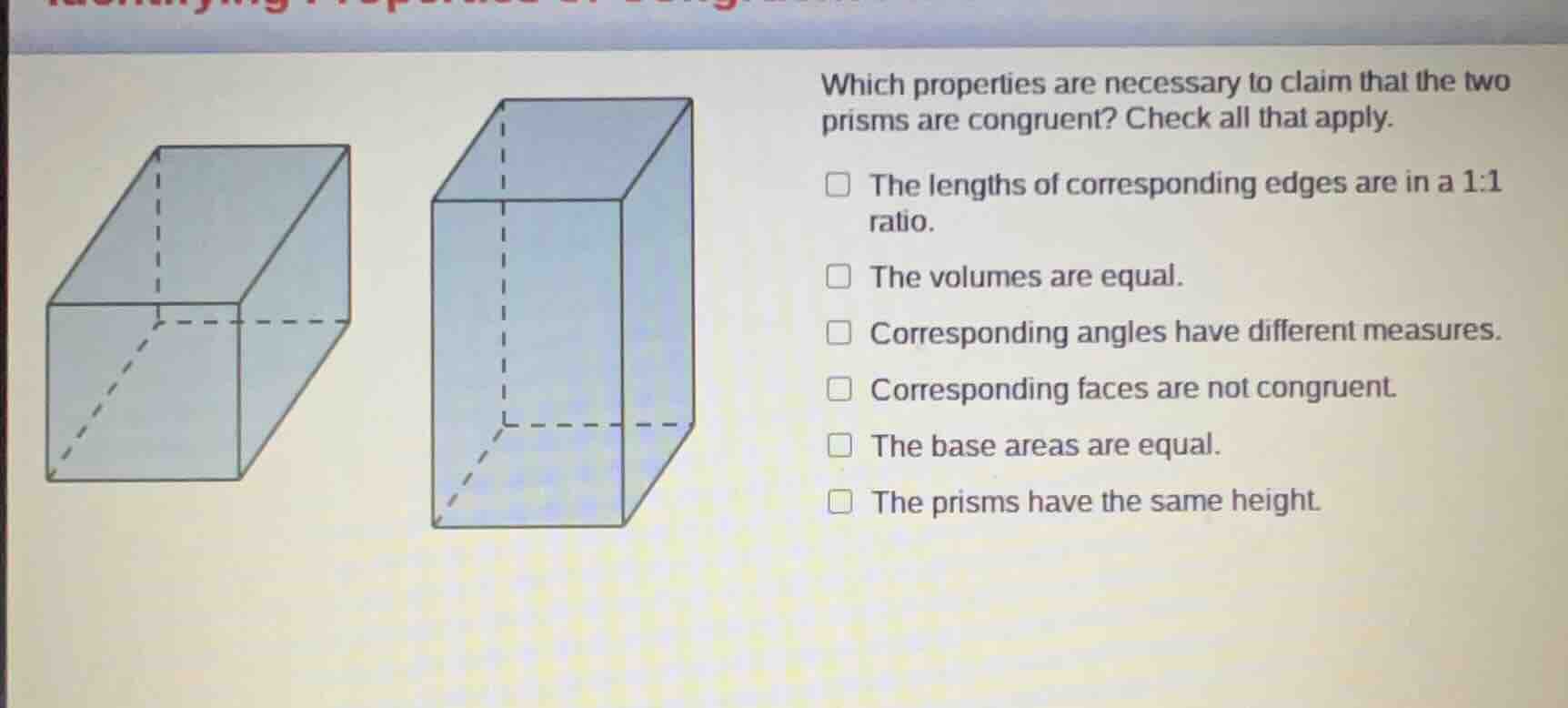
Question
which properties are necessary to claim that the two prisms are congruent? check all that apply. the lengths of corresponding edges are in a 1:1 ratio. the volumes are equal. corresponding angles have different measures. corresponding faces are not congruent. the base areas are equal. the prisms have the same height.
- For congruent prisms, corresponding edges must be equal (1:1 ratio), so this is necessary.
- Congruent prisms have equal volumes (since volume = base area × height, and if edges are equal, volume is equal), so this is necessary.
- Corresponding angles in prisms (which are right angles for rectangular prisms) must be equal, so "different measures" is wrong.
- Corresponding faces must be congruent for congruent prisms, so "not congruent" is wrong.
- Base areas being equal alone isn't enough (e.g., different heights with same base area would not be congruent), so this isn't necessary.
- Having the same height alone isn't enough (different base dimensions with same height would not be congruent), but combined with equal base (from 1:1 edges) it works, and since edges are 1:1, height is same. Also, from the 1:1 edges, height is same. But the key necessary ones from the options: 1:1 edges (so all dimensions equal), equal volume (follows from congruence), and same height (follows from 1:1 edges). Wait, actually, let's re - evaluate:
- "The lengths of corresponding edges are in a 1:1 ratio": If corresponding edges are in 1:1 ratio, then all corresponding linear measurements (length, width, height) are equal. For prisms (especially rectangular prisms as shown), this means the prisms are congruent. So this is necessary.
- "The volumes are equal": For two prisms, if they are congruent, their volumes must be equal (since congruent figures have equal volume). Also, if volumes are equal and they are prisms with the same shape (like rectangular prisms), and if edges are in 1:1, volume is equal. But is equal volume sufficient? No, but the question is about necessary properties. Congruent prisms must have equal volume, so this is necessary.
- "The prisms have the same height": If the corresponding edges are in 1:1 ratio, then the height (which is one of the edges) will be the same. So this is a result of the 1:1 edge ratio. Also, for the prisms to be congruent, the height must be the same (along with length and width).
Now, the incorrect options:
- "Corresponding angles have different measures": In prisms (rectangular prisms here), all angles are right angles, so corresponding angles must be equal. So this is incorrect.
- "Corresponding faces are not congruent": For congruent prisms, corresponding faces must be congruent (since all edges are equal, the faces which are rectangles will have equal length and width, so congruent). So this is incorrect.
- "The base areas are equal": Base area equal can happen with different length and width (e.g., base 2x3 and 1x6 have same area but different dimensions). So equal base area alone doesn't ensure congruence. So this is not a necessary property.
So the correct options are: "The lengths of corresponding edges are in a 1:1 ratio", "The volumes are equal", "The prisms have the same height". Wait, but let's check the figure. The prisms are rectangular prisms. For two rectangular prisms to be congruent, all corresponding edge lengths must be equal (so 1:1 ratio for edges), which implies same height, same length, same width, so volume is equal (volume = l×w×h, so if l, w, h are equal, volume is equal).
So the necessary properties from the options are:
- The lengths of corresponding edges are in a 1:1 ratio.
- The volumes are equal.
- The prisms have the same height.
Wait, but when edges are in 1:1 ratio, height is same, so "the prisms have the same height" is a consequence of the 1:1 edge ratio. But the question is about which properties are necessary to claim congruence. So:
- "The lengths of cor…

Snap & solve any problem in the app
Get step-by-step solutions on Sovi AI
Photo-based solutions with guided steps
Explore more problems and detailed explanations
- The lengths of corresponding edges are in a 1:1 ratio.
- The volumes are equal.
- The prisms have the same height.