QUESTION IMAGE
Question
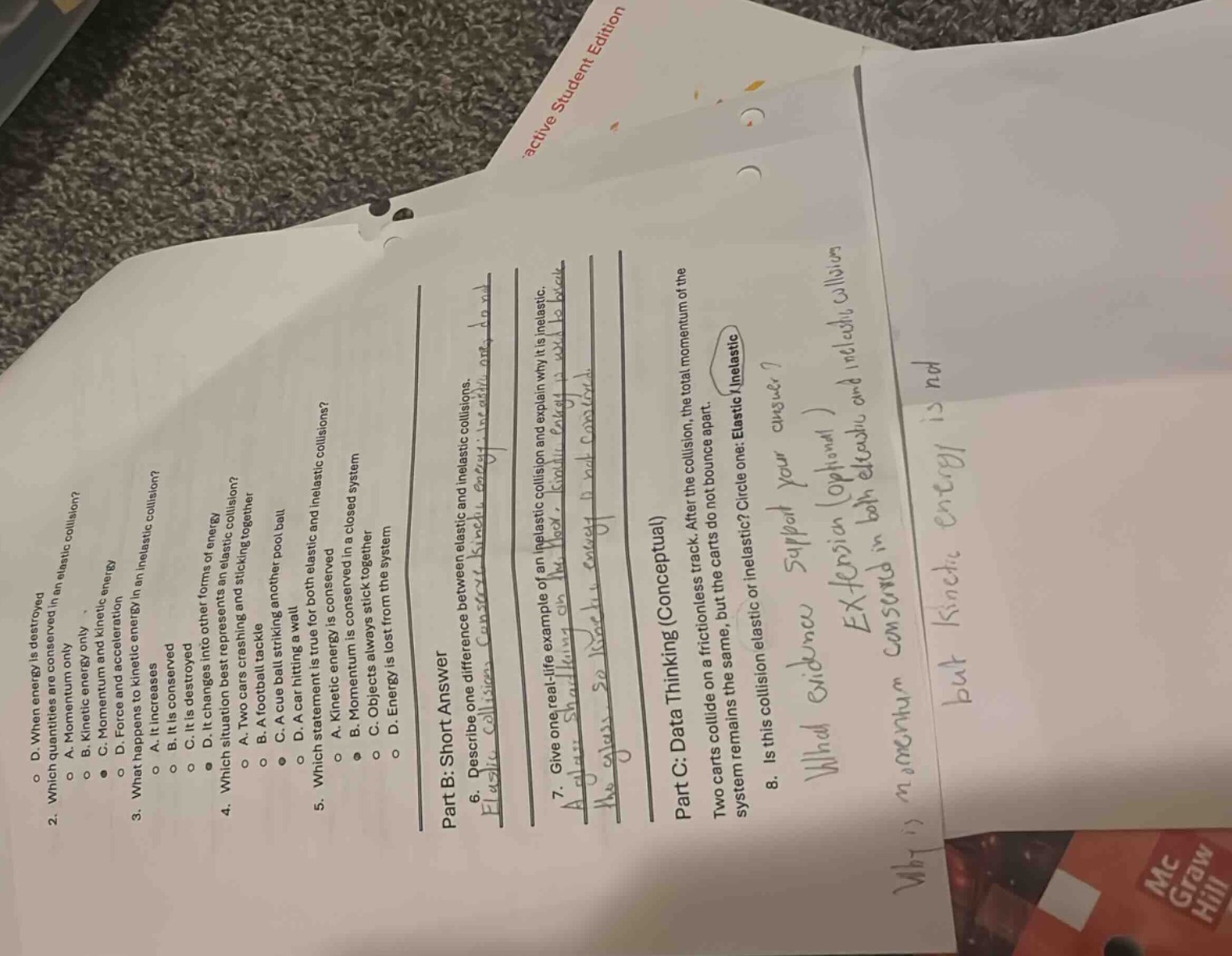
- which quantities are conserved in an elastic collision?o a. momentum onlyo b. kinetic energy only● c. momentum and kinetic energyo d. force and acceleration3. what happens to kinetic energy in an inelastic collision?o a. it increaseso b. it is conservedo c. it is destroyed● d. it changes into other forms of energy4. which situation best represents an elastic collision?o a. two cars crashing and sticking togethero b. a football tackle● c. a cue ball striking another pool ballo d. a car hitting a wall5. which statement is true for both elastic and inelastic collisions?o a. kinetic energy is conserved● b. momentum is conserved in a closed systemo c. objects always stick togethero d. energy is lost from the systempart b: short answer6. describe one difference between elastic and inelastic collisions.7. give one real-life example of an inelastic collision and explain why it is inelastic.part c: data thinking (conceptual)two carts collide on a frictionless track. after the collision, the total momentum of the system remains the same, but the carts do not bounce apart.8. is this collision elastic or inelastic? circle one: elastic / inelastic
Response
Part A: Multiple Choice
Step1: Elastic collision conserved quantities
In elastic collisions, both momentum and kinetic energy are conserved.
Step2: Inelastic collision KE change
In inelastic collisions, kinetic energy converts to other forms (sound, heat, deformation), so it is not conserved and changes form.
Step3: Identify elastic collision example
Elastic collisions involve objects bouncing apart with no permanent deformation; a cue ball striking another pool ball fits this.
Step4: Elastic/inelastic shared rule
For both collision types in a closed system, total momentum is always conserved.
Brief Explanations
- The key difference is kinetic energy conservation: elastic collisions conserve total kinetic energy, while inelastic collisions do not (kinetic energy is lost to heat, sound, or permanent deformation).
- Example: A hammer driving a nail into wood. This is inelastic because the hammer and nail move together after impact, and kinetic energy is converted into work to push the nail into the wood, sound, and heat, so total kinetic energy is not conserved.
Brief Explanations
- The collision is inelastic because the carts do not bounce apart (they stay in contact or move together after collision), and kinetic energy is not conserved (even though momentum remains the same, the lack of bouncing indicates kinetic energy was converted to other forms like sound or internal energy in the carts).

Snap & solve any problem in the app
Get step-by-step solutions on Sovi AI
Photo-based solutions with guided steps
Explore more problems and detailed explanations
- C. Momentum and kinetic energy
- D. It changes into other forms of energy
- C. A cue ball striking another pool ball
- B. Momentum is conserved in a closed system
---