QUESTION IMAGE
Question
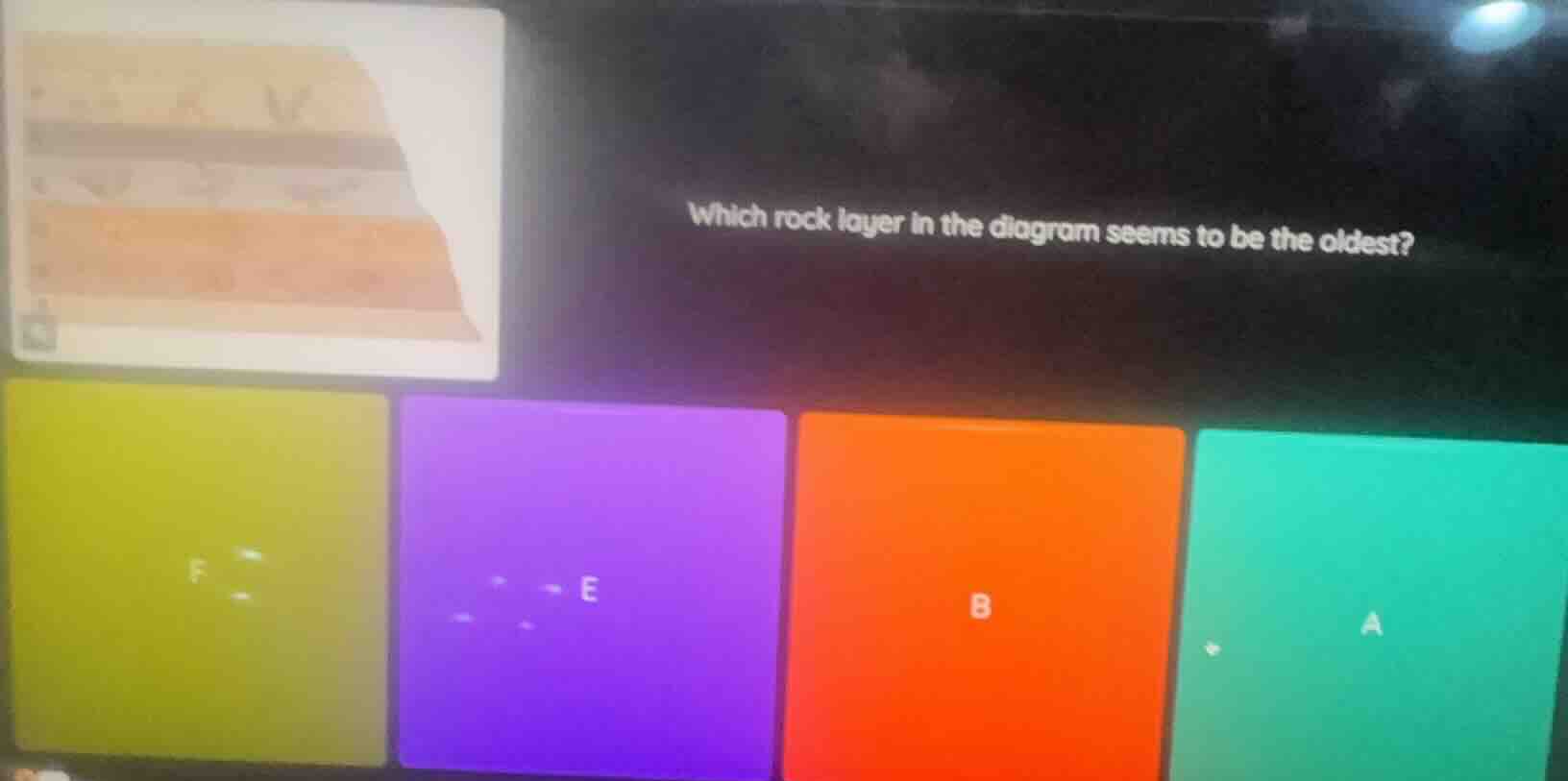
which rock layer in the diagram seems to be the oldest?
To determine the oldest rock layer, we use the principle of superposition in geology (a key concept in Earth Science, part of Natural Science). The principle states that in undisturbed sedimentary rock layers, the oldest layers are at the bottom, and younger layers are deposited on top. Assuming the diagram shows horizontal sedimentary layers (even partially visible), the bottom - most layer (or the layer that would be at the lowest position if we consider the typical layering) is the oldest. From the visible part of the diagram (the layered rock image at the top left, and the color - coded options below, likely corresponding to layers), the layer that is at the lowest position (or the one that would be the bottom layer in the sequence) is the oldest. If we assume the layers are labeled such that the bottom - most is, for example, the one corresponding to the lowest - positioned color (like the yellow - green one labeled F, but more accurately, based on superposition, the lowest layer in the diagram's rock section is the oldest. If we consider the options, the layer that is the bottom - most in the rock layer diagram (the top - left image) would be the oldest. Typically, in such diagrams, the bottom layer (the one at the very bottom of the rock section) is the oldest. So if we assume the layers are F, E, B, A from bottom to top (or the order in the rock diagram), the bottom - most (like F or the lowest - visible layer) is the oldest. But more precisely, using superposition, the oldest layer is the one at the bottom of the rock sequence.

Snap & solve any problem in the app
Get step-by-step solutions on Sovi AI
Photo-based solutions with guided steps
Explore more problems and detailed explanations
Assuming the rock layers follow the principle of superposition (oldest at the bottom), the oldest rock layer is the bottom - most layer in the diagram. If we consider the labeled options (F, E, B, A) and the rock layer diagram, the oldest is likely the layer corresponding to the lowest - positioned layer in the rock section (e.g., if F is the bottom - most, then F is the oldest). But based on typical diagramming, the oldest rock layer is the bottom - most layer in the rock sequence shown. If we take the options, and assuming the rock layer in the diagram has layers with the bottom - most being, for example, the one labeled F (or the lowest - colored layer in the diagram's rock part), then the oldest rock layer is the bottom - most layer (e.g., F - labeled layer or the lowest - positioned layer in the rock diagram). However, if we consider the options given (F, E, B, A) and the rock layer diagram, the oldest is the bottom - most layer in the rock section, which would be the one at the lowest position in the diagram's rock layers. So the answer is the bottom - most rock layer (e.g., if the layers are F, E, B, A from bottom to top, then F is the oldest).