QUESTION IMAGE
Question
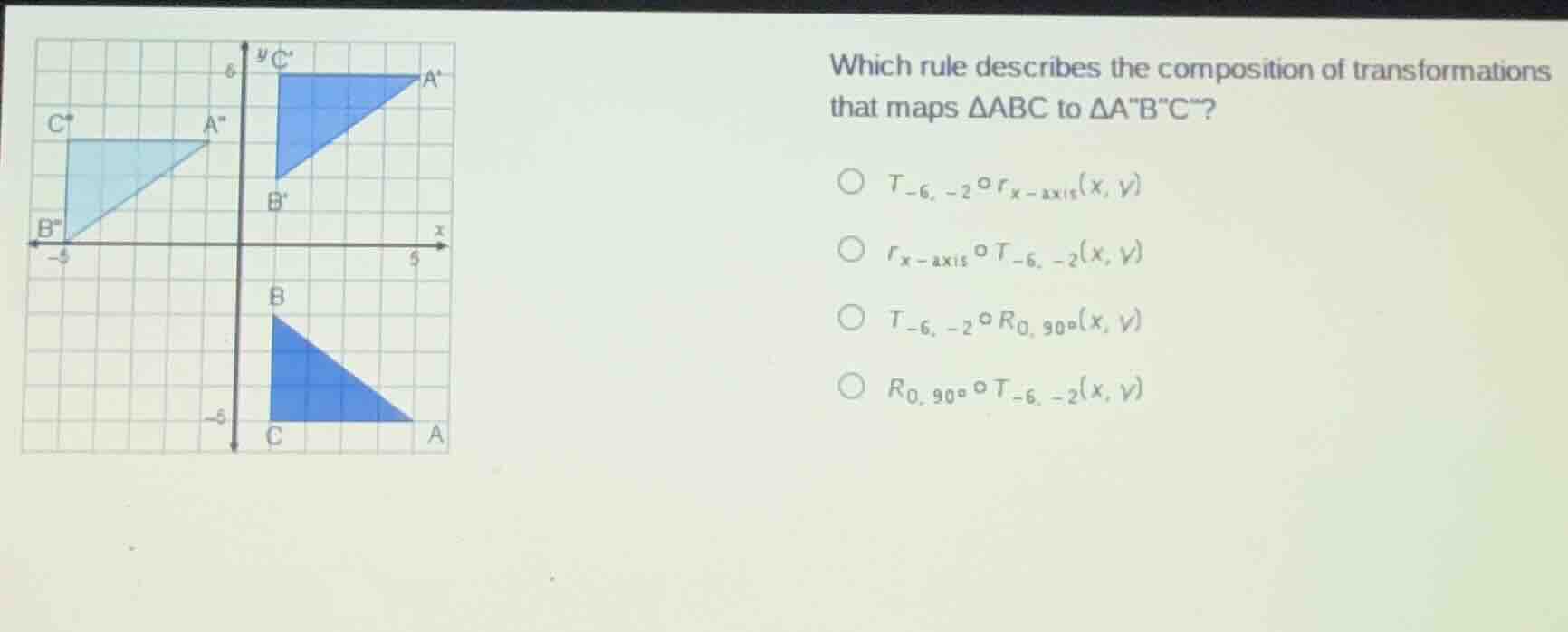
which rule describes the composition of transformations that maps $\delta abc$ to $\delta abc$? $\bigcirc$ $t_{-6, -2} \circ r_{x-axis}(x, y)$ $\bigcirc$ $r_{x-axis} \circ t_{-6, -2}(x, y)$ $\bigcirc$ $t_{-6, -2} \circ r_{0, 90\circ}(x, y)$ $\bigcirc$ $r_{0, 90\circ} \circ t_{-6, -2}(x, y)$
Step1: Identify ΔABC coordinates
Let’s take vertices: $A=(4,-5)$, $B=(0,-2)$, $C=(0,-5)$
Step2: Test first transformation option
First apply $r_{x-axis}(x,y)=(x,-y)$ to ΔABC:
$A'=(4,5)$, $B'=(0,2)$, $C'=(0,5)$ (matches top blue triangle)
Then apply $T_{-6,-2}(x,y)=(x-6,y-2)$:
$A''=(4-6,5-2)=(-2,3)$, $B''=(0-6,2-2)=(-6,0)$, $C''=(0-6,5-2)=(-6,3)$ (matches light blue triangle)
Step3: Verify order of operations
Composition $T_{-6,-2} \circ r_{x-axis}(x,y)$ means reflection first, then translation, which maps ΔABC to ΔA''B''C''.

Snap & solve any problem in the app
Get step-by-step solutions on Sovi AI
Photo-based solutions with guided steps
Explore more problems and detailed explanations
$T_{-6,\ -2} \circ r_{x-axis}(x, y)$