QUESTION IMAGE
Question
which sentence includes a nonrestrictive clause that is punctuated correctly?
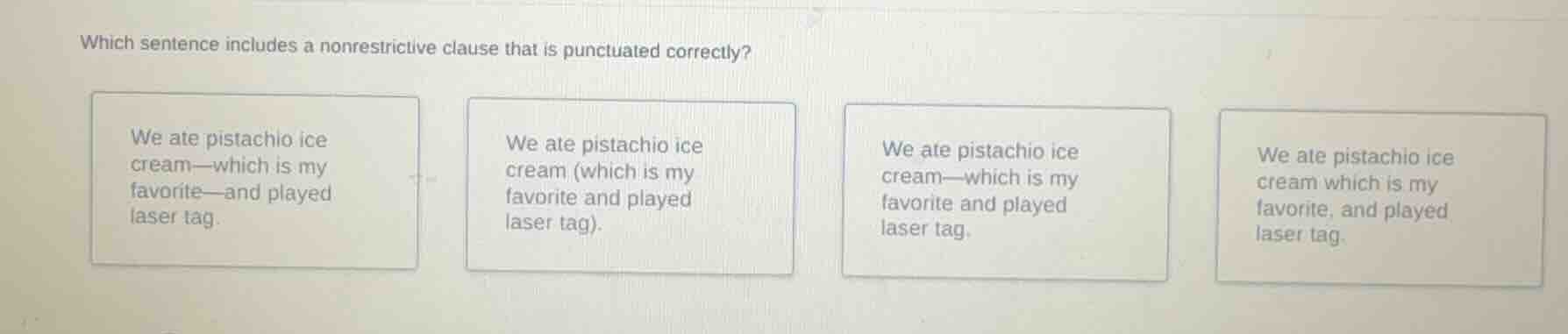
we ate pistachio ice cream—which is my favorite—and played laser tag.
we ate pistachio ice cream (which is my favorite and played laser tag).
we ate pistachio ice cream—which is my favorite and played laser tag.
we ate pistachio ice cream which is my favorite, and played laser tag.
A nonrestrictive clause adds extra, non-essential information and must be set off from the main clause. It should be enclosed on both ends with appropriate punctuation (em dashes, commas, or parentheses).
- The first option correctly uses em dashes to set off the nonrestrictive clause which is my favorite on both sides, separating it from the main clause parts "We ate pistachio ice cream" and "and played laser tag".
- The second option incorrectly closes the parenthetical clause only at the end of the entire sentence, not after the clause itself.
- The third option only uses an em dash at the start of the clause, not at the end, failing to properly set off the nonrestrictive clause.
- The fourth option uses a comma after the clause but no punctuation before it, which is incorrect for setting off a nonrestrictive clause.

Snap & solve any problem in the app
Get step-by-step solutions on Sovi AI
Photo-based solutions with guided steps
Explore more problems and detailed explanations
We ate pistachio ice cream—which is my favorite—and played laser tag.