QUESTION IMAGE
Question
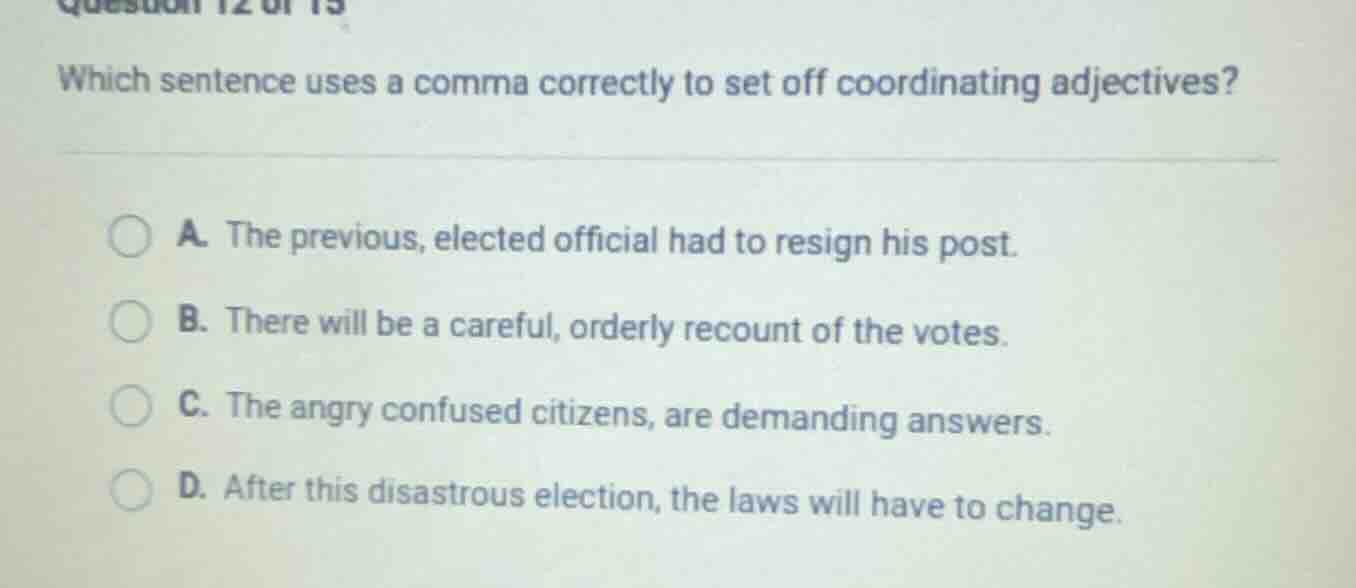
which sentence uses a comma correctly to set off coordinating adjectives? a. the previous, elected official had to resign his post. b. there will be a careful, orderly recount of the votes. c. the angry confused citizens, are demanding answers. d. after this disastrous election, the laws will have to change.
To determine which sentence uses a comma correctly for coordinating adjectives, we first recall that coordinating adjectives are adjectives that modify the same noun and can be separated by "and" (e.g., "a tall, handsome man" is equivalent to "a tall and handsome man").
- Option A: "previous" and "elected" are not coordinating adjectives. "Elected" is a participial adjective that functions more like a modifier indicating the official was elected, and we wouldn't say "previous and elected official", so the comma is incorrect.
- Option B: "careful" and "orderly" are coordinating adjectives modifying "recount". We can say "a careful and orderly recount", so the comma is used correctly to separate them.
- Option C: The comma after "citizens" is incorrect. "Angry" and "confused" are coordinating adjectives modifying "citizens", but the comma should be between the adjectives, not after the noun (i.e., "The angry, confused citizens are demanding answers").
- Option D: The comma here is used to separate an introductory phrase ("After this disastrous election") from the main clause, not to separate coordinating adjectives. So this is not an example of a comma for coordinating adjectives.

Snap & solve any problem in the app
Get step-by-step solutions on Sovi AI
Photo-based solutions with guided steps
Explore more problems and detailed explanations
B. There will be a careful, orderly recount of the votes.