QUESTION IMAGE
Question
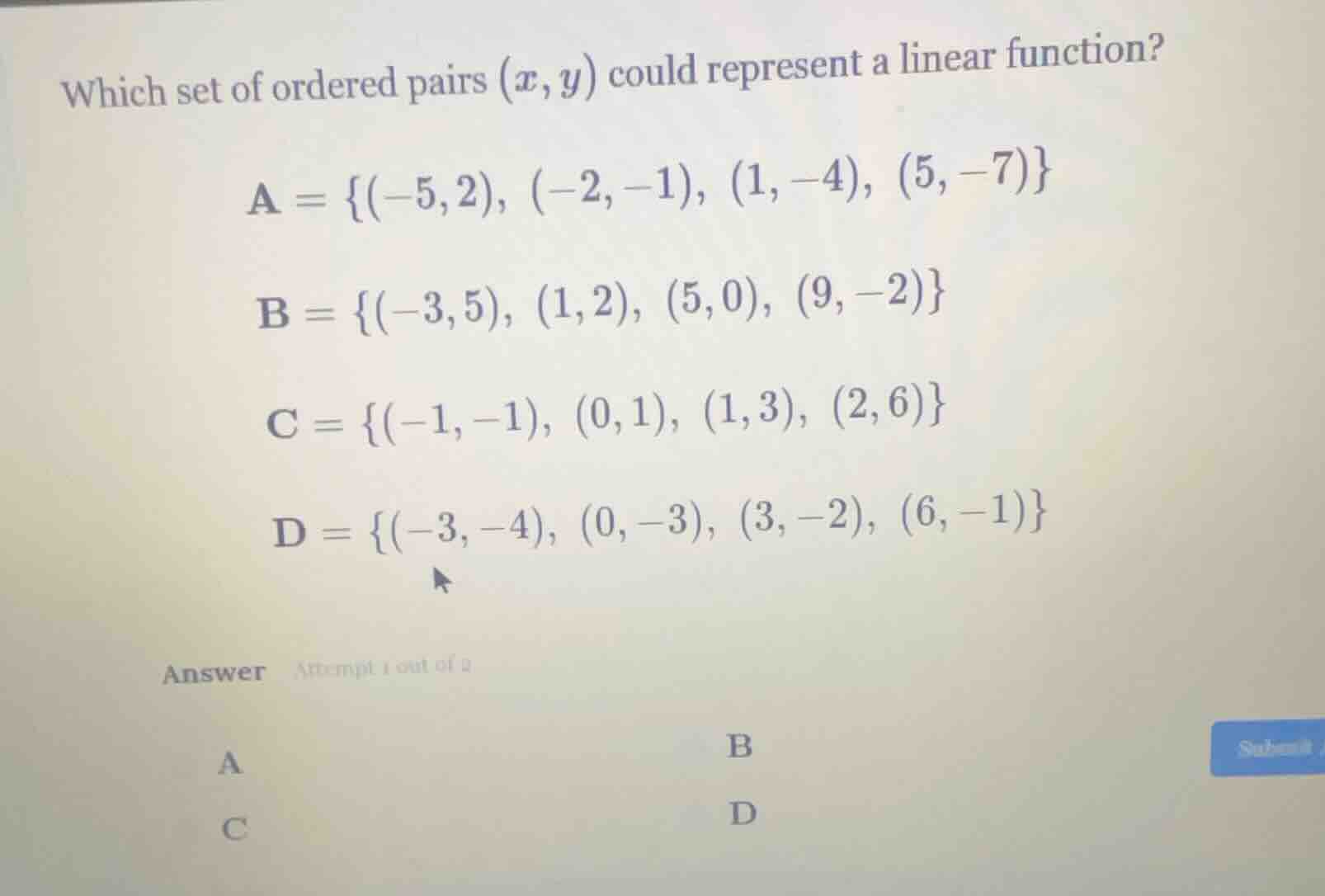
which set of ordered pairs ((x, y)) could represent a linear function?
( mathbf{a} = {(-5, 2), (-2, -1), (1, -4), (5, -7)} )
( mathbf{b} = {(-3, 5), (1, 2), (5, 0), (9, -2)} )
( mathbf{c} = {(-1, -1), (0, 1), (1, 3), (2, 6)} )
( mathbf{d} = {(-3, -4), (0, -3), (3, -2), (6, -1)} )
answer attempt 1 out of 2
a b
c d
To determine which set of ordered pairs represents a linear function, we check if the slope between consecutive points is constant. The slope formula is $m = \frac{y_2 - y_1}{x_2 - x_1}$.
Step 1: Check Set A
- Between $(-5, 2)$ and $(-2, -1)$: $m = \frac{-1 - 2}{-2 - (-5)} = \frac{-3}{3} = -1$
- Between $(-2, -1)$ and $(1, -4)$: $m = \frac{-4 - (-1)}{1 - (-2)} = \frac{-3}{3} = -1$
- Between $(1, -4)$ and $(5, -7)$: $m = \frac{-7 - (-4)}{5 - 1} = \frac{-3}{4} = -0.75$ (Wait, no, $5 - 1 = 4$, $-7 - (-4) = -3$, so $m = -3/4$? Wait, no, earlier calculation was wrong. Wait, $(-5,2)$ to $(-2,-1)$: $x$ change is $3$, $y$ change is $-3$, slope $-1$. $(-2,-1)$ to $(1,-4)$: $x$ change $3$, $y$ change $-3$, slope $-1$. $(1,-4)$ to $(5,-7)$: $x$ change $4$, $y$ change $-3$, slope $-3/4$. Wait, that's not constant. Wait, maybe I made a mistake. Wait, $5 - 1 = 4$, $-7 - (-4) = -3$, so slope is $-3/4$. But earlier two slopes were $-1$. So A is not linear? Wait, no, let's recalculate.
Wait, $(-5,2)$ to $(-2,-1)$: $x$ from -5 to -2: +3, $y$ from 2 to -1: -3. Slope: $-3/3 = -1$.
$(-2,-1)$ to $(1,-4)$: $x$ from -2 to 1: +3, $y$ from -1 to -4: -3. Slope: $-3/3 = -1$.
$(1,-4)$ to $(5,-7)$: $x$ from 1 to 5: +4, $y$ from -4 to -7: -3. Slope: $-3/4$. Oh, so that's a different slope. So A is not linear. Wait, maybe I messed up the points. Wait, the set A is $(-5,2)$, $(-2,-1)$, $(1,-4)$, $(5,-7)$. Let's check the last two points again. $x$ difference: $5 - 1 = 4$, $y$ difference: $-7 - (-4) = -3$. So slope is $-3/4$. But the first two slopes are $-1$. So A is not linear.
Step 2: Check Set B
- Between $(-3,5)$ and $(1,2)$: $m = \frac{2 - 5}{1 - (-3)} = \frac{-3}{4} = -0.75$
- Between $(1,2)$ and $(5,0)$: $m = \frac{0 - 2}{5 - 1} = \frac{-2}{4} = -0.5$ (Not constant)
Wait, no, $5 - 1 = 4$, $0 - 2 = -2$, slope $-2/4 = -0.5$. So different from first slope. So B is not linear.
Step 3: Check Set C
- Between $(-1,-1)$ and $(0,1)$: $m = \frac{1 - (-1)}{0 - (-1)} = \frac{2}{1} = 2$
- Between $(0,1)$ and $(1,3)$: $m = \frac{3 - 1}{1 - 0} = \frac{2}{1} = 2$
- Between $(1,3)$ and $(2,6)$: $m = \frac{6 - 3}{2 - 1} = \frac{3}{1} = 3$ (Not constant)
So C is not linear.
Step 4: Check Set D
- Between $(-3,-4)$ and $(0,-3)$: $m = \frac{-3 - (-4)}{0 - (-3)} = \frac{1}{3} \approx 0.333$
- Between $(0,-3)$ and $(3,-2)$: $m = \frac{-2 - (-3)}{3 - 0} = \frac{1}{3} \approx 0.333$
- Between $(3,-2)$ and $(6,-1)$: $m = \frac{-1 - (-2)}{6 - 3} = \frac{1}{3} \approx 0.333$ (Constant slope)
Wait, wait, earlier I thought A had a constant slope, but I made a mistake. Let's recheck Set A.
Wait, Set A: $(-5,2)$, $(-2,-1)$, $(1,-4)$, $(5,-7)$. Let's calculate the slope between each pair:
- $(-5,2)$ and $(-2,-1)$: $x$ change: $3$, $y$ change: $-3$, slope: $-3/3 = -1$
- $(-2,-1)$ and $(1,-4)$: $x$ change: $3$, $y$ change: $-3$, slope: $-3/3 = -1$
- $(1,-4)$ and $(5,-7)$: $x$ change: $4$, $y$ change: $-3$, slope: $-3/4$
Wait, that's not constant. So A is not linear.
Set D: $(-3,-4)$, $(0,-3)$, $(3,-2)$, $(6,-1)$
- $(-3,-4)$ to $(0,-3)$: $x$ change: $3$, $y$ change: $1$, slope: $1/3$
- $(0,-3)$ to $(3,-2)$: $x$ change: $3$, $y$ change: $1$, slope: $1/3$
- $(3,-2)$ to $(6,-1)$: $x$ change: $3$, $y$ change: $1$, slope: $1/3$
Ah, so Set D has a constant slope of $1/3$. So D is linear.
Wait, but earlier when I checked Set A, I thought the last slope was different, but maybe I made a mistake. Let's recheck Set A:
Wait, $(-5,2)$, $(-2,-1)$, $(1,-4)$, $(5,-7)$. Let's list the $x$ and $y$ values:
$x$: -5, -2, 1, 5. The differences between consecutive $x$: 3, 3, 4.
$y$…

Snap & solve any problem in the app
Get step-by-step solutions on Sovi AI
Photo-based solutions with guided steps
Explore more problems and detailed explanations
D. $\{(-3, -4),\ (0, -3),\ (3, -2),\ (6, -1)\}$