QUESTION IMAGE
Question
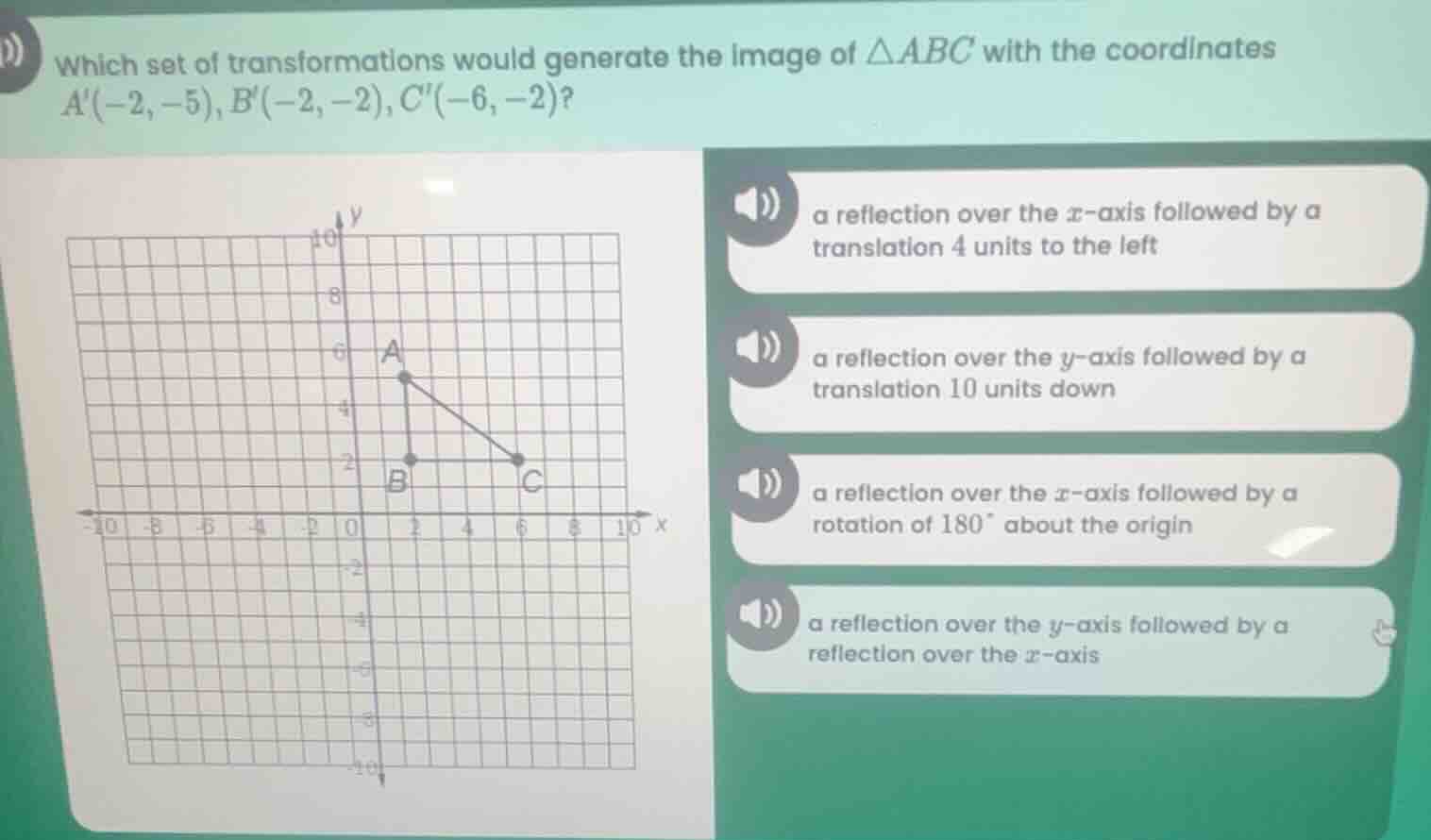
which set of transformations would generate the image of $\triangle abc$ with the coordinates $a(-2,-5), b(-2,-2), c(-6,-2)$?
options: a reflection over the $x$-axis followed by a translation 4 units to the left; a reflection over the $y$-axis followed by a translation 10 units down; a reflection over the $x$-axis followed by a rotation of $180^\circ$ about the origin; a reflection over the $y$-axis followed by a reflection over the $x$-axis
Step1: Find original coordinates
From the graph, original \( A(2,5) \), \( B(2,2) \), \( C(6,2) \).
Step2: Analyze each option
- Option 1: Reflect over \( x \)-axis: \( A(2,-5) \), \( B(2,-2) \), \( C(6,-2) \). Translate 4 left: \( A(-2,-5) \), \( B(-2,-2) \), \( C(2,-2) \) (not matching \( C'(-6,-2) \)).
- Option 2: Reflect over \( y \)-axis: \( A(-2,5) \), \( B(-2,2) \), \( C(-6,2) \). Translate 10 down: \( A(-2,-5) \), \( B(-2,-2) \), \( C(-6,-2) \) (matches \( A', B', C' \)).
- Option 3: Reflect over \( x \)-axis: \( A(2,-5) \), \( B(2,-2) \), \( C(6,-2) \). Rotate \( 180^\circ \): \( A(-2,5) \), \( B(-2,2) \), \( C(-6,2) \) (not matching).
- Option 4: Reflect over \( y \)-axis: \( A(-2,5) \), \( B(-2,2) \), \( C(-6,2) \). Reflect over \( x \)-axis: \( A(-2,-5) \), \( B(-2,-2) \), \( C(-6,-2) \)? Wait, no—wait, original after \( y \)-axis reflection is \( A(-2,5) \), \( B(-2,2) \), \( C(-6,2) \). Reflect over \( x \)-axis: \( A(-2,-5) \), \( B(-2,-2) \), \( C(-6,-2) \). Wait, but let's recheck Option 2: translate 10 down from \( y \)-axis reflection. \( y \)-axis reflection: \( A(-2,5) \), \( B(-2,2) \), \( C(-6,2) \). Translate 10 down: subtract 10 from \( y \)-coordinate: \( 5 - 10 = -5 \), \( 2 - 10 = -8 \)? Wait, no! Wait, I made a mistake. Wait original \( B \) is \( (2,2) \), reflect over \( y \)-axis: \( (-2,2) \). Translate 10 down: \( y \)-coordinate \( 2 - 10 = -8 \), but \( B' \) is \( (-2,-2) \). Oh no, my mistake earlier. Wait let's re-express:
Wait original coordinates: \( A(2,5) \), \( B(2,2) \), \( C(6,2) \).
Option 2: reflection over \( y \)-axis then translation 10 down.
Reflection over \( y \)-axis: \( (x,y) \to (-x,y) \). So \( A(2,5) \to (-2,5) \), \( B(2,2) \to (-2,2) \), \( C(6,2) \to (-6,2) \).
Translation 10 down: \( (x,y) \to (x, y - 10) \). So \( A(-2,5 - 10) = (-2,-5) \), \( B(-2,2 - 10) = (-2,-8) \), but \( B' \) is \( (-2,-2) \). So that's wrong. Wait, so my earlier analysis was wrong.
Wait let's check Option 4: reflection over \( y \)-axis then reflection over \( x \)-axis.
Reflection over \( y \)-axis: \( A(-2,5) \), \( B(-2,2) \), \( C(-6,2) \).
Reflection over \( x \)-axis: \( (x,y) \to (x, -y) \). So \( A(-2,-5) \), \( B(-2,-2) \), \( C(-6,-2) \). Which matches \( A', B', C' \)! Wait, so I messed up Option 2. Let's recheck all:
- Option 1: Reflect over \( x \)-axis: \( (x,y) \to (x, -y) \). So \( A(2,-5) \), \( B(2,-2) \), \( C(6,-2) \). Translate 4 left: \( (x - 4, y) \). So \( A(2 - 4, -5) = (-2,-5) \), \( B(2 - 4, -2) = (-2,-2) \), \( C(6 - 4, -2) = (2,-2) \). \( C' \) is \( (-6,-2) \), so no.
- Option 2: Reflect over \( y \)-axis: \( (-2,5) \), \( (-2,2) \), \( (-6,2) \). Translate 10 down: \( (-2,5 - 10) = (-2,-5) \), \( (-2,2 - 10) = (-2,-8) \), \( (-6,2 - 10) = (-6,-8) \). Not matching \( B'(-2,-2) \), \( C'(-6,-2) \).
- Option 3: Reflect over \( x \)-axis: \( (2,-5) \), \( (2,-2) \), \( (6,-2) \). Rotate \( 180^\circ \): \( (-2,5) \), \( (-2,2) \), \( (-6,2) \). Not matching.
- Option 4: Reflect over \( y \)-axis: \( (-2,5) \), \( (-2,2) \), \( (-6,2) \). Reflect over \( x \)-axis: \( (-2,-5) \), \( (-2,-2) \), \( (-6,-2) \). Which matches \( A'(-2,-5) \), \( B'(-2,-2) \), \( C'(-6,-2) \). Wait, but earlier I thought Option 2 was wrong, and Option 4 is correct? Wait no, let's check the original graph again. Wait the original \( B \) is at \( (2,2) \), \( C \) at \( (6,2) \), \( A \) at \( (2,5) \). So after reflecting over \( y \)-axis: \( B(-2,2) \), \( C(-6,2) \), \( A(-2,5) \). Then reflecting over \( x \)-axis: \( B(-2,-2) \), \(…

Snap & solve any problem in the app
Get step-by-step solutions on Sovi AI
Photo-based solutions with guided steps
Explore more problems and detailed explanations
The correct option is the fourth one: a reflection over the \( y \)-axis followed by a reflection over the \( x \)-axis (the last option in the list).