QUESTION IMAGE
Question
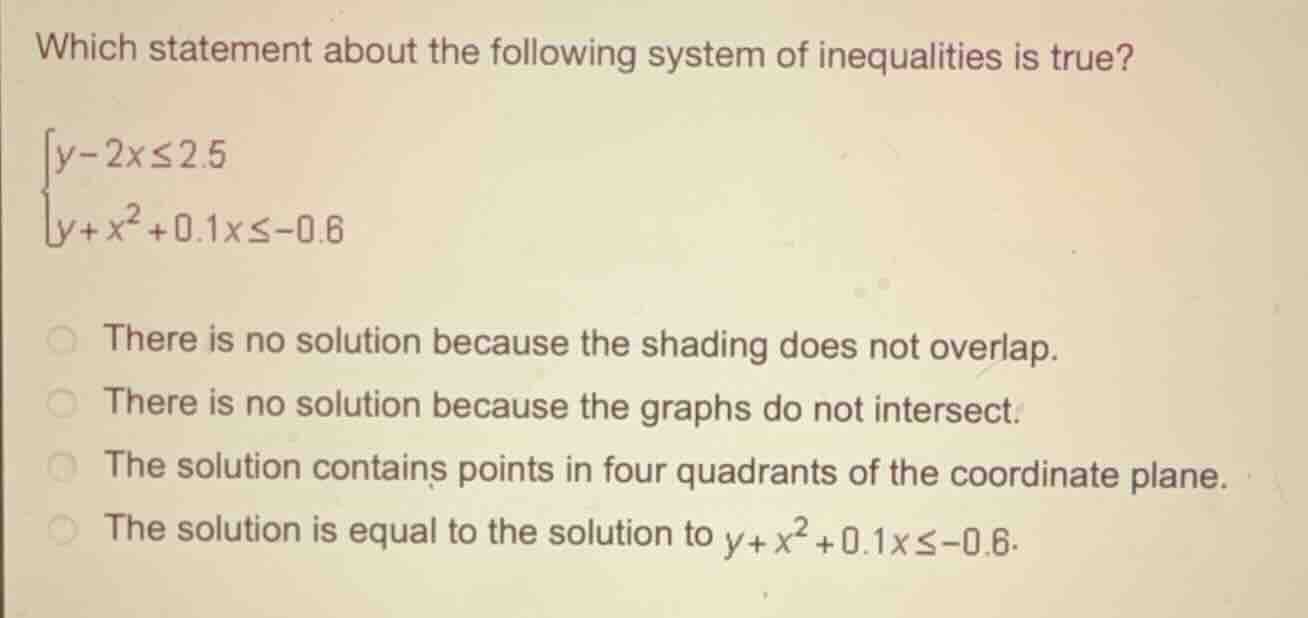
which statement about the following system of inequalities is true?\
\
there is no solution because the shading does not overlap.\
there is no solution because the graphs do not intersect.\
the solution contains points in four quadrants of the coordinate plane.\
the solution is equal to the solution to $y + x^2 + 0.1x \leq -0.6$.
Step1: Analyze the first inequality
Rewrite \( y - 2x\leq2.5 \) as \( y\leq2x + 2.5 \), which is a linear inequality representing the region below (or on) the line \( y = 2x+2.5 \).
Step2: Analyze the second inequality
Rewrite \( y + x^{2}+0.1x\leq - 0.6 \) as \( y\leq -x^{2}-0.1x - 0.6 \), which is a quadratic inequality representing the region below (or on) the parabola \( y=-x^{2}-0.1x - 0.6 \). The parabola \( y =-x^{2}-0.1x - 0.6 \) opens downwards (since the coefficient of \( x^{2}\) is - 1<0). The vertex of the parabola \( y = ax^{2}+bx + c\) is at \( x=-\frac{b}{2a}\), here \( a=-1\), \( b = - 0.1\), so \( x=-\frac{-0.1}{2\times(-1)}=-\frac{0.1}{2}=-0.05\). Substitute \( x = - 0.05\) into the parabola equation: \( y=-(-0.05)^{2}-0.1\times(-0.05)-0.6=-0.0025 + 0.005-0.6=-0.5975\). So the vertex is at \((-0.05,-0.5975)\).
Step3: Analyze the relationship between the two regions
For a system of inequalities \(
\), the solution is the intersection of the two regions. We need to check if the region defined by \( y\leq -x^{2}-0.1x - 0.6\) is a subset of the region defined by \( y\leq2x + 2.5\) or not.
Let's take a point on the parabola \( y=-x^{2}-0.1x - 0.6\), say \( x = 0\), then \( y=-0 - 0-0.6=-0.6\). Substitute \( x = 0\), \( y=-0.6\) into the first inequality: \( - 0.6-2\times0=-0.6\leq2.5\), which is true. Let's take another point, for the parabola, when \( x=-1\), \( y=-(-1)^{2}-0.1\times(-1)-0.6=-1 + 0.1-0.6=-1.5\). Substitute into the first inequality: \( - 1.5-2\times(-1)=-1.5 + 2 = 0.5\leq2.5\), true. In general, for the parabola \( y=-x^{2}-0.1x - 0.6\), we can show that \( -x^{2}-0.1x - 0.6\leq2x + 2.5\) (by considering the difference \( (2x + 2.5)-(-x^{2}-0.1x - 0.6)=x^{2}+2.1x + 3.1\). The discriminant of \( x^{2}+2.1x + 3.1\) is \( \Delta=(2.1)^{2}-4\times1\times3.1=4.41-12.4=-7.99<0\), so \( x^{2}+2.1x + 3.1>0\) for all real \( x\), which means \( -x^{2}-0.1x - 0.6<2x + 2.5\) for all real \( x\)). So the region defined by \( y\leq -x^{2}-0.1x - 0.6\) is entirely within the region defined by \( y\leq2x + 2.5\). Therefore, the solution of the system is the same as the solution of \( y + x^{2}+0.1x\leq - 0.6\).
Now let's analyze the other options:
- Option 1: The shading does overlap (since the region of the quadratic inequality is within the linear inequality's region), so this is false.
- Option 2: The graphs (the line and the parabola) may intersect or not, but the solution is about the regions, not just the intersection of the graphs. Also, the region of the quadratic is within the linear's region, so the solution is non - empty. So this is false.
- Option 3: The parabola \( y=-x^{2}-0.1x - 0.6\) has \( y=-x^{2}-0.1x - 0.6=-(x^{2}+0.1x + 0.6)\). The discriminant of \( x^{2}+0.1x + 0.6\) is \( \Delta=(0.1)^{2}-4\times1\times0.6=0.01 - 2.4=-2.39<0\), so \( x^{2}+0.1x + 0.6>0\) for all real \( x\), so \( y=-x^{2}-0.1x - 0.6<0\) for all real \( x\). Also, from the vertex \( x=-0.05\) (negative), and when \( x = 0\), \( y=-0.6\) (negative), when \( x>0\), \( y=-x^{2}-0.1x - 0.6\) is more negative. So the region of the quadratic inequality is in quadrants where \( y<0\), and \( x\) can be negative or non - negative, but it does not cover four quadrants. So this is false.

Snap & solve any problem in the app
Get step-by-step solutions on Sovi AI
Photo-based solutions with guided steps
Explore more problems and detailed explanations
The solution is equal to the solution to \( y + x^{2}+0.1x\leq - 0.6\).