QUESTION IMAGE
Question
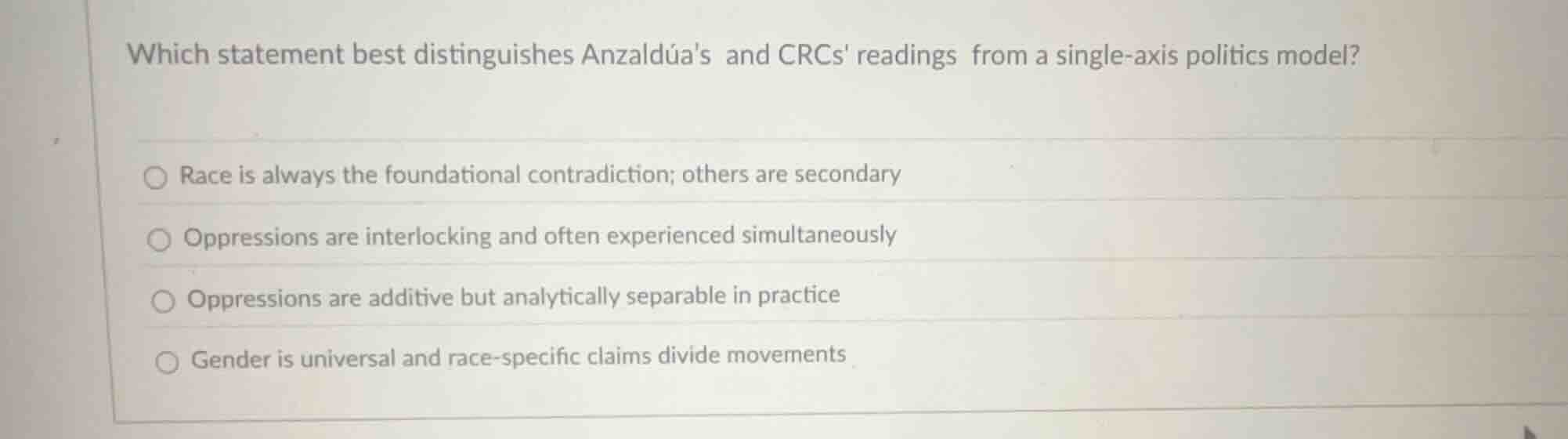
which statement best distinguishes anzaldúas and crcs readings from a single - axis politics model?
- race is always the foundational contradiction; others are secondary
- oppressions are interlocking and often experienced simultaneously
- oppressions are additive but analytically separable in practice
- gender is universal and race - specific claims divide movements
Brief Explanations
To solve this, we analyze each option:
- Option 1 ("Race is always...") suggests a single - axis (race - centered) approach, which is what the question wants to distinguish from, so it's incorrect.
- Option 2 ("Oppressions are interlocking...") aligns with the intersectional approach (seen in Anzaldúa's and CRCs' work), where multiple oppressions (like race, gender, class) are interconnected and experienced at the same time, unlike a single - axis model that focuses on one form of oppression.
- Option 3 ("Oppressions are additive...") implies oppressions can be separated and added, which is not in line with intersectional thinking and is more like a single - axis - like fragmented view, so it's incorrect.
- Option 4 ("Gender is universal...") promotes division and a single - axis - like hierarchy (prioritizing gender universality over race - specific claims), which is not what distinguishes the intersectional approach from single - axis, so it's incorrect.

Snap & solve any problem in the app
Get step-by-step solutions on Sovi AI
Photo-based solutions with guided steps
Explore more problems and detailed explanations
B. Oppressions are interlocking and often experienced simultaneously