QUESTION IMAGE
Question
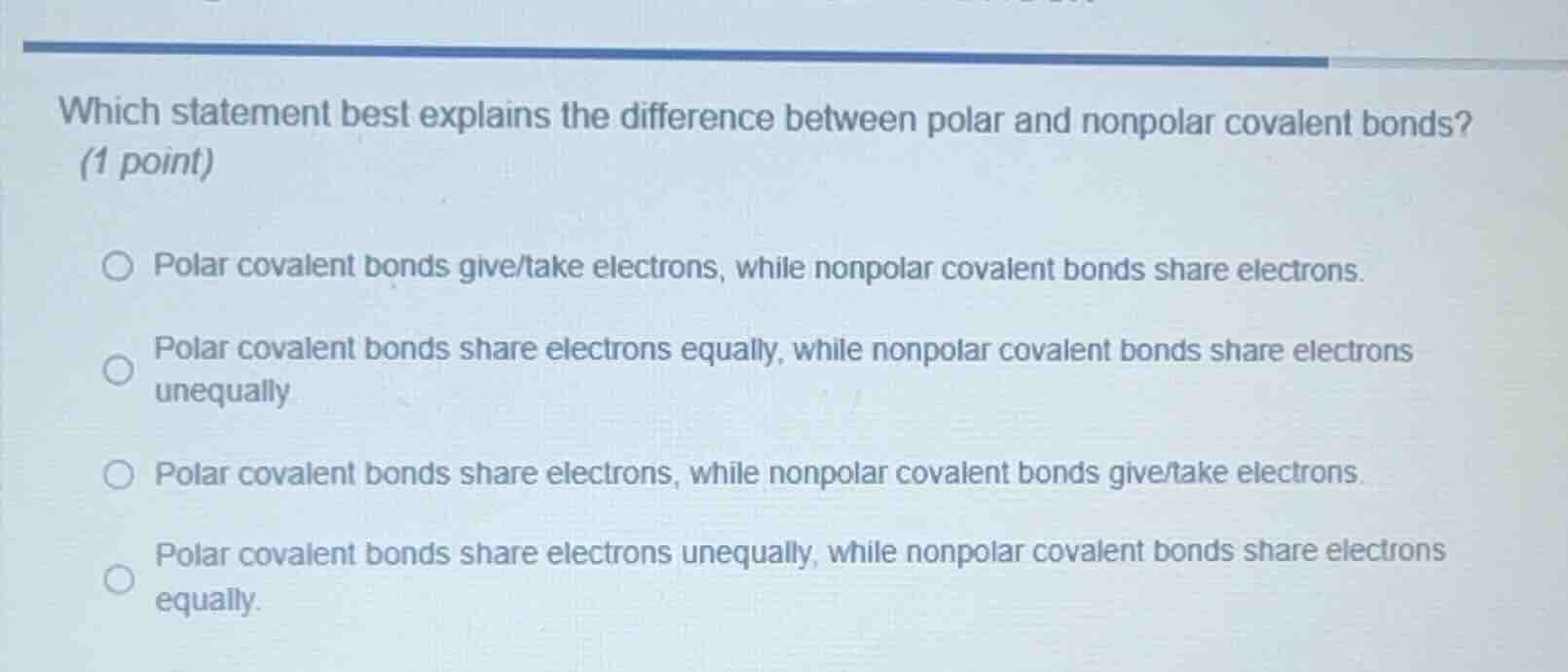
which statement best explains the difference between polar and nonpolar covalent bonds? (1 point) polar covalent bonds give/take electrons, while nonpolar covalent bonds share electrons. polar covalent bonds share electrons equally, while nonpolar covalent bonds share electrons unequally polar covalent bonds share electrons, while nonpolar covalent bonds give/take electrons. polar covalent bonds share electrons unequally, while nonpolar covalent bonds share electrons equally.
To determine the correct statement, we analyze the nature of covalent bonds:
- Covalent bonds involve electron sharing (ionic bonds involve electron transfer). So options suggesting polar/nonpolar covalent bonds give/take electrons are incorrect.
- In polar covalent bonds, electrons are shared unequally (due to electronegativity differences), creating partial charges. In nonpolar covalent bonds, electrons are shared equally (e.g., in diatomic molecules like \( \text{O}_2 \) or \( \text{H}_2 \)).
- The first incorrect option: Covalent bonds (both polar and nonpolar) share electrons, not give/take (that's ionic).
- The second incorrect option: It reverses the electron - sharing equality.
- The third incorrect option: Again, covalent bonds (polar and nonpolar) share electrons; giving/taking is ionic.
- The fourth option correctly states that polar covalent bonds share electrons unequally, while nonpolar covalent bonds share electrons equally.

Snap & solve any problem in the app
Get step-by-step solutions on Sovi AI
Photo-based solutions with guided steps
Explore more problems and detailed explanations
D. Polar covalent bonds share electrons unequally, while nonpolar covalent bonds share electrons equally.