QUESTION IMAGE
Question
8
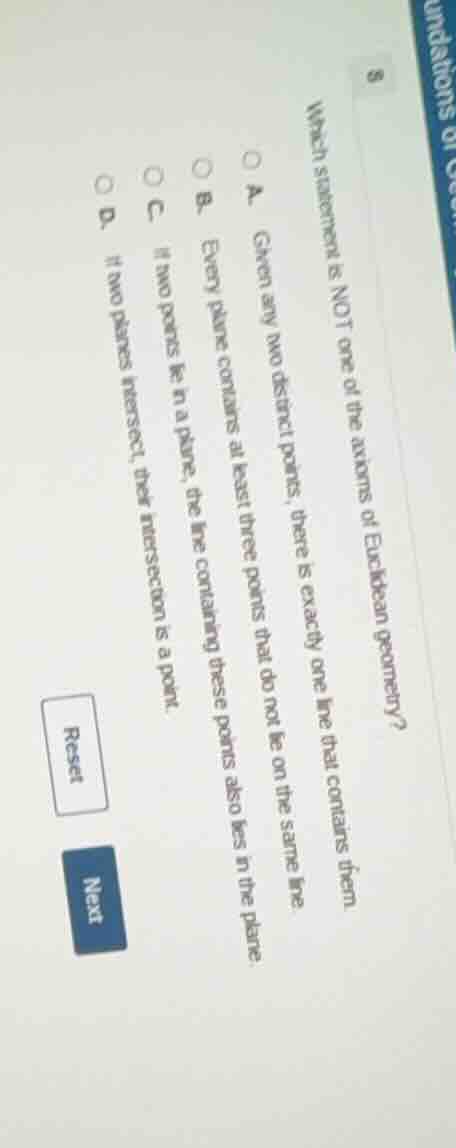
which statement is not one of the axioms of euclidean geometry?
a. given any two distinct points, there is exactly one line that contains them
b. every plane contains at least three points that do not lie on the same line.
c. if two points lie in a plane, the line containing these points also lies in the plane.
d. if two planes intersect, their intersection is a point.
reset
next
Brief Explanations
- Recall Euclidean geometry axioms:
- A: Given two distinct points, exactly one line contains them (axiom of line through two points).
- B: A plane is defined by at least three non - collinear points, but the statement says "at least three points that do not lie on the same line" to define a plane, but the axiom about plane and line: If two points lie in a plane, the line through them lies in the plane (which is related to plane - line containment). However, the statement in B is about defining a plane with non - collinear points, but the key is that the axiom for plane - line is about two points in a plane implying the line is in the plane. Wait, no, let's re - examine:
- C: If two points lie in a plane, the line containing them lies in the plane (this is an axiom of Euclidean geometry for plane and line).
- D: If two planes intersect, their intersection is a line (not a point). So D is not an axiom (the correct statement is that the intersection of two planes is a line). Wait, but let's check the options again. Wait, the question is which is NOT an axiom. Let's recall the axioms:
- Axiom 1: Through any two points, there is exactly one line (matches option A).
- Axiom related to plane: If two points lie in a plane, the line containing them lies in the plane (matches option C).
- Axiom for plane definition: A plane contains at least three non - collinear points (but option B says "every plane contains at least three points that do not lie on the same line" – this is part of the plane definition axiom. Wait, no, the mistake is in option D: The intersection of two planes is a line, not a point. So option D is NOT an axiom of Euclidean geometry. Wait, but let's check again. Wait, the options:
- Option D: "If two planes intersect, their intersection is a point." But in Euclidean geometry, the intersection of two planes is a line. So D is not an axiom. But wait, let's check the other options. Wait, maybe I made a mistake. Let's re - evaluate:
- Option B: "Every plane contains at least three points that do not lie on the same line." This is an axiom (a plane is defined by at least three non - collinear points).
- Option D: The intersection of two planes is a line, so saying it's a point is wrong. So D is not an axiom. Wait, but the options: Let's check the original question again. Wait, the options are:
- A: Correct axiom.
- B: Correct (plane has at least three non - collinear points).
- C: Correct (line through two plane points is in the plane).
- D: Incorrect, because two planes intersect in a line, not a point. So D is NOT an axiom.

Snap & solve any problem in the app
Get step-by-step solutions on Sovi AI
Photo-based solutions with guided steps
Explore more problems and detailed explanations
D. If two planes intersect, their intersection is a point.