QUESTION IMAGE
Question
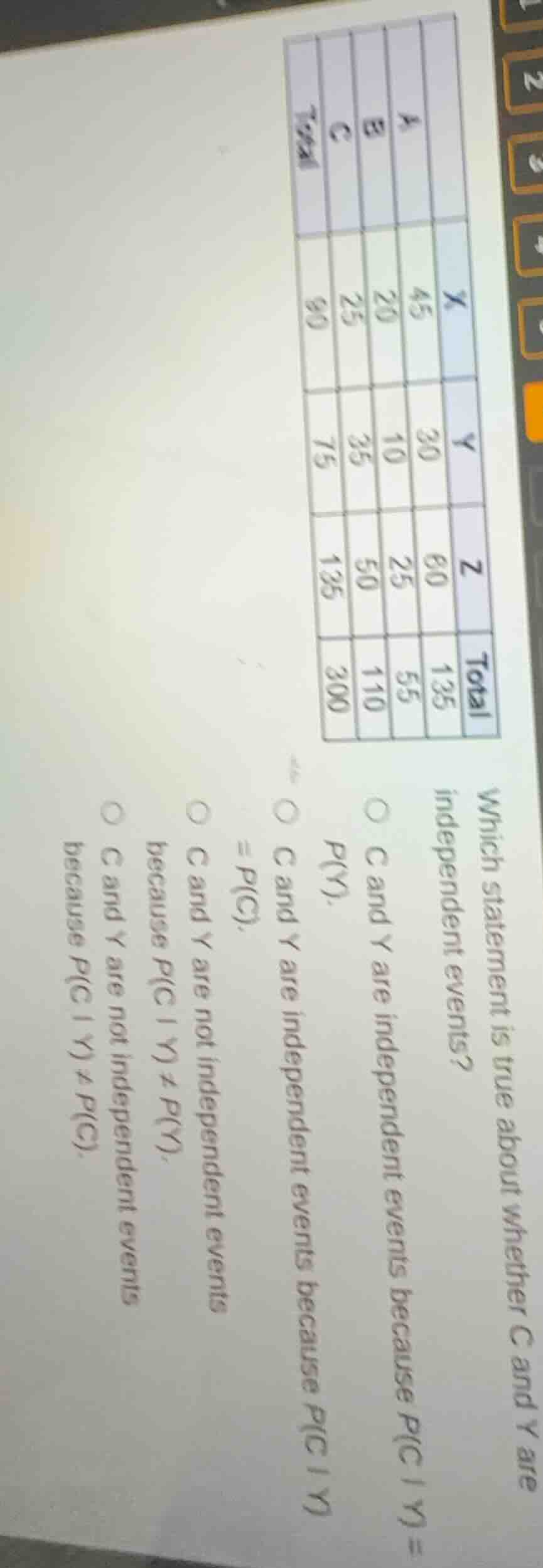
which statement is true about whether c and y are independent events? c and y are independent events because ( p(c mid y) = p(y) ). c and y are independent events because ( p(c mid y) = p(c) ). c and y are not independent events because ( p(c mid y)
eq p(y) ). c and y are not independent events because ( p(c mid y)
eq p(c) ).
Step1: Recall the definition of independent events
Two events \( C \) and \( Y \) are independent if \( P(C|Y) = P(C) \). We need to calculate \( P(C|Y) \) and \( P(C) \) using the given table.
Step2: Calculate \( P(C) \)
First, find the total number of observations, which is \( 300 \) (from the "Total" row and "Total" column). The number of times \( C \) occurs is the sum of the values in the \( C \) column: \( 25 + 35 + 50 = 110 \)? Wait, no, looking at the table: the columns are \( A, B, C \) and rows are \( X, Y, Z, \) Total. Wait, the "Total" row for each column: \( A \) total is \( 135 \), \( B \) total is \( 55 \), \( C \) total is \( 110 \)? Wait, no, the last row is "Total" with values \( 135, 55, 110, 300 \). Wait, the "Y" row: \( A: 30 \), \( B: 10 \), \( C: 35 \), Total for \( Y \) row: \( 30 + 10 + 35 = 75 \) (which matches the "Total" column for \( Y \) row: \( 75 \)).
So, \( P(C) = \frac{\text{Total number of } C}{\text{Total number of observations}} = \frac{110}{300} = \frac{11}{30} \approx 0.3667 \).
Step3: Calculate \( P(C|Y) \)
\( P(C|Y) = \frac{\text{Number of times } C \text{ and } Y \text{ occur}}{\text{Number of times } Y \text{ occurs}} \). The number of times \( C \) and \( Y \) occur is \( 35 \) (from the \( Y \) row and \( C \) column). The number of times \( Y \) occurs is \( 75 \) (from the "Total" column for \( Y \) row). So, \( P(C|Y) = \frac{35}{75} = \frac{7}{15} \approx 0.4667 \).
Step4: Compare \( P(C|Y) \) and \( P(C) \)
We have \( P(C) = \frac{110}{300} = \frac{11}{30} \approx 0.3667 \) and \( P(C|Y) = \frac{35}{75} = \frac{7}{15} \approx 0.4667 \). Since \( \frac{7}{15}
eq \frac{11}{30} \) (because \( \frac{7}{15} = \frac{14}{30} \) and \( \frac{14}{30}
eq \frac{11}{30} \)), we have \( P(C|Y)
eq P(C) \). Therefore, \( C \) and \( Y \) are not independent because \( P(C|Y)
eq P(C) \).

Snap & solve any problem in the app
Get step-by-step solutions on Sovi AI
Photo-based solutions with guided steps
Explore more problems and detailed explanations
C and Y are not independent events because \( P(C|Y)
eq P(C) \) (the last option: "C and Y are not independent events because \( P(C | Y)
eq P(C) \)").