QUESTION IMAGE
Question
which statement is true?
the probability that a randomly selected adult chose hawaii as the preferred destination is \\(\frac{147}{355}\\).
the probability that a randomly selected person who chose hawaii as the preferred destination is a teenager is \\(\frac{33}{50}\\).
the probability that a randomly selected child chose florida as the preferred destination is \\(\frac{62}{95}\\).
the probability that a randomly selected person who chose mexico as the preferred destination is a child is \\(\frac{14}{113}\\).
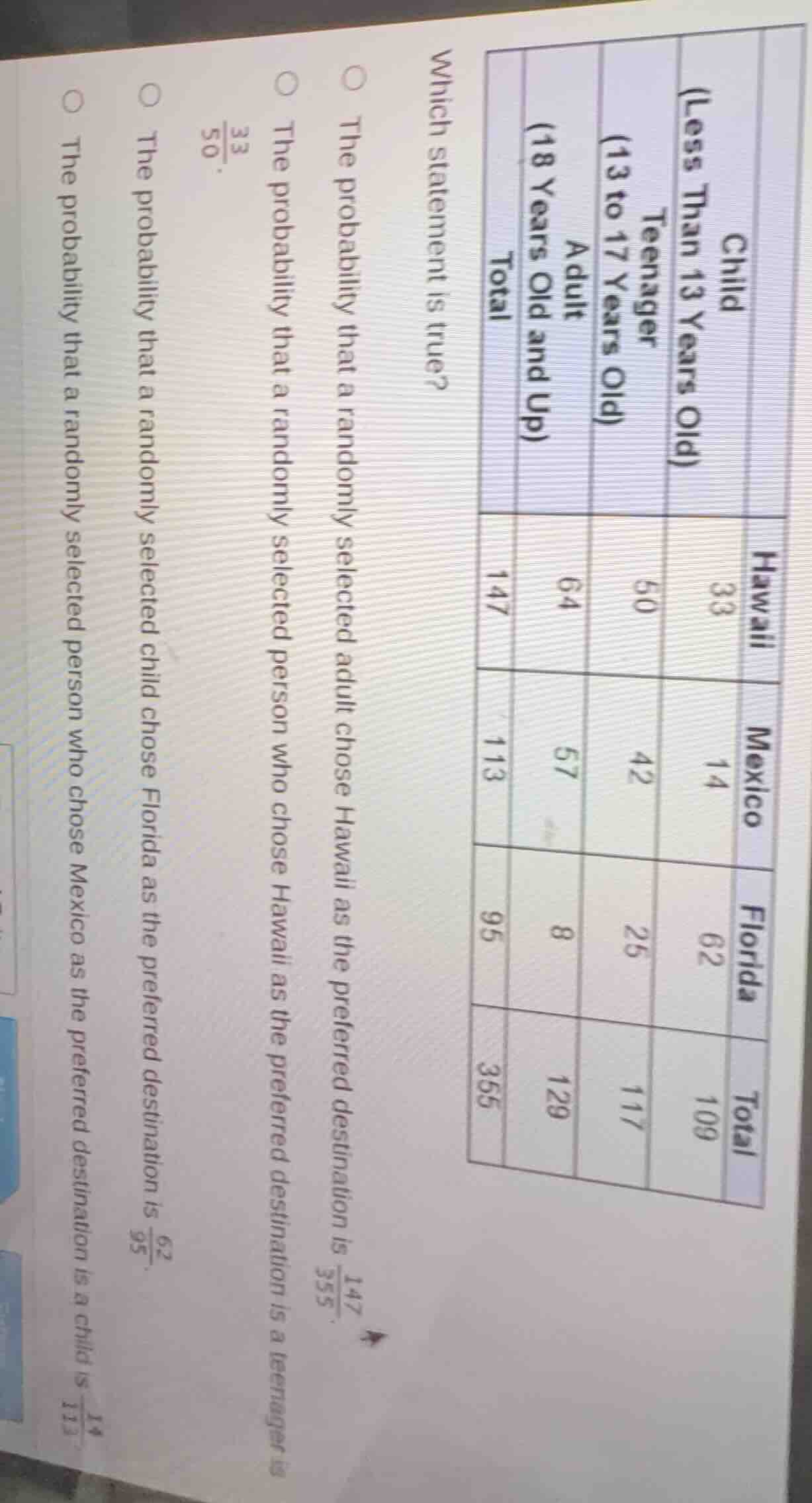
| child (less than 13 years old) | teenager (13 to 17 years old) | adult (18 years old and up) | total | |
|---|---|---|---|---|
| mexico | 14 | 42 | 57 | 113 |
| florida | 62 | 25 | 8 | 95 |
| total | 109 | 117 | 129 | 355 |
To determine the correct statement, we analyze each option using the given table:
Option 1: "The probability that a randomly selected adult chose Hawaii as the preferred destination is $\boldsymbol{\frac{147}{355}}$."
- Total adults: Sum of "Adult (18 Years Old and Up)" column: $64 + 57 + 8 = 129$ (wait, no—wait, the "Total" row for adults is $129$? Wait, no, the table’s "Total" column for adults is $129$? Wait, no, the table’s "Total" row (last row) has "Adult" as $129$, "Teenager" as $117$, "Child" as $109$, and grand total $129 + 117 + 109 = 355$.
- Adults who chose Hawaii: $64$ (from Hawaii’s "Adult" row).
- So probability = $\frac{\text{Adults who chose Hawaii}}{\text{Total adults}} = \frac{64}{129}$, not $\frac{147}{355}$. $\frac{147}{355}$ is $\frac{\text{Total Hawaii}}{\text{Grand Total}}$, which is not the probability for adults choosing Hawaii. Incorrect.
Option 2: "The probability that a randomly selected person who chose Hawaii as the preferred destination is a teenager is $\boldsymbol{\frac{33}{50}}$."
- Total people who chose Hawaii: $147$ (from Hawaii’s "Total" row).
- Teenagers who chose Hawaii: $60$ (from Hawaii’s "Teenager" row).
- Probability = $\frac{60}{147} = \frac{20}{49} \approx 0.408$, while $\frac{33}{50} = 0.66$. Not equal. Incorrect.
Option 3: "The probability that a randomly selected child chose Florida as the preferred destination is $\boldsymbol{\frac{62}{95}}$."
- Total children: $109$ (from "Total" row, "Child" column).
- Children who chose Florida: $62$ (from Florida’s "Child" row).
- Probability = $\frac{\text{Children who chose Florida}}{\text{Total children}} = \frac{62}{109}$, not $\frac{62}{95}$. $\frac{62}{95}$ is $\frac{\text{Children who chose Florida}}{\text{Total Florida}}$, which is not the probability for children choosing Florida. Incorrect.
Option 4: "The probability that a randomly selected person who chose Mexico as the preferred destination is a child is $\boldsymbol{\frac{14}{113}}$."
- Total people who chose Mexico: $113$ (from Mexico’s "Total" row).
- Children who chose Mexico: $14$ (from Mexico’s "Child" row).
- Probability = $\frac{\text{Children who chose Mexico}}{\text{Total people who chose Mexico}} = \frac{14}{113} \approx 0.124$, which matches. Let’s verify:
- Total Mexico: $14$ (child) + $42$ (teen) + $57$ (adult) = $14 + 42 + 57 = 113$ (correct).
- Children in Mexico: $14$ (correct).
- Thus, probability = $\frac{14}{113}$. Correct.

Snap & solve any problem in the app
Get step-by-step solutions on Sovi AI
Photo-based solutions with guided steps
Explore more problems and detailed explanations
The probability that a randomly selected person who chose Mexico as the preferred destination is a child is $\frac{14}{117}$? Wait, no—wait, the option says $\frac{14}{113}$. Wait, Mexico’s total is $113$, children in Mexico is $14$, so $\frac{14}{113}$ is correct. So the correct statement is:
The probability that a randomly selected person who chose Mexico as the preferred destination is a child is $\frac{14}{113}$ (the last option).