QUESTION IMAGE
Question
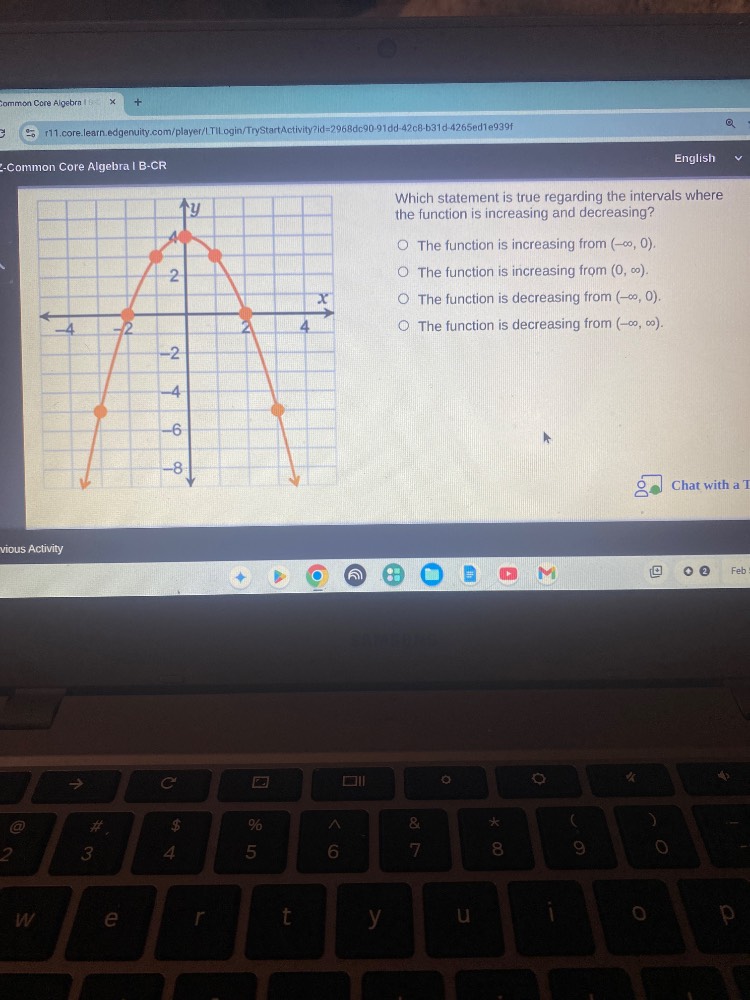
which statement is true regarding the intervals where the function is increasing and decreasing? the function is increasing from $(-infty, 0)$. the function is increasing from $(0, infty)$. the function is decreasing from $(-infty, 0)$. the function is decreasing from $(-infty, infty)$.
The graph is a parabola opening downward (since the coefficient of \(x^2\) is negative, or visually, it has a maximum at \(x = 0\)). For a downward - opening parabola, the function increases as \(x\) approaches the vertex from the left (i.e., from \((-\infty, 0)\)) and decreases as \(x\) moves away from the vertex to the right (i.e., from \((0,\infty)\)). Let's analyze each option:
- Option 1: "The function is increasing from \((-\infty, 0)\)". As \(x\) values increase from \(-\infty\) to \(0\), the \(y\) - values of the parabola increase (since we are moving towards the maximum point at \(x = 0\)). This is correct.
- Option 2: "The function is increasing from \((0,\infty)\)". For \(x>0\), as \(x\) increases, the \(y\) - values of the downward - opening parabola decrease, so this is false.
- Option 3: "The function is decreasing from \((-\infty, 0)\)". For \(x\) in \((-\infty, 0)\), as \(x\) increases (moves towards \(0\)), the \(y\) - values increase, so the function is not decreasing here, this is false.
- Option 4: "The function is decreasing from \((-\infty, \infty)\)". The function increases on \((-\infty, 0)\) and decreases on \((0,\infty)\), so it is not decreasing over the entire real line, this is false.

Snap & solve any problem in the app
Get step-by-step solutions on Sovi AI
Photo-based solutions with guided steps
Explore more problems and detailed explanations
The function is increasing from \((-\infty, 0)\)