QUESTION IMAGE
Question
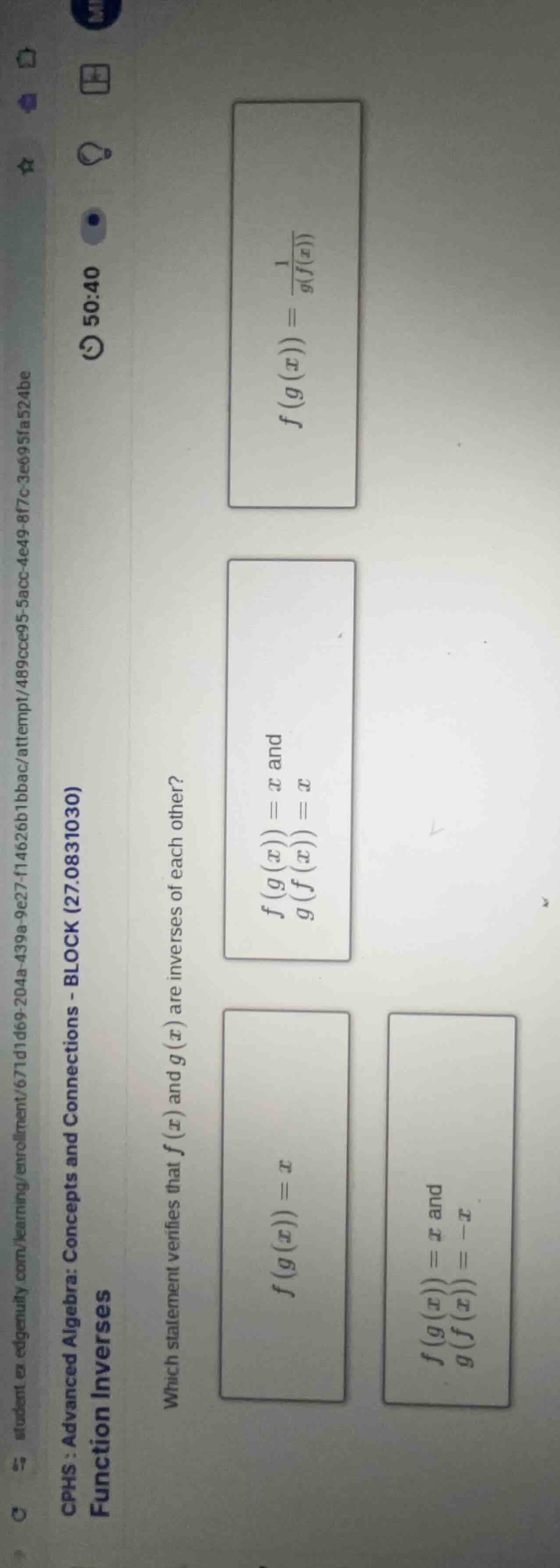
which statement verifies that ( f(x) ) and ( g(x) ) are inverses of each other?
options:
- ( f(g(x)) = x )
- ( f(g(x)) = x ) and ( g(f(x)) = x )
- ( f(g(x)) = \frac{1}{g(f(x))} )
- ( f(g(x)) = x ) and ( g(f(x)) = -x )
To determine if two functions \( f(x) \) and \( g(x) \) are inverses of each other, we use the definition of inverse functions. Two functions \( f \) and \( g \) are inverses if and only if:
- \( f(g(x)) = x \) for all \( x \) in the domain of \( g \), and
- \( g(f(x)) = x \) for all \( x \) in the domain of \( f \).
Let's analyze each option:
Option 1: \( f(g(x)) = \frac{1}{g(f(x))} \)
This does not match the definition of inverse functions. Inverse functions should compose to \( x \), not a reciprocal relationship. So this is incorrect.
Option 2: \( f(g(x)) = x \) and \( g(f(x)) = x \)
This directly matches the definition of inverse functions. If composing \( f \) with \( g \) gives \( x \) and composing \( g \) with \( f \) also gives \( x \), then \( f \) and \( g \) are inverses.
Option 3: \( f(g(x)) = x \) (only one composition)
The definition of inverse functions requires both compositions (\( f(g(x)) = x \) and \( g(f(x)) = x \)) to hold. Just one composition being \( x \) is not sufficient. So this is incorrect.
Option 4: \( f(g(x)) = x \) and \( g(f(x)) = -x \)
For inverse functions, both compositions should result in \( x \). Here, \( g(f(x)) = -x \), which is not \( x \) (unless \( x = 0 \), but this needs to hold for all \( x \)). So this is incorrect.

Snap & solve any problem in the app
Get step-by-step solutions on Sovi AI
Photo-based solutions with guided steps
Explore more problems and detailed explanations
The correct option is the one where \( f(g(x)) = x \) and \( g(f(x)) = x \) (the second option in the list of choices).