QUESTION IMAGE
Question
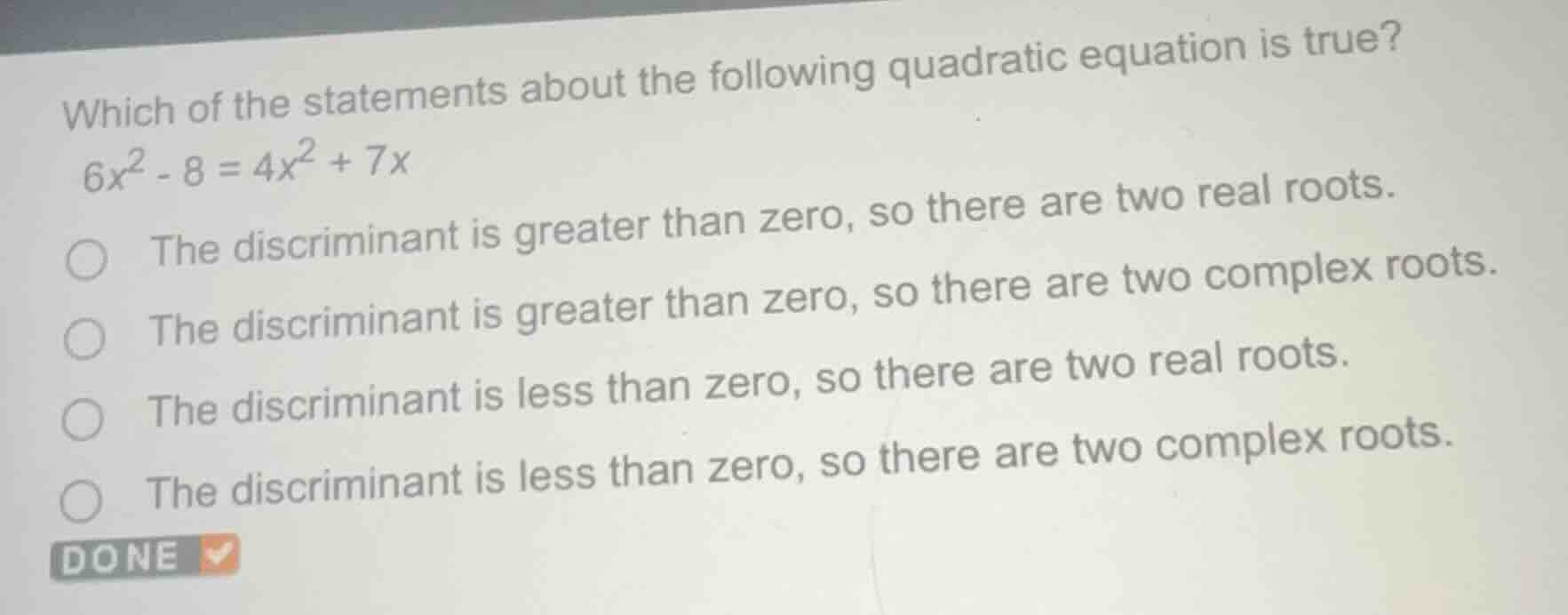
which of the statements about the following quadratic equation is true?
$6x^2 - 8 = 4x^2 + 7x$
the discriminant is greater than zero, so there are two real roots.
the discriminant is greater than zero, so there are two complex roots.
the discriminant is less than zero, so there are two real roots.
the discriminant is less than zero, so there are two complex roots.
Step1: Rearrange to standard quadratic form
Subtract $4x^2$ and $7x$ from both sides:
$6x^2 - 4x^2 -7x -8 = 0$
$2x^2 -7x -8 = 0$
Step2: Identify coefficients
For $ax^2+bx+c=0$, $a=2$, $b=-7$, $c=-8$
Step3: Calculate discriminant
Use $\Delta = b^2 - 4ac$:
$\Delta = (-7)^2 - 4(2)(-8) = 49 + 64 = 113$
Step4: Analyze discriminant value
$\Delta = 113 > 0$, so two real roots exist.

Snap & solve any problem in the app
Get step-by-step solutions on Sovi AI
Photo-based solutions with guided steps
Explore more problems and detailed explanations
The discriminant is greater than zero, so there are two real roots.