QUESTION IMAGE
Question
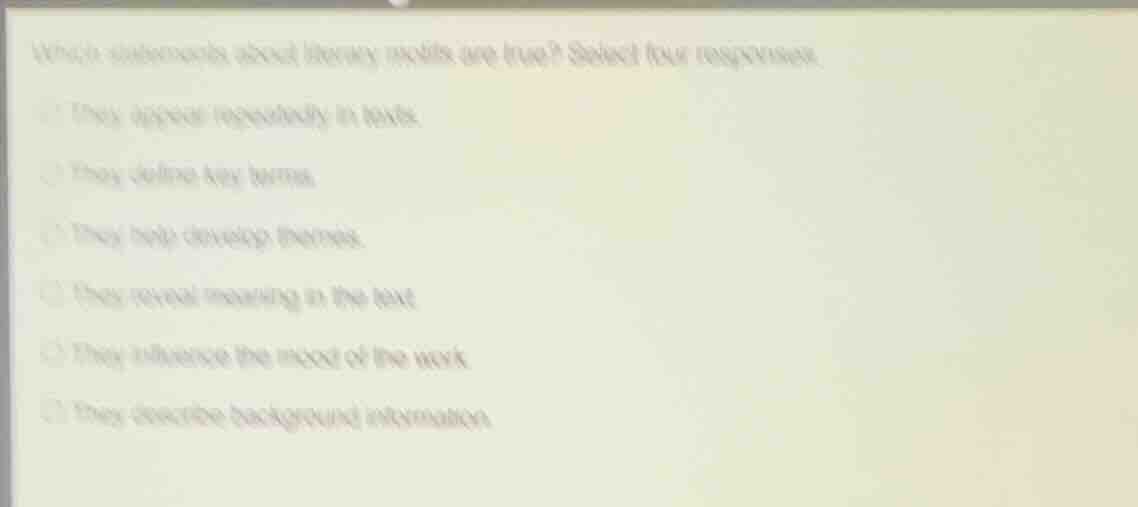
which statements about literary motifs are true? select four responses. they appear repeatedly in texts. they define key terms. they help develop themes. they reveal meaning in the text. they influence the mood of the work. they describe background information.
- Literary motifs appear repeatedly (not haphazardly) to develop themes, reveal meaning, influence mood, and can relate to defining key terms or background? Wait, let's analyze each:
- "They appear haphazardly in texts" is false (motifs are recurring, intentional).
- "They define key terms" – motifs can relate to key concepts/terms' exploration.
- "They help develop themes" – true, motifs reinforce themes.
- "They reveal meaning in the text" – true, recurring motifs add symbolic/contextual meaning.
- "They influence the mood of the work" – true, motifs (e.g., darkness) set mood.
- "They describe background information" – false (background is setting/context, motifs are recurring elements). Wait, the question says "select four responses". Let's re-evaluate:
Correct ones: "They define key terms" (motifs can embody key terms' essence), "They help develop themes" (core function), "They reveal meaning in the text" (symbolic/recurring meaning), "They influence the mood of the work" (e.g., a motif of decay can create somber mood). Wait, but maybe "They describe background information" is wrong, "appear haphazardly" is wrong. So the four true ones: "They define key terms", "They help develop themes", "They reveal meaning in the text", "They influence the mood of the work". Wait, maybe I made a mistake. Let's recall: Literary motifs are recurring elements (symbols, images, etc.) that contribute to theme, mood, and meaning. They are not haphazard (so first is false), they don't describe background (background is setting/context, motifs are symbolic), but they define key terms (by embodying them), develop themes, reveal meaning, influence mood. So the four true ones are: "They define key terms", "They help develop themes", "They reveal meaning in the text", "They influence the mood of the work". Wait, but maybe the options are: Let's list all options:
- They appear haphazardly in texts – False (motifs are recurring, intentional)
- They define key terms – True (motifs can represent/define key thematic terms)
- They help develop themes – True (recurring motifs reinforce themes)
- They reveal meaning in the text – True (motifs add symbolic/contextual meaning)
- They influence the mood of the work – True (motifs set emotional tone)
- They describe background information – False (background is setting, motifs are symbolic elements)
So we need to select four. So the four true ones are: "They define key terms", "They help develop themes", "They reveal meaning in the text", "They influence the mood of the work". Wait, but maybe the intended answers are: Let's check again. Maybe "They describe background information" is wrong, "appear haphazardly" is wrong. So the four correct are:
- They define key terms
- They help develop themes
- They reveal meaning in the text
- They influence the mood of the work
Or maybe "They describe background information" is a trick, but no. So the four correct options are the second, third, fourth, and fifth.

Snap & solve any problem in the app
Get step-by-step solutions on Sovi AI
Photo-based solutions with guided steps
Explore more problems and detailed explanations
B. They define key terms
C. They help develop themes
D. They reveal meaning in the text
E. They influence the mood of the work
(Note: Assuming the options are labeled as A to F with A being "They appear haphazardly...", B "They define...", C "They help...", D "They reveal...", E "They influence...", F "They describe...")