QUESTION IMAGE
Question
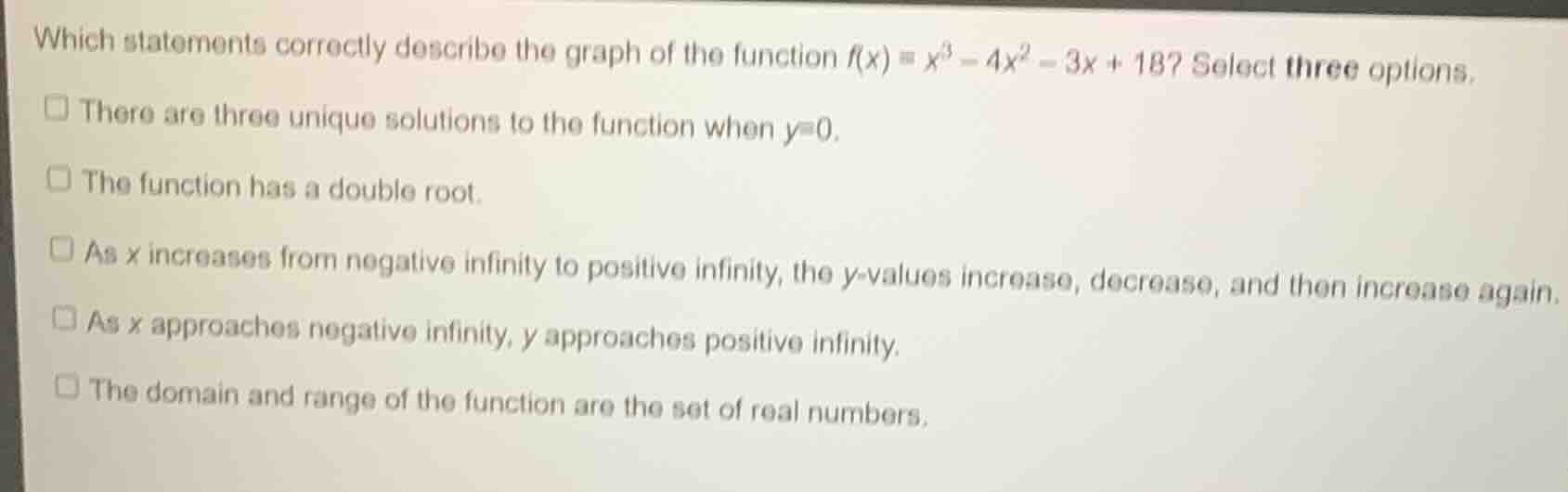
which statements correctly describe the graph of the function $f(x) = x^3 - 4x^2 - 3x + 18$? select three options.
- there are three unique solutions to the function when $y=0$.
- the function has a double root.
- as $x$ increases from negative infinity to positive infinity, the $y$-values increase, decrease, and then increase again.
- as $x$ approaches negative infinity, $y$ approaches positive infinity.
- the domain and range of the function are the set of real numbers.
To solve this, we analyze the cubic function \( f(x) = x^3 - 4x^2 - 3x + 18 \):
Step 1: Analyze roots (solutions when \( y = 0 \))
A cubic function \( ax^3 + bx^2 + cx + d \) can have up to 3 real roots. Let's try to factor \( f(x) \). By trial, \( x = -2 \) is a root:
\( f(-2) = (-2)^3 - 4(-2)^2 - 3(-2) + 18 = -8 - 16 + 6 + 18 = 0 \).
So, \( (x + 2) \) is a factor. Dividing \( f(x) \) by \( (x + 2) \) (or using polynomial division), we get:
\( f(x) = (x + 2)(x^2 - 6x + 9) = (x + 2)(x - 3)^2 \).
Thus, roots are \( x = -2 \) (simple root) and \( x = 3 \) (double root). So:
- "There are three unique solutions..." is false (only two unique roots: \( -2 \) and \( 3 \), with \( 3 \) repeated).
- "The function has a double root" is true ( \( x = 3 \) is a double root).
Step 2: Analyze end behavior and monotonicity
For a cubic \( ax^3 + bx^2 + cx + d \) with \( a > 0 \):
- As \( x \to -\infty \), \( y \to -\infty \) (since \( x^3 \) dominates, and \( a = 1 > 0 \)).
- As \( x \to +\infty \), \( y \to +\infty \).
The derivative \( f'(x) = 3x^2 - 8x - 3 \) (quadratic) determines increasing/decreasing behavior. A cubic with \( a > 0 \) has a general shape: increase, decrease, then increase (since the derivative (quadratic) can have two critical points, creating a "hill" and a "valley"). So:
- "As \( x \) increases from \( -\infty \) to \( +\infty \), \( y \)-values increase, decrease, then increase" is true.
- "As \( x \) approaches negative infinity, \( y \) approaches positive infinity" is false (it approaches \( -\infty \)).
Step 3: Analyze domain and range
For polynomial functions (like cubics), the domain is all real numbers. The range of a cubic function (with \( a
eq 0 \)) is also all real numbers (since it is continuous and unbounded in both directions). So:
- "The domain and range... are the set of real numbers" is true.
Correct Options:
- The function has a double root.
- As \( x \) increases from negative infinity to positive infinity, the \( y \)-values increase, decrease, and then increase again.
- The domain and range of the function are the set of real numbers.

Snap & solve any problem in the app
Get step-by-step solutions on Sovi AI
Photo-based solutions with guided steps
Explore more problems and detailed explanations
- The function has a double root.
- As \( x \) increases from negative infinity to positive infinity, the \( y \)-values increase, decrease, and then increase again.
- The domain and range of the function are the set of real numbers.