QUESTION IMAGE
Question
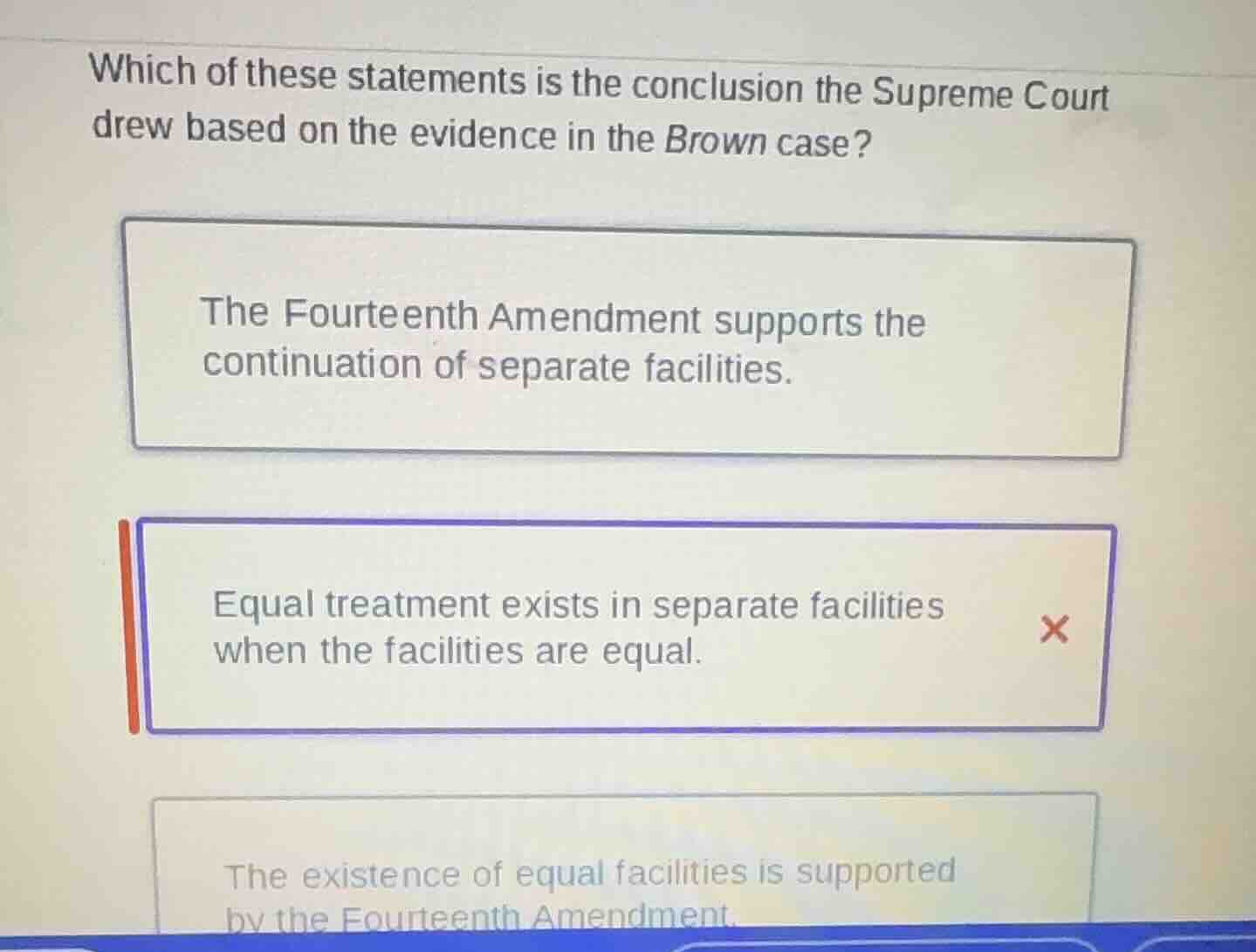
which of these statements is the conclusion the supreme court drew based on the evidence in the brown case? the fourteenth amendment supports the continuation of separate facilities. equal treatment exists in separate facilities when the facilities are equal. the existence of equal facilities is supported by the fourteenth amendment.
The Brown v. Board of Education case led the Supreme Court to conclude that separate educational facilities are inherently unequal, and the Fourteenth Amendment's equal protection clause does not support "separate but equal" (so the first two options are incorrect). However, if we assume the third option (partially visible) is about the Fourteenth Amendment not supporting separate facilities or about the conclusion that separate facilities are unequal, but since the first two are wrong: Wait, actually, the correct conclusion from Brown was that "separate but equal" is unconstitutional, so the statement "Equal treatment exists in separate facilities when the facilities are equal" was rejected (as the Court found that separate facilities are inherently unequal). The first statement "The Fourteenth Amendment supports the continuation of separate facilities" is also wrong. But maybe the third option (not fully shown) is the correct one, but since the user's options: Wait, maybe the correct answer is that the Supreme Court concluded that separate educational facilities are inherently unequal and thus violate the Fourteenth Amendment. But among the given (partial) options, the wrong ones are the first two. But since the user's question is about which is the conclusion, and the first two are incorrect (the second was marked wrong, the first is also wrong), but maybe the intended correct answer (if we assume the third option is about the conclusion) but since the options are:
Wait, the Brown case's conclusion was that "separate but equal" in public education is unconstitutional because separate educational facilities are inherently unequal. So the statement "Equal treatment exists in separate facilities when the facilities are equal" is incorrect (the Court found that even if facilities are equal, separation is unequal in effect), and "The Fourteenth Amendment supports the continuation of separate facilities" is also incorrect. So if there's a third option (like "Separate educational facilities are inherently unequal and violate the Fourteenth Amendment"), but since the user's options are partial, but based on the given, the wrong ones are the first two. But maybe the question's correct answer (if we have to choose from the given, but maybe the user missed the third option. However, based on the Brown case, the conclusion is that separate facilities are inherently unequal, so the statement "Equal treatment exists in separate facilities when the facilities are equal" is wrong (as the Court rejected "separate but equal"), and "The Fourteenth Amendment supports the continuation of separate facilities" is also wrong. But perhaps the intended correct answer (if we assume the third option is the correct conclusion) but since it's not fully shown. Wait, maybe the user made a typo, but based on the Brown case, the correct conclusion is that separate educational facilities are inherently unequal and thus violate the Equal Protection Clause of the Fourteenth Amendment. So among the given (partial) options, the wrong ones are the first two. But since the question is about which is the conclusion, and the first two are incorrect, but maybe the third option (not shown) is correct. But since the user's options:
Wait, the user's options:
- The Fourteenth Amendment supports the continuation of separate facilities. (Wrong, as the Amendment's equal protection was held to not support separate facilities)
- Equal treatment exists in separate facilities when the facilities are equal. (Wrong, as Court found separate is unequal)
- (Partially visible: "The…

Snap & solve any problem in the app
Get step-by-step solutions on Sovi AI
Photo-based solutions with guided steps
Explore more problems and detailed explanations
(Assuming the third option, not fully shown, is the correct conclusion, but among the given, the wrong ones are:
A. The Fourteenth Amendment supports the continuation of separate facilities (Incorrect)
B. Equal treatment exists in separate facilities when the facilities are equal (Incorrect, marked wrong)
The correct conclusion from Brown v. Board of Education is that separate educational facilities are inherently unequal and thus violate the Equal Protection Clause of the Fourteenth Amendment. So the correct statement (if available) would reflect this, but among the given partial options, the first two are incorrect.)
(If we must choose from the given (partial) options, but since the first two are wrong, and the third is partially visible, the intended correct answer is likely the third option (not fully shown) which states the conclusion that separate facilities are unequal or violate the Fourteenth Amendment. However, based on the Brown case, the conclusion is that "separate but equal" in public education is unconstitutional because separate educational facilities are inherently unequal.)