QUESTION IMAGE
Question
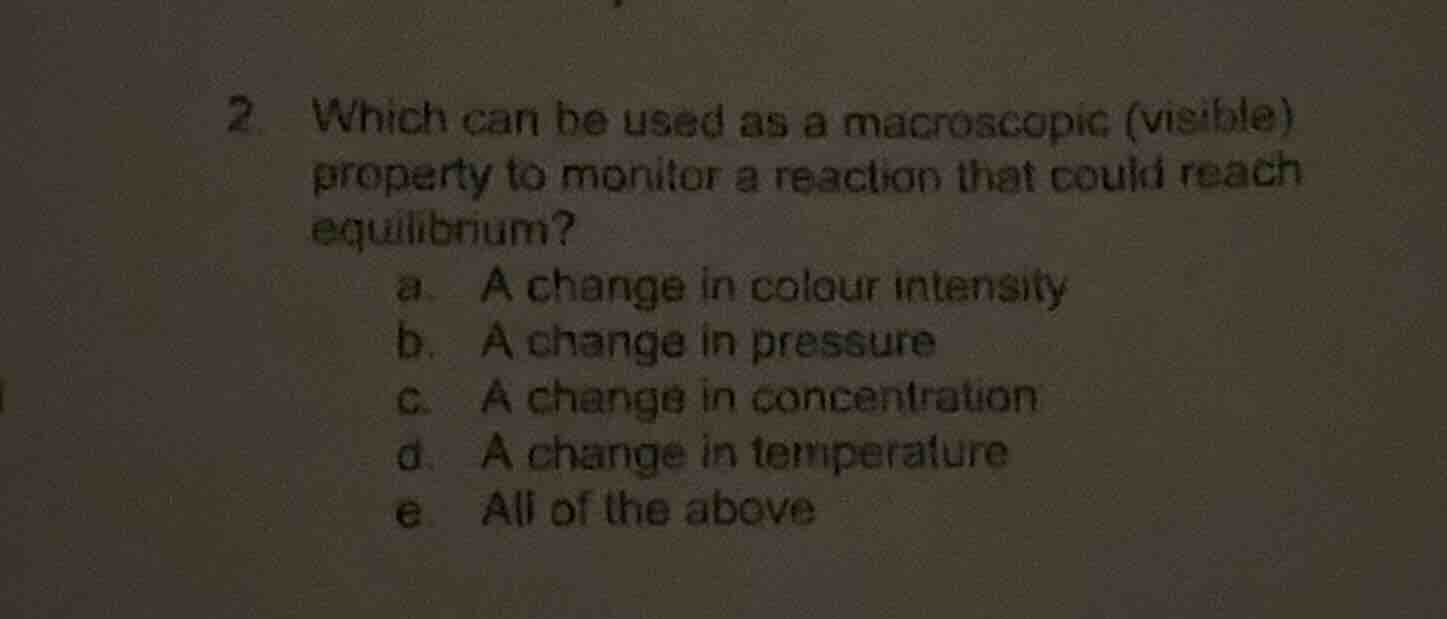
- which can be used as a macroscopic (visible) property to monitor a reaction that could reach equilibrium?
a. a change in colour intensity
b. a change in pressure
c. a change in concentration
d. a change in temperature
e. all of the above
Brief Explanations
To determine the answer, we analyze each option:
- Option a: A change in colour intensity is a visible (macroscopic) property. For example, in reactions with colored reactants or products, as the reaction approaches equilibrium, the color intensity (related to concentration of colored species) stabilizes, so it can monitor equilibrium.
- Option b: A change in pressure (for gaseous reactions, especially when the number of moles of gas changes) is a macroscopic property. As the reaction reaches equilibrium, pressure (a measurable, visible - in terms of pressure gauge readings - property) stops changing.
- Option c: A change in concentration, although concentration itself is a microscopic - level concept in terms of individual particles, the macroscopic manifestations (like color intensity, pressure which are related to concentration) or even direct measurement of concentration (using macroscopic techniques like titration for solution - phase reactions) can be used. At equilibrium, the concentration of reactants and products stops changing, so monitoring concentration change (through its macroscopic manifestations) is valid.
- Option d: A change in temperature. If a reaction is exothermic or endothermic, as it approaches equilibrium, the heat released or absorbed will stabilize, and the temperature (a macroscopic property) will stop changing. So temperature change can be used to monitor equilibrium.
Since all of the options (a, b, c, d) describe macroscopic properties that can be used to monitor a reaction approaching equilibrium, the correct answer is e.

Snap & solve any problem in the app
Get step-by-step solutions on Sovi AI
Photo-based solutions with guided steps
Explore more problems and detailed explanations
e. All of the above