QUESTION IMAGE
Question
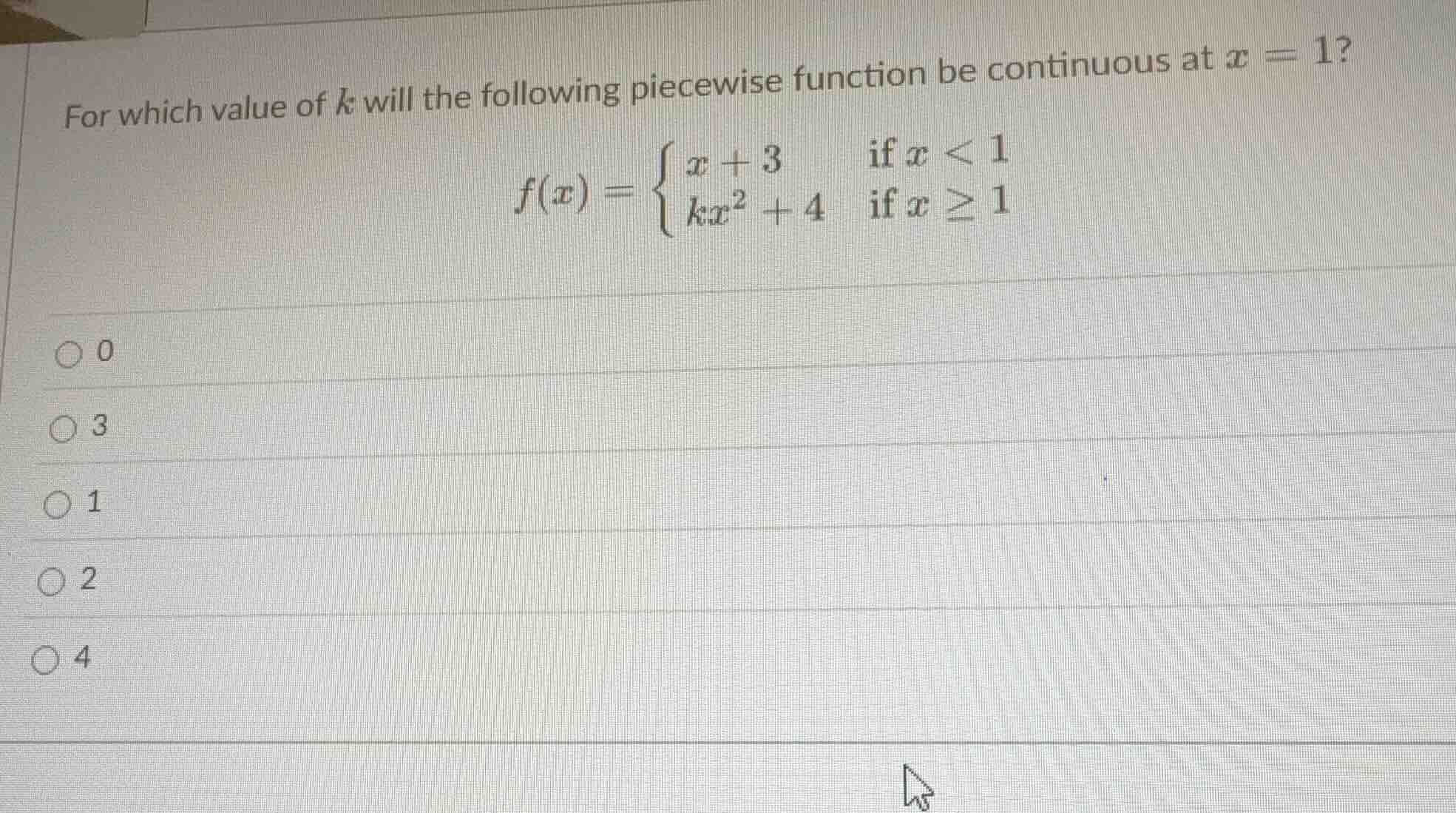
for which value of k will the following piecewise function be continuous at x = 1?
$f(x) = \
$
\bigcirc 0
\bigcirc 3
\bigcirc 1
\bigcirc 2
\bigcirc 4
Step1: Find left - hand limit at \(x = 1\)
For \(x<1\), \(f(x)=x + 3\). The left - hand limit as \(x\) approaches \(1\) is \(\lim_{x
ightarrow1^{-}}f(x)=\lim_{x
ightarrow1^{-}}(x + 3)\). Substitute \(x = 1\) into \(x + 3\), we get \(1+3=4\).
Step2: Find right - hand limit at \(x = 1\)
For \(x\geq1\), \(f(x)=kx^{2}+4\). The right - hand limit as \(x\) approaches \(1\) is \(\lim_{x
ightarrow1^{+}}f(x)=\lim_{x
ightarrow1^{+}}(kx^{2}+4)\). Substitute \(x = 1\) into \(kx^{2}+4\), we get \(k(1)^{2}+4=k + 4\).
Step3: For continuity at \(x = 1\)
A function \(y = f(x)\) is continuous at \(x=a\) if \(\lim_{x
ightarrow a^{-}}f(x)=\lim_{x
ightarrow a^{+}}f(x)\). So we set the left - hand limit equal to the right - hand limit: \(4=k + 4\). Solving for \(k\), we subtract \(4\) from both sides of the equation: \(k=4 - 4=0\)? Wait, no, wait. Wait, no, I made a mistake. Wait, the left - hand limit is \(\lim_{x
ightarrow1^{-}}f(x)=1 + 3=4\), the right - hand limit is \(\lim_{x
ightarrow1^{+}}f(x)=k(1)^{2}+4=k + 4\). For continuity, \(\lim_{x
ightarrow1^{-}}f(x)=\lim_{x
ightarrow1^{+}}f(x)\), so \(4=k + 4\)? No, that would give \(k = 0\), but let's check again. Wait, no, maybe I messed up the left - hand function. Wait, the left - hand function is \(x + 3\), when \(x\) approaches \(1\) from the left, \(x<1\), so \(f(x)=x + 3\), so \(\lim_{x
ightarrow1^{-}}f(x)=1+3 = 4\). The right - hand function is \(kx^{2}+4\), when \(x\) approaches \(1\) from the right, \(x\geq1\), so \(\lim_{x
ightarrow1^{+}}f(x)=k(1)^{2}+4=k + 4\). For continuity, \(\lim_{x
ightarrow1^{-}}f(x)=\lim_{x
ightarrow1^{+}}f(x)\), so \(4=k + 4\)? No, that can't be. Wait, no, maybe the left - hand limit is wrong? Wait, no, \(x+3\) at \(x = 1\) is \(4\). Wait, but let's check the options. Wait, maybe I made a mistake. Wait, let's re - do it.
Wait, the function is continuous at \(x = 1\) if \(f(1^{-})=f(1^{+})=f(1)\). \(f(1^{-})\) is the limit as \(x\) approaches \(1\) from the left, which is \(1 + 3=4\). \(f(1^{+})\) is the limit as \(x\) approaches \(1\) from the right, which is \(k(1)^{2}+4=k + 4\). And \(f(1)=k(1)^{2}+4=k + 4\). For continuity, \(f(1^{-})=f(1^{+})\), so \(4=k + 4\)? No, that gives \(k = 0\), but option A is \(0\). Wait, but let's check with \(k = 0\), the right - hand function is \(0\times x^{2}+4 = 4\), and the left - hand limit is \(4\), so at \(x = 1\), the function value from the right is \(4\), from the left is \(4\), so it's continuous. Wait, but let's check the options. The options are \(0\), \(3\), \(1\), \(2\), \(4\). So \(k = 0\) is option A.
Wait, but maybe I made a mistake in the left - hand limit. Wait, \(x<1\), so as \(x\) approaches \(1\) from the left, \(x\) is getting closer to \(1\), so \(f(x)=x + 3\), so \(\lim_{x
ightarrow1^{-}}f(x)=1+3 = 4\). The right - hand side: \(x\geq1\), so \(f(1)=k(1)^{2}+4=k + 4\). For continuity, these two must be equal, so \(4=k + 4\), so \(k = 0\). So the answer should be \(0\).

Snap & solve any problem in the app
Get step-by-step solutions on Sovi AI
Photo-based solutions with guided steps
Explore more problems and detailed explanations
A. 0