QUESTION IMAGE
Question
while researching a topic, a student has taken the following notes:
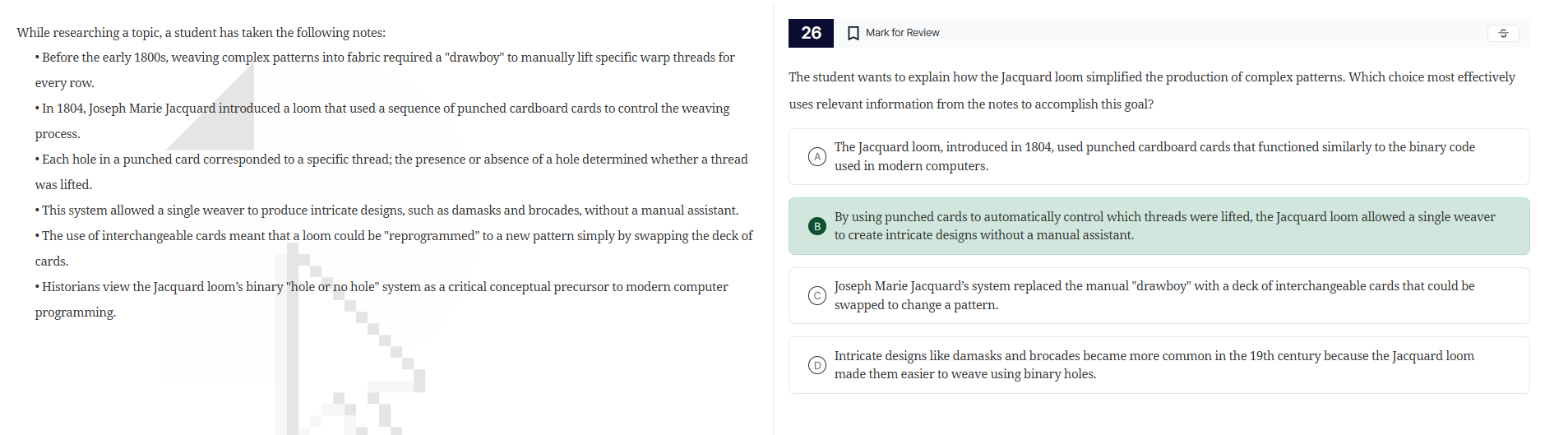
- before the early 1800s, weaving complex patterns into fabric required a \drawboy\ to manually lift specific warp threads for every row.
- in 1804, joseph marie jacquard introduced a loom that used a sequence of punched cardboard cards to control the weaving process.
- each hole in a punched card corresponded to a specific thread; the presence or absence of a hole determined whether a thread was lifted.
- this system allowed a single weaver to produce intricate designs, such as damasks and brocades, without a manual assistant.
- the use of interchangeable cards meant that a loom could be
eprogrammed\ to a new pattern simply by swapping the deck of cards.
- historians view the jacquard looms binary \hole or no hole\ system as a critical conceptual precursor to modern computer programming.
26 mark for review
the student wants to explain how the jacquard loom simplified the production of complex patterns. which choice most effectively uses relevant information from the notes to accomplish this goal?
a the jacquard loom, introduced in 1804, used punched cardboard cards that functioned similarly to the binary code used in modern computers.
b by using punched cards to automatically control which threads were lifted, the jacquard loom allowed a single weaver to create intricate designs without a manual assistant.
c joseph marie jacquards system replaced the manual \drawboy\ with a deck of interchangeable cards that could be swapped to change a pattern.
d intricate designs like damasks and brocades became more common in the 19th century because the jacquard loom made them easier to weave using binary holes.
To determine the best choice, we analyze each option:
- Option A: The notes don't mention a comparison to modern computer binary code, so this is irrelevant.
- Option B: It uses the relevant info from the notes (punched cards controlling thread lifting, single weaver without manual assistant) to explain how the loom simplified complex pattern production.
- Option C: While it mentions replacing the drawboy and interchangeable cards, it doesn't clearly connect to simplifying complex pattern production as effectively as B.
- Option D: The notes don't discuss the prevalence of designs in the 19th century, so this is not supported.

Snap & solve any problem in the app
Get step-by-step solutions on Sovi AI
Photo-based solutions with guided steps
Explore more problems and detailed explanations
B. By using punched cards to automatically control which threads were lifted, the Jacquard loom allowed a single weaver to create intricate designs without a manual assistant.