QUESTION IMAGE
Question
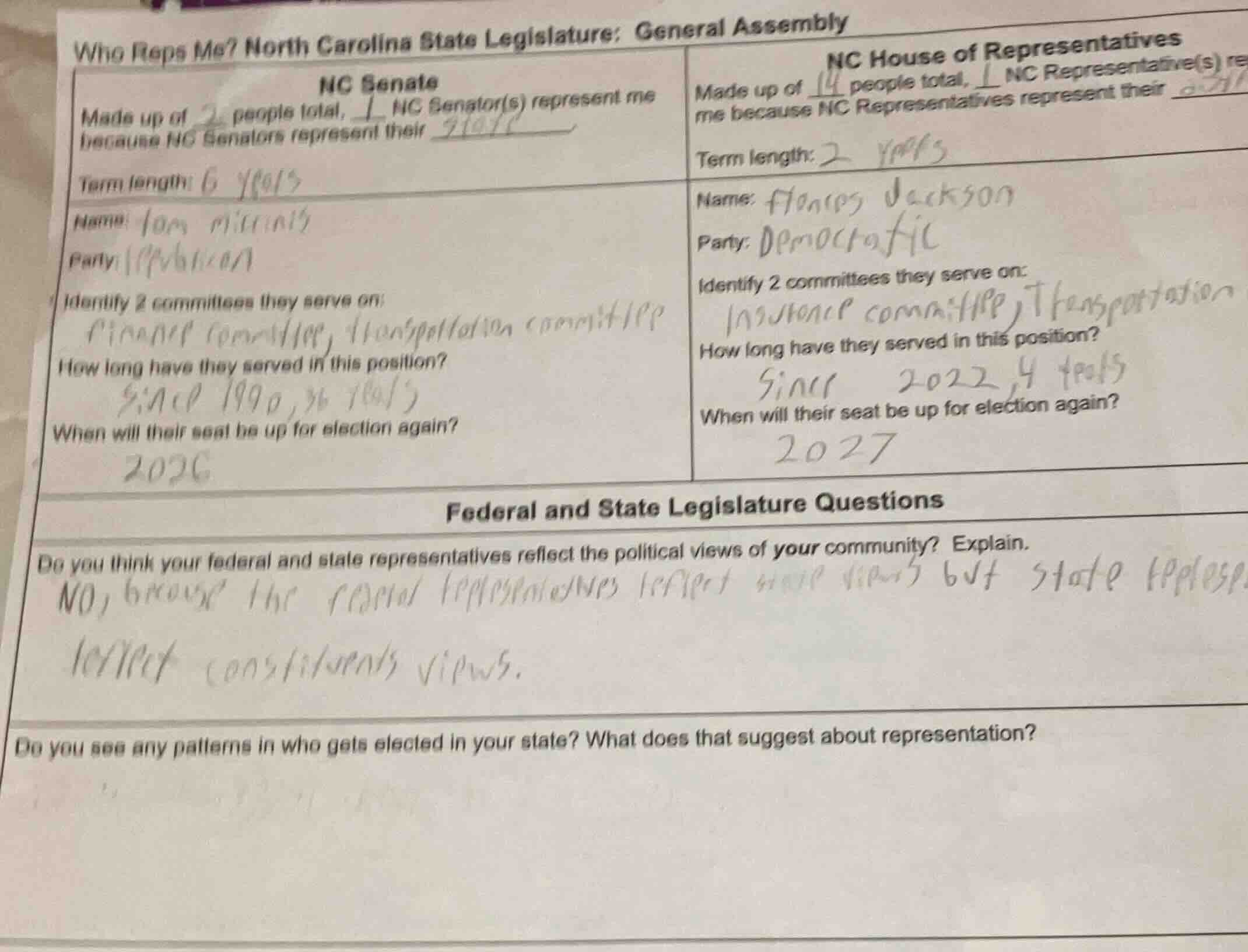
who reps me? north carolina state legislature: general assemblync senatemade up of 2 people total, 1 nc senator(s) represent mebecause nc senators represent their stateterm length: 6 yearsname: tom mcinnisparty: republicanidentify 2 committees they serve on:finance committee, transportation committeehow long have they served in this position?since 1990, 36 yearswhen will their seat be up for election again?2026nc house of representativesmade up of 14 people total, 1 nc representative(s) reme because nc representatives represent their distterm length: 2 yearsname: florios jacksonparty: democraticidentify 2 committees they serve on:insurance committee, transportationhow long have they served in this position?since 2022,4 yearswhen will their seat be up for election again?2027federal and state legislature questionsdo you think your federal and state representatives reflect the political views of your community? explain.no, because the federal representatives reflect their views but state represent their constituents views.do you see any patterns in who gets elected in your state? what does that suggest about representation?
For the final question, a common pattern in North Carolina's elections is that incumbents (like the listed legislators with long tenures) often win re-election, and there is a split between urban areas electing more Democrats and rural areas electing more Republicans. This suggests representation can be skewed towards the preferences of long-serving officials and that geographic political divides mean some community views are prioritized over others, leading to uneven representation across the state.

Snap & solve any problem in the app
Get step-by-step solutions on Sovi AI
Photo-based solutions with guided steps
Explore more problems and detailed explanations
A common pattern is that incumbents frequently win re-election, and there is a geographic split: urban areas tend to elect Democratic officials, while rural areas favor Republicans. This suggests that representation in the state is often tilted towards the priorities of long-serving politicians, and the political divide means that the views of urban and rural communities are not evenly reflected in the legislature, leading to partial, geographically segmented representation.