QUESTION IMAGE
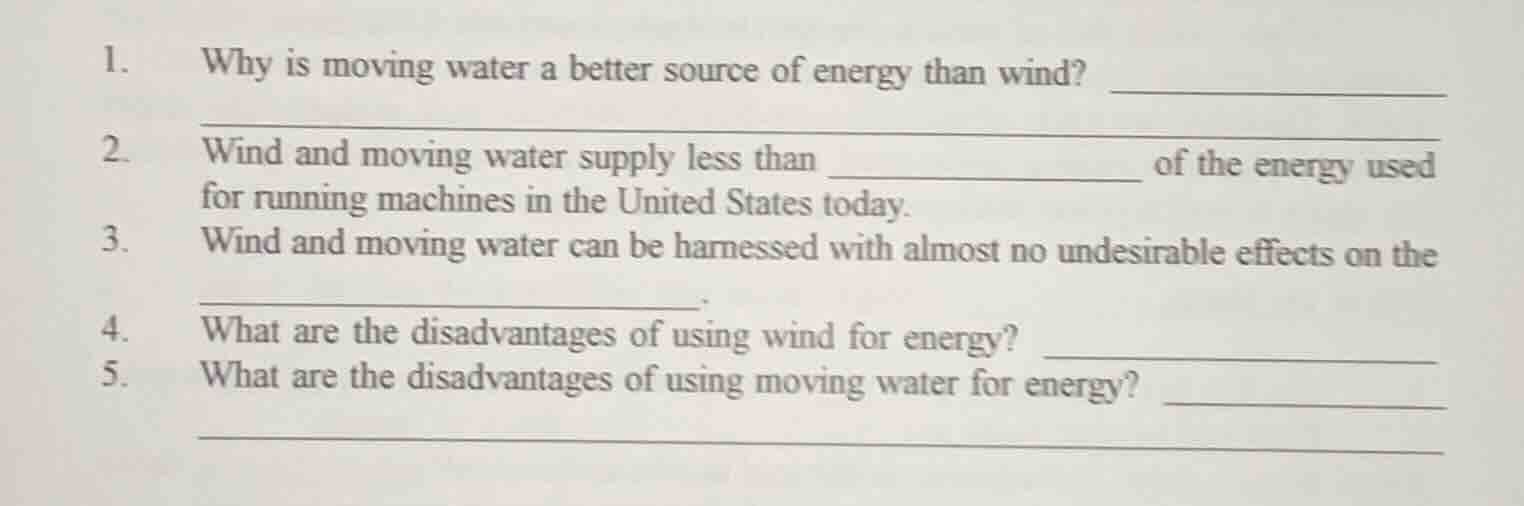
Question
- why is moving water a better source of energy than wind?
- wind and moving water supply less than of the energy used for running machines in the united states today.
- wind and moving water can be harnessed with almost no undesirable effects on the .
- what are the disadvantages of using wind for energy?
- what are the disadvantages of using moving water for energy?
These questions are related to energy sources (wind and moving water) and their characteristics, which falls under the subfield of Environmental Sciences (within Natural Science). Here are the answers and explanations for each sub - question:
Sub - question 1
Moving water is denser than air. The energy in a fluid is related to its mass and velocity. Since water has a much higher density than air, for the same velocity, moving water has more kinetic energy (using the formula $KE=\frac{1}{2}mv^{2}$, where $m$ is mass and $v$ is velocity). Also, water flow can be more consistent in some cases (e.g., in a river with a steady current) compared to wind, which can be more variable. So, moving water can provide a more concentrated and often more reliable source of energy for conversion (like in hydroelectric power plants) than wind (used in wind turbines).
In the United States, wind and moving water (hydroelectric, etc.) supply less than 10% (this is a general knowledge fact about the energy mix in the US, where fossil fuels and other sources like nuclear are more dominant) of the energy used for running machines (industrial energy use).
When we harness wind (wind turbines) and moving water (hydroelectric dams, etc.), if done properly, they have almost no undesirable effects on the environment (ecosystem, air quality, water quality in a broad sense). For example, wind turbines don't emit greenhouse gases during operation, and well - designed hydroelectric plants can have minimal impact on the surrounding environment (though there can be exceptions, but the question states "almost no").

Snap & solve any problem in the app
Get step-by-step solutions on Sovi AI
Photo-based solutions with guided steps
Explore more problems and detailed explanations
Moving water is denser than air, so it has more kinetic energy for the same velocity (from $KE = \frac{1}{2}mv^{2}$, higher $m$ for water). Also, water flow can be more consistent, providing a more reliable energy source.