QUESTION IMAGE
Question
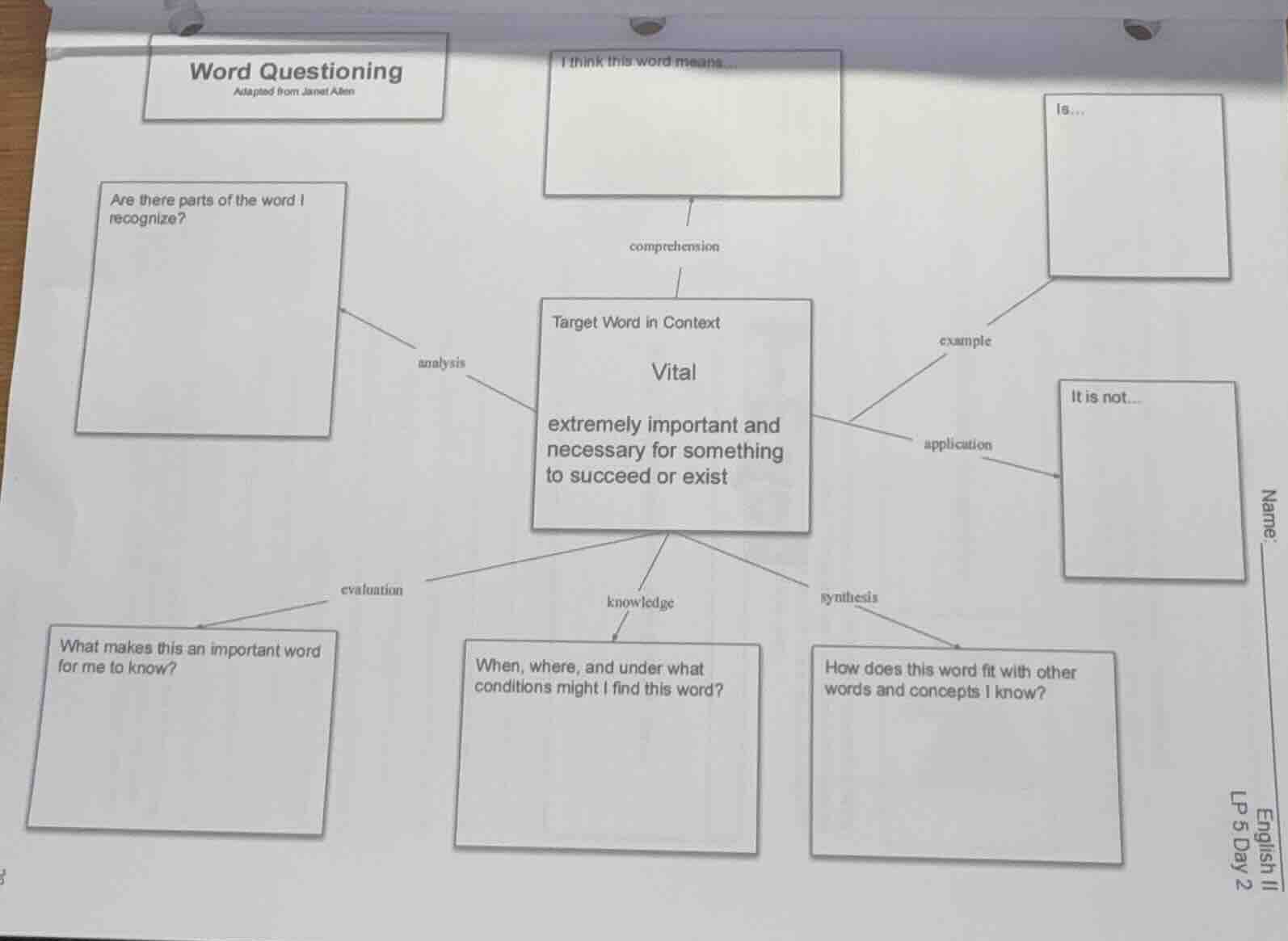
word questioning
adapted from janet allen
are there parts of the word i recognize?
i think this word means...
is...
comprehension
analysis
target word in context
vital
extremely important and
necessary for something
to succeed or exist
example
application
it is not...
evaluation
knowledge
synthesis
what makes this an important word
for me to know?
when, where, and under what
conditions might i find this word?
how does this word fit with other
words and concepts i know?
name:
english ii
lp 5 day 2
Since the problem is about word analysis and understanding (related to vocabulary and language study), we can fill in the blanks as follows:
1. "I think this word means..." (Comprehension)
- Brief Explanations: This is about understanding the meaning of "vital". Based on the given definition ("extremely important and necessary for something to succeed or exist"), we can state what we think it means. For example, "I think this word means something that is very important and essential for a task or a thing to be successful or to exist."
- Answer: I think this word means something very important and essential for success or existence.
2. "Is..." (Example)
- Brief Explanations: We need to give an example of something that is vital. For example, "Is oxygen vital for human life?" Here we are showing an example of a situation where the word "vital" applies.
- Answer: Is oxygen vital for human life?
3. "It is not..." (Application - showing what it is not)
- Brief Explanations: We can contrast "vital" with something that is not vital. For example, "It is not a minor or unimportant factor in a project's success."
- Answer: It is not a minor factor in success.
4. "Are there parts of the word I recognize?" (Analysis - word parts)
- Brief Explanations: The word "vital" - we can check if we recognize any parts. "Vital" comes from Latin "vita" meaning life, so maybe we recognize the root related to life. Or we can think about similar words like "vitality". So we can say, "I recognize that 'vital' might be related to 'life' (from Latin 'vita') and I know the word 'vitality' which is related."
- Answer: I recognize the root related to life (from Latin "vita") and know "vitality".
5. "What makes this an important word for me to know?" (Evaluation)
- Brief Explanations: We can explain why "vital" is important. For example, "It's important to know 'vital' because it helps describe the importance of things in various contexts like health, work, or nature, so I can communicate clearly about what's essential."
- Answer: It's important to know to describe essential things in life, work, etc.
6. "When, where, and under what conditions might I find this word?" (Knowledge)
- Brief Explanations: We can think of contexts where "vital" is used. For example, "I might find this word in science (e.g., 'vital organs'), in business (e.g., 'vital decisions'), or in daily conversations about important things (e.g., 'vital to study for exams')."
- Answer: In science (vital organs), business (vital decisions), or daily talks.
7. "How does this word fit with other words and concepts I know?" (Synthesis)
- Brief Explanations: We can relate "vital" to similar or related words. For example, "It fits with words like 'essential', 'crucial', and 'important' as they all describe high significance. Also, concepts like 'necessity' or 'importance' in different fields."
- Answer: It fits with 'essential', 'crucial', and concepts of necessity.

Snap & solve any problem in the app
Get step-by-step solutions on Sovi AI
Photo-based solutions with guided steps
Explore more problems and detailed explanations
Since the problem is about word analysis and understanding (related to vocabulary and language study), we can fill in the blanks as follows:
1. "I think this word means..." (Comprehension)
- Brief Explanations: This is about understanding the meaning of "vital". Based on the given definition ("extremely important and necessary for something to succeed or exist"), we can state what we think it means. For example, "I think this word means something that is very important and essential for a task or a thing to be successful or to exist."
- Answer: I think this word means something very important and essential for success or existence.
2. "Is..." (Example)
- Brief Explanations: We need to give an example of something that is vital. For example, "Is oxygen vital for human life?" Here we are showing an example of a situation where the word "vital" applies.
- Answer: Is oxygen vital for human life?
3. "It is not..." (Application - showing what it is not)
- Brief Explanations: We can contrast "vital" with something that is not vital. For example, "It is not a minor or unimportant factor in a project's success."
- Answer: It is not a minor factor in success.
4. "Are there parts of the word I recognize?" (Analysis - word parts)
- Brief Explanations: The word "vital" - we can check if we recognize any parts. "Vital" comes from Latin "vita" meaning life, so maybe we recognize the root related to life. Or we can think about similar words like "vitality". So we can say, "I recognize that 'vital' might be related to 'life' (from Latin 'vita') and I know the word 'vitality' which is related."
- Answer: I recognize the root related to life (from Latin "vita") and know "vitality".
5. "What makes this an important word for me to know?" (Evaluation)
- Brief Explanations: We can explain why "vital" is important. For example, "It's important to know 'vital' because it helps describe the importance of things in various contexts like health, work, or nature, so I can communicate clearly about what's essential."
- Answer: It's important to know to describe essential things in life, work, etc.
6. "When, where, and under what conditions might I find this word?" (Knowledge)
- Brief Explanations: We can think of contexts where "vital" is used. For example, "I might find this word in science (e.g., 'vital organs'), in business (e.g., 'vital decisions'), or in daily conversations about important things (e.g., 'vital to study for exams')."
- Answer: In science (vital organs), business (vital decisions), or daily talks.
7. "How does this word fit with other words and concepts I know?" (Synthesis)
- Brief Explanations: We can relate "vital" to similar or related words. For example, "It fits with words like 'essential', 'crucial', and 'important' as they all describe high significance. Also, concepts like 'necessity' or 'importance' in different fields."
- Answer: It fits with 'essential', 'crucial', and concepts of necessity.