QUESTION IMAGE
Question
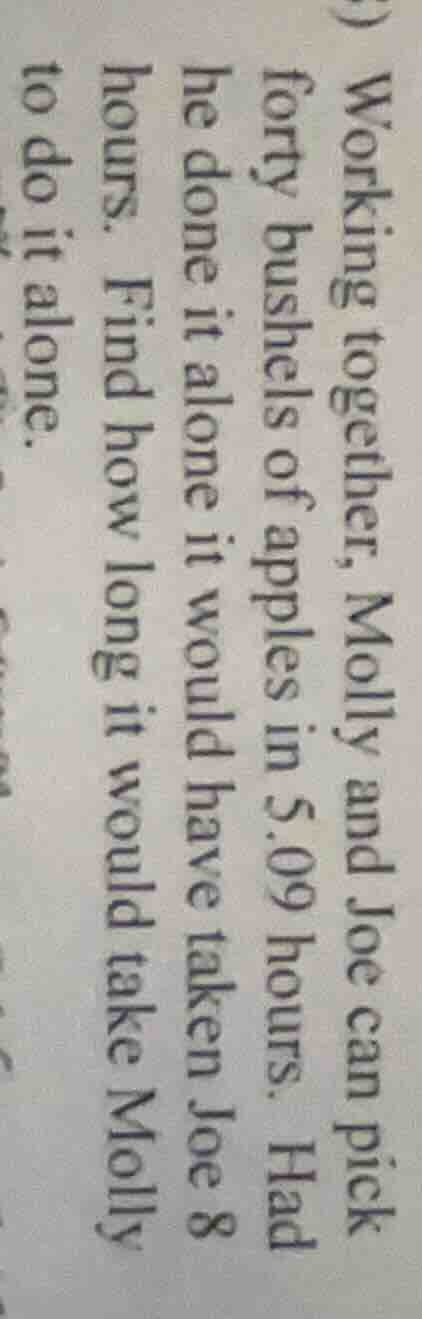
working together, molly and joe can pick forty bushels of apples in 5.09 hours. had he done it alone it would have taken joe 8 hours. find how long it would take molly to do it alone.
Step1: Define variables
Let \( t_J \) be Joe's time alone (8 hours), \( t_M \) be Molly's time alone (unknown), and \( t_{together} = 5.09 \) hours. The work rate of Joe is \( \frac{1}{t_J} \), Molly's is \( \frac{1}{t_M} \), and together is \( \frac{1}{t_{together}} \). So, \( \frac{1}{t_J} + \frac{1}{t_M} = \frac{1}{t_{together}} \).
Step2: Substitute known values
Substitute \( t_J = 8 \) and \( t_{together} = 5.09 \): \( \frac{1}{8} + \frac{1}{t_M} = \frac{1}{5.09} \).
Step3: Solve for \( \frac{1}{t_M} \)
\( \frac{1}{t_M} = \frac{1}{5.09} - \frac{1}{8} \). Calculate \( \frac{1}{5.09} \approx 0.1965 \), \( \frac{1}{8} = 0.125 \). So, \( \frac{1}{t_M} \approx 0.1965 - 0.125 = 0.0715 \).
Step4: Find \( t_M \)
\( t_M = \frac{1}{0.0715} \approx 14.0 \) hours (rounded). Wait, let's recalculate more accurately. \( \frac{1}{5.09} - \frac{1}{8} = \frac{8 - 5.09}{5.09 \times 8} = \frac{2.91}{40.72} \approx 0.07146 \). Then \( t_M = \frac{40.72}{2.91} \approx 14.0 \) hours. Wait, maybe I made a mistake. Wait, the total work is 40 bushels? Wait, the problem says "forty bushels of apples in 5.09 hours". Oh! I misread. The total work is 40 bushels. So the rate together is \( \frac{40}{5.09} \) bushels per hour. Joe's rate: if he does it alone in 8 hours, his rate is \( \frac{40}{8} = 5 \) bushels per hour. Let's redefine:
Let total work \( W = 40 \) bushels.
Rate of Joe: \( r_J = \frac{W}{t_J} = \frac{40}{8} = 5 \) bushels/hour.
Rate of together: \( r_{together} = \frac{W}{t_{together}} = \frac{40}{5.09} \approx 7.8585 \) bushels/hour.
Rate of Molly: \( r_M = r_{together} - r_J = 7.8585 - 5 = 2.8585 \) bushels/hour.
Then time for Molly alone: \( t_M = \frac{W}{r_M} = \frac{40}{2.8585} \approx 14.0 \) hours. Wait, that's the same result. Wait, maybe the initial misreading of "forty" was correct. So the correct approach is using work rates:
Let \( t_M \) be Molly's time. Then \( \frac{1}{8} + \frac{1}{t_M} = \frac{1}{5.09} \) (if we consider work as 1 job, i.e., 40 bushels is 1 job). Then \( \frac{1}{t_M} = \frac{1}{5.09} - \frac{1}{8} \). Calculating:
\( \frac{1}{5.09} \approx 0.19646 \)
\( \frac{1}{8} = 0.125 \)
\( 0.19646 - 0.125 = 0.07146 \)
\( t_M = \frac{1}{0.07146} \approx 14.0 \) hours. So Molly would take approximately 14.0 hours.

Snap & solve any problem in the app
Get step-by-step solutions on Sovi AI
Photo-based solutions with guided steps
Explore more problems and detailed explanations
\boxed{14.0} (or more accurately, let's calculate \( \frac{1}{\frac{1}{5.09} - \frac{1}{8}} \)):
\( \frac{1}{\frac{8 - 5.09}{5.09 \times 8}} = \frac{5.09 \times 8}{2.91} = \frac{40.72}{2.91} \approx 14.0 \) hours.