QUESTION IMAGE
Question
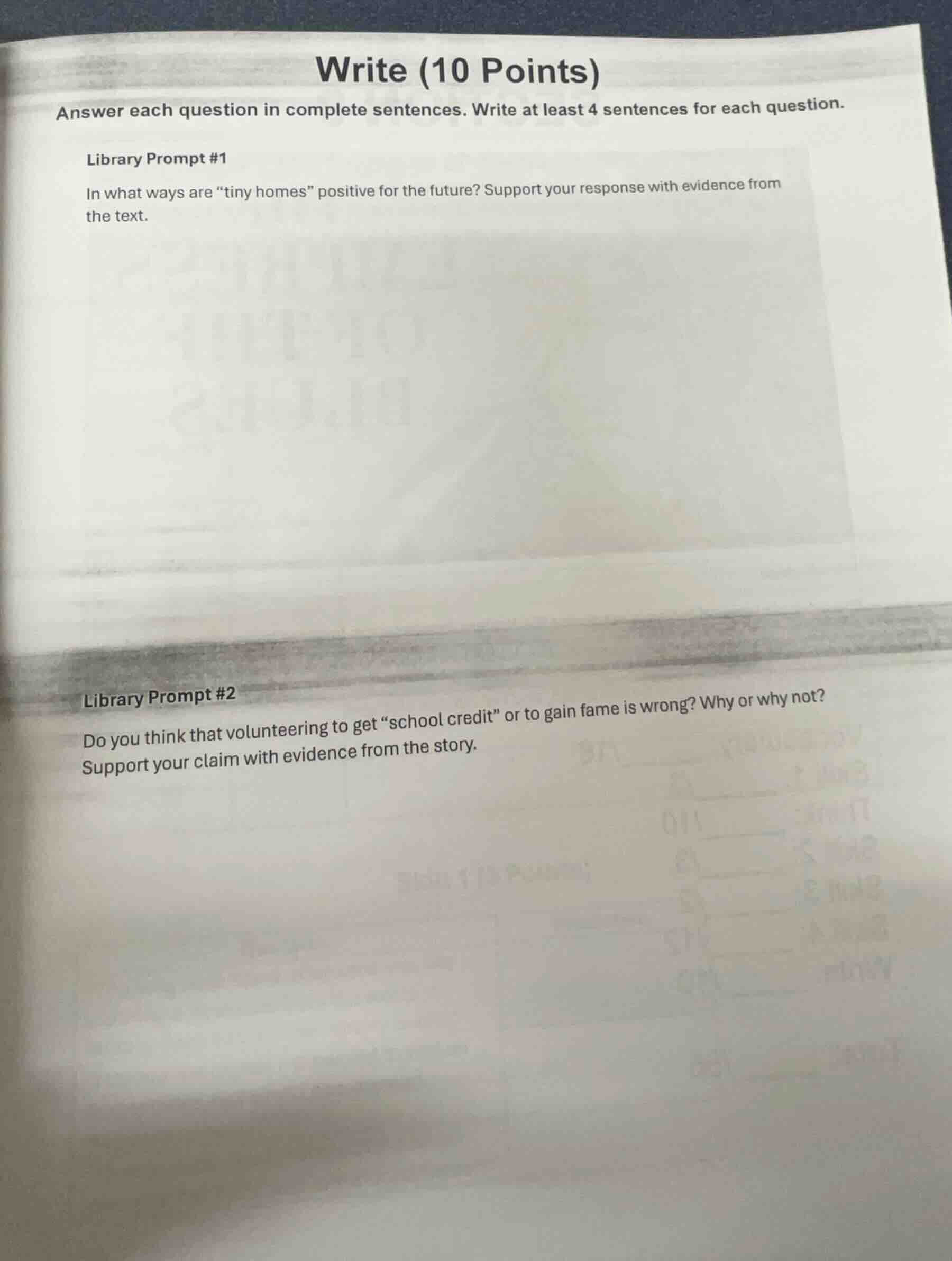
write (10 points)
answer each question in complete sentences. write at least 4 sentences for each question.
library prompt #1
in what ways are \tiny homes\ positive for the future? support your response with evidence from the text.
library prompt #2
do you think that volunteering to get \school credit\ or to gain fame is wrong? why or why not?
support your claim with evidence from the story.
To answer these questions, we need to analyze each prompt and provide well - structured responses with evidence (though since the text isn't provided, we'll give general - structured answers that can be adapted once the text is available).
Library Prompt #1
Tiny homes can be positive for the future in multiple ways. Firstly, they are highly cost - effective. The reduced size means lower construction costs, as less materials are needed. For example, a tiny home might cost a fraction of what a traditional home costs, making homeownership more accessible. Secondly, they are environmentally friendly. With a smaller footprint, they consume less energy for heating, cooling, and lighting. This helps in reducing the overall carbon footprint, which is crucial for combating climate change. Thirdly, they promote minimalist living. By having less space, people are encouraged to own fewer possessions, which can lead to a more sustainable and less consumer - driven lifestyle. Finally, in terms of land use, tiny homes can be placed in more compact developments, which can help in efficiently using land, especially in urban areas where space is at a premium.
Whether volunteering for school credit or fame is wrong depends on perspective, but there are strong arguments that it is. Volunteering is meant to be an act of altruism, where one helps others without expecting personal gain. If the main motivation is school credit or fame, the true spirit of volunteering is lost. For instance, if a student volunteers just to get credit, they may not be fully engaged in helping others and may only do the minimum required. Also, when people volunteer for fame, it can seem insincere, and the people being helped may feel like they are just a means to an end for the volunteer. However, on the other hand, if these external motivators lead a person to start volunteering and they then develop a genuine desire to help, it could be seen as a positive first step. But generally, the purest form of volunteering is driven by a desire to assist others, not personal gain.

Snap & solve any problem in the app
Get step-by-step solutions on Sovi AI
Photo-based solutions with guided steps
Explore more problems and detailed explanations
Tiny homes are positive for the future in several ways. They are cost - effective as their smaller size leads to lower construction and maintenance costs, making housing more affordable. They are environmentally friendly because they use less energy for heating, cooling, and lighting, thus reducing carbon emissions. Tiny homes also promote minimalist living, encouraging people to own fewer items and live more sustainably. Additionally, they make efficient use of land, which is beneficial in urban areas with limited space.