QUESTION IMAGE
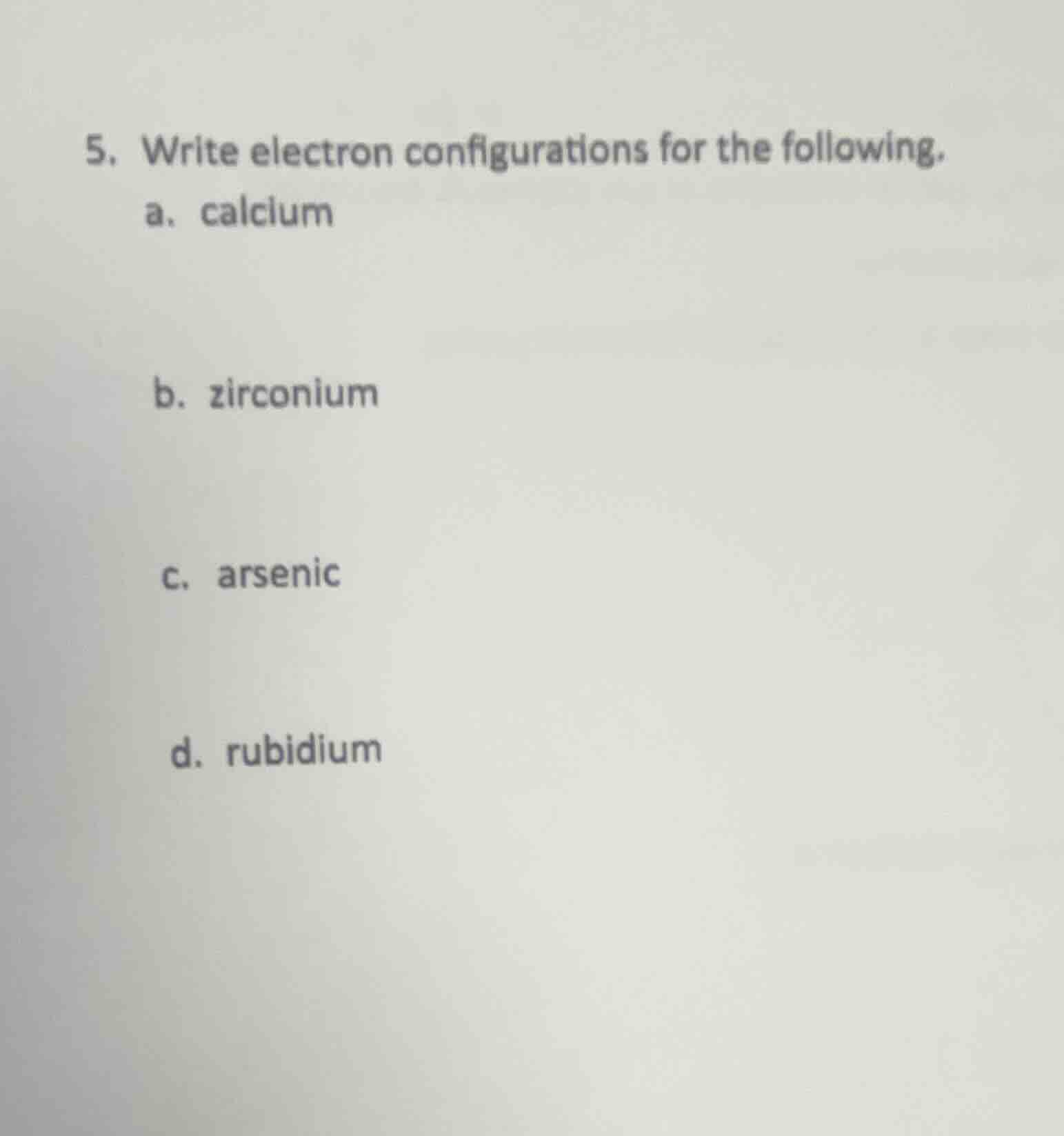
Question
- write electron configurations for the following.
a. calcium
b. zirconium
c. arsenic
d. rubidium
Part a: Calcium (Ca)
Step1: Determine atomic number
Calcium has an atomic number of 20, so it has 20 electrons.
Step2: Fill orbitals
Follow Aufbau principle: \(1s^2 2s^2 2p^6 3s^2 3p^6 4s^2\) (since 4s fills before 3d for Ca, as it's an s - block element).
Step1: Determine atomic number
Zirconium has an atomic number of 40, so 40 electrons.
Step2: Fill orbitals
Using Aufbau principle, after argon (\([Ar] = 1s^2 2s^2 2p^6 3s^2 3p^6\)), we fill 4s, 3d, 4p, 5s, 4d. The electron configuration is \([Kr]4d^2 5s^2\) (where \([Kr]\) is krypton's configuration: \(1s^2 2s^2 2p^6 3s^2 3p^6 4s^2 3d^{10} 4p^6\)).
Step1: Determine atomic number
Arsenic has an atomic number of 33, so 33 electrons.
Step2: Fill orbitals
Using Aufbau principle, after argon (\([Ar]\)), we fill 4s, 3d, 4p. The configuration is \([Ar]3d^{10} 4s^2 4p^3\) (since \([Ar]=1s^2 2s^2 2p^6 3s^2 3p^6\), then \(4s^2\), \(3d^{10}\), and \(4p^3\) to reach 33 electrons).

Snap & solve any problem in the app
Get step-by-step solutions on Sovi AI
Photo-based solutions with guided steps
Explore more problems and detailed explanations
\(1s^2 2s^2 2p^6 3s^2 3p^6 4s^2\) or \([Ar]4s^2\) (where \([Ar]\) is the electron configuration of argon, \(1s^2 2s^2 2p^6 3s^2 3p^6\))