QUESTION IMAGE
Question
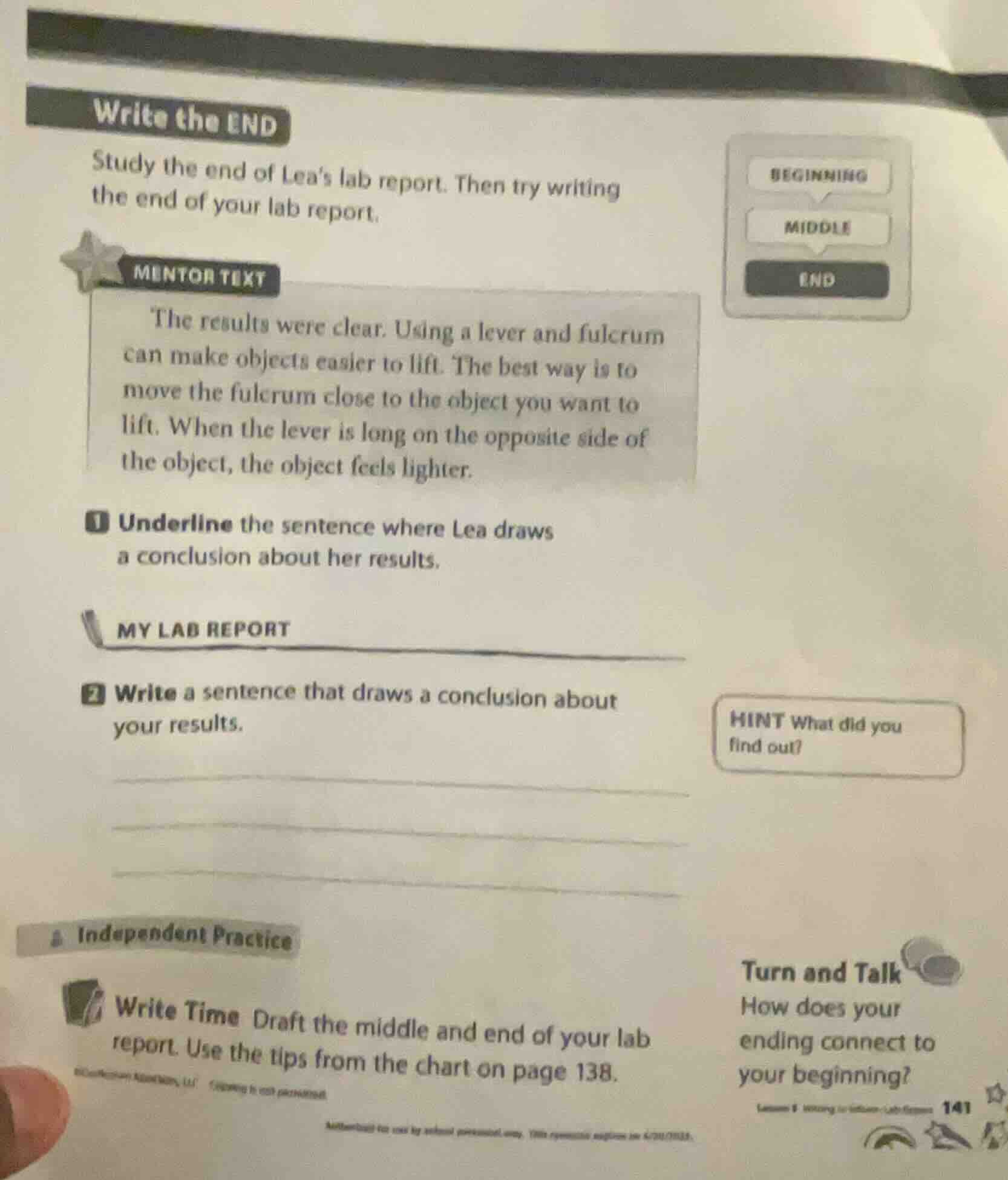
write the end
study the end of leas lab report. then try writing
the end of your lab report.
mentor text
the results were clear. using a lever and fulcrum
can make objects easier to lift. the best way is to
move the fulcrum close to the object you want to
lift. when the lever is long on the opposite side of
the object, the object feels lighter.
1 underline the sentence where lea draws
a conclusion about her results.
my lab report
2 write a sentence that draws a conclusion about
your results.
independent practice
write time draft the middle and end of your lab
report. use the tips from the chart on page 138.
beginning
middle
end
hint what did you
find out?
turn and talk
how does your
ending connect to
your beginning?
- For question 1, the concluding sentence summarizes the core finding of the experiment about levers and fulcrums.
- For question 2, the conclusion should reflect a clear, evidence-based finding from a lever/fulcrum lab, mirroring the mentor text's structure.
- For independent practice, draft the middle (experimental steps/observations) and end (conclusion) of a lab report, tying the conclusion back to the experiment's initial purpose.

Snap & solve any problem in the app
Get step-by-step solutions on Sovi AI
Photo-based solutions with guided steps
Explore more problems and detailed explanations
- Underlined sentence: "Using a lever and fulcrum can make objects easier to lift."
- Example conclusion sentence: "Our experiment confirmed that positioning the fulcrum closer to a heavy object drastically reduces the force needed to lift it with a lever."
- Independent Practice (example):
Middle: "We tested lifting a 5kg weight with a lever, placing the fulcrum 10cm, 20cm, and 30cm from the weight. When the fulcrum was 10cm from the weight, we only needed 1kg of force to lift it; at 30cm from the weight, we needed 3kg of force. We repeated each test 3 times and got consistent results."
End: "The data clearly shows that the closer the fulcrum is to the load being lifted, the less force is required to move the load using a lever. This matches our initial hypothesis about how levers multiply force."