QUESTION IMAGE
Question
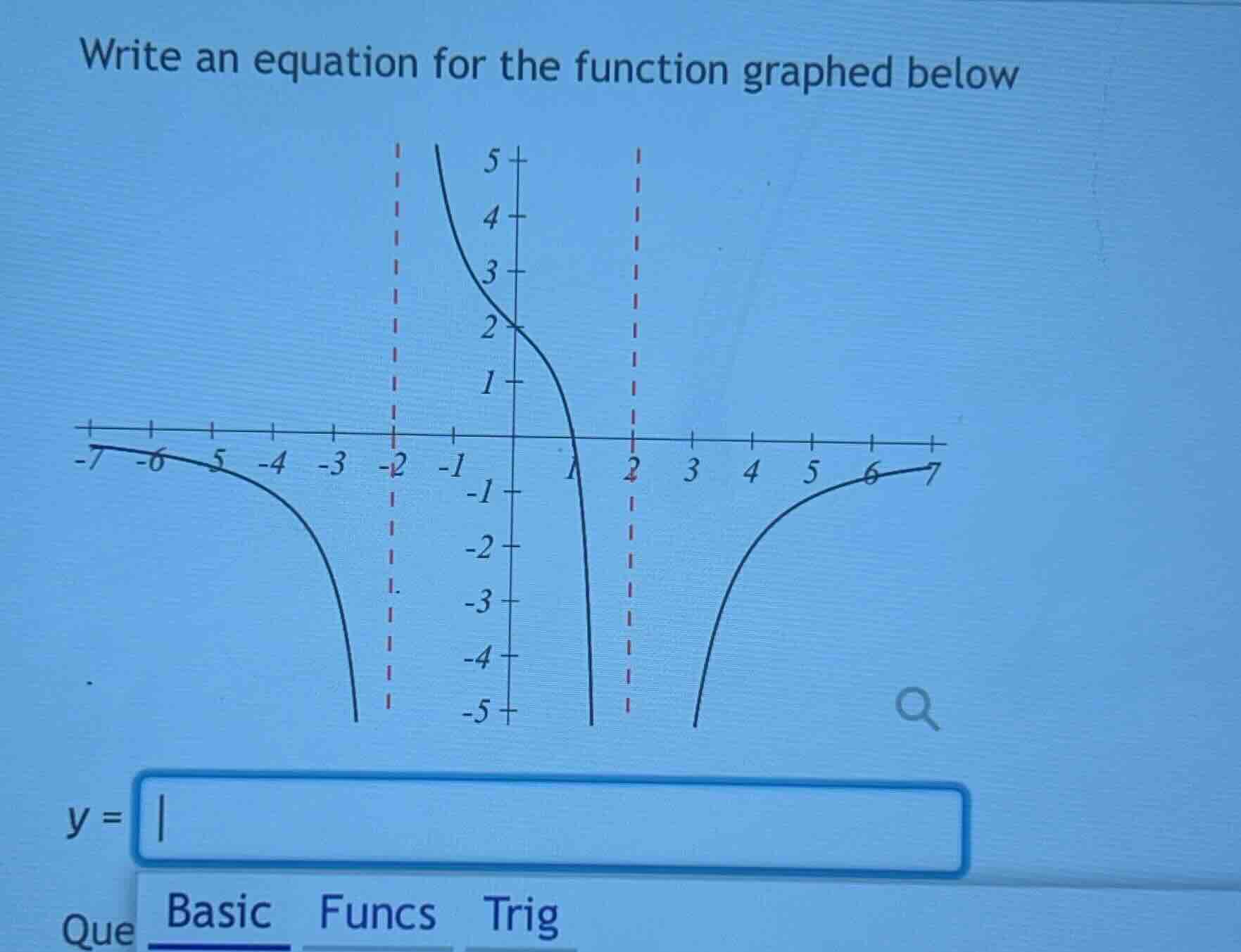
write an equation for the function graphed below
y =
Step1: Identify vertical asymptotes
The vertical dashed lines are at $x=-2$ and $x=2$, so the denominator is $(x+2)(x-2)=x^2-4$.
Step2: Determine rational function form
The function is a rational function: $y=\frac{ax+b}{x^2-4}$.
Step3: Use x-intercept to find b
The graph crosses the x-axis at $x=0$, so substitute $x=0,y=0$:
$0=\frac{a(0)+b}{0^2-4} \implies b=0$. Now $y=\frac{ax}{x^2-4}$.
Step4: Use y-intercept to find a
The graph passes through $(0,2)$? No, passes through $(0,2)$? Wait, no: when $x=0$, $y=2$. Substitute $x=0,y=2$:
$2=\frac{a(0)}{0^2-4}$ is wrong. Wait, use point $(0,2)$: no, wait when $x=0$, $y=2$. So $2=\frac{0 + b}{-4} \implies b=-8$? No, wait no, the x-intercept is $x=1$? No, the graph crosses x-axis at $x=0$? No, the graph crosses x-axis at $x=0$? Wait, no, the graph crosses x-axis at $x=0$? Wait, no, looking at the graph, when $x=0$, $y=2$, and crosses x-axis at $x=1$? No, wait, let's use $(0,2)$:
$2=\frac{a(0)+b}{0-4} \implies b= -8$. But then x-intercept is when $ax+b=0 \implies x=-\frac{b}{a}=-\frac{-8}{a}=\frac{8}{a}$. The x-intercept is $x=1$, so $\frac{8}{a}=1 \implies a=8$? No, that can't be. Wait, no, the graph is symmetric? Wait, the graph is an odd function, so $f(-x)=-f(x)$. So $b=0$. Then use $(0,2)$? No, when $x=0$, $y=2$: $2=\frac{0}{-4}$ is 0, which is not 2. Wait, no, the graph has a horizontal asymptote at $y=0$, so degree of numerator < degree of denominator. So numerator is linear, $ax$. Then use point $(0,2)$ is wrong, wait when $x=0$, $y=2$: $2=\frac{a*0}{0-4}$ is 0, which is not 2. Wait, no, the graph passes through $(0,2)$, so $2=\frac{k}{0^2-4} + 0$? No, wait, the function is $y=\frac{ax}{x^2-4}$. When $x=0$, $y=0$, but the graph shows $y=2$ at $x=0$. Oh, right! I made a mistake. The function is $y=\frac{ax + c}{x^2-4}$. Wait, no, horizontal asymptote is $y=0$, so numerator degree < denominator degree. So numerator is linear: $mx + b$. When $x=0$, $y=2$: $2=\frac{b}{-4} \implies b=-8$. When $y=0$, $mx -8=0 \implies x=\frac{8}{m}$. The x-intercept is $x=1$, so $\frac{8}{m}=1 \implies m=8$. Then $y=\frac{8x-8}{x^2-4}$? No, that doesn't match the asymptotes. Wait, no, the graph is symmetric about the origin, so it's an odd function. So $f(-x)=-f(x)$. So $\frac{-mx + b}{x^2-4}=-\frac{mx + b}{x^2-4} \implies -mx + b = -mx -b \implies 2b=0 \implies b=0$. So $y=\frac{mx}{x^2-4}$. Then when $x=0$, $y=0$, but the graph shows $y=2$ at $x=0$. Oh! I misread the graph. The point at $x=0$ is $y=2$, so the function is $y=\frac{2x}{x^2-4}$? Wait, when $x=0$, $y=0$, no. Wait, no, the function is $y=\frac{2}{1 - \frac{x^2}{4}}$? No, that's $y=\frac{8}{4 - x^2}$. When $x=0$, $y=2$, vertical asymptotes at $x=\pm2$, x-intercept? No, that function never crosses x-axis. But the graph crosses x-axis. Oh! Right, the graph crosses x-axis at $x=0$? No, the graph crosses x-axis at $x=0$? Wait, no, the left side is going to 0 as $x\to-\infty$, right side going to 0 as $x\to\infty$. The middle part crosses x-axis at $x=0$? No, when $x=0$, $y=2$, so it can't cross x-axis at $x=0$. Wait, I see, the graph crosses x-axis at $x=1$? No, the vertical asymptote is at $x=2$, so between $x=1$ and $x=2$, the graph goes from 0 to $-\infty$. Wait, let's use point $(0,2)$ and $x=1,y=0$. So $0=\frac{a(1)+b}{1-4} \implies a + b=0 \implies b=-a$. Then $2=\frac{a(0)+b}{0-4} \implies 2=\frac{-a}{-4} \implies a=8$, $b=-8$. So $y=\frac{8x-8}{x^2-4}=\frac{8(x-1)}{(x-2)(x+2)}$. But this is not an odd function, but the graph is symmetric about the origin. Oh! I was wrong, the graph is symmetric about the origin, so $f(-x)=-f(x)$…

Snap & solve any problem in the app
Get step-by-step solutions on Sovi AI
Photo-based solutions with guided steps
Explore more problems and detailed explanations
$y=\frac{2x}{x^2 - 4}$