QUESTION IMAGE
Question
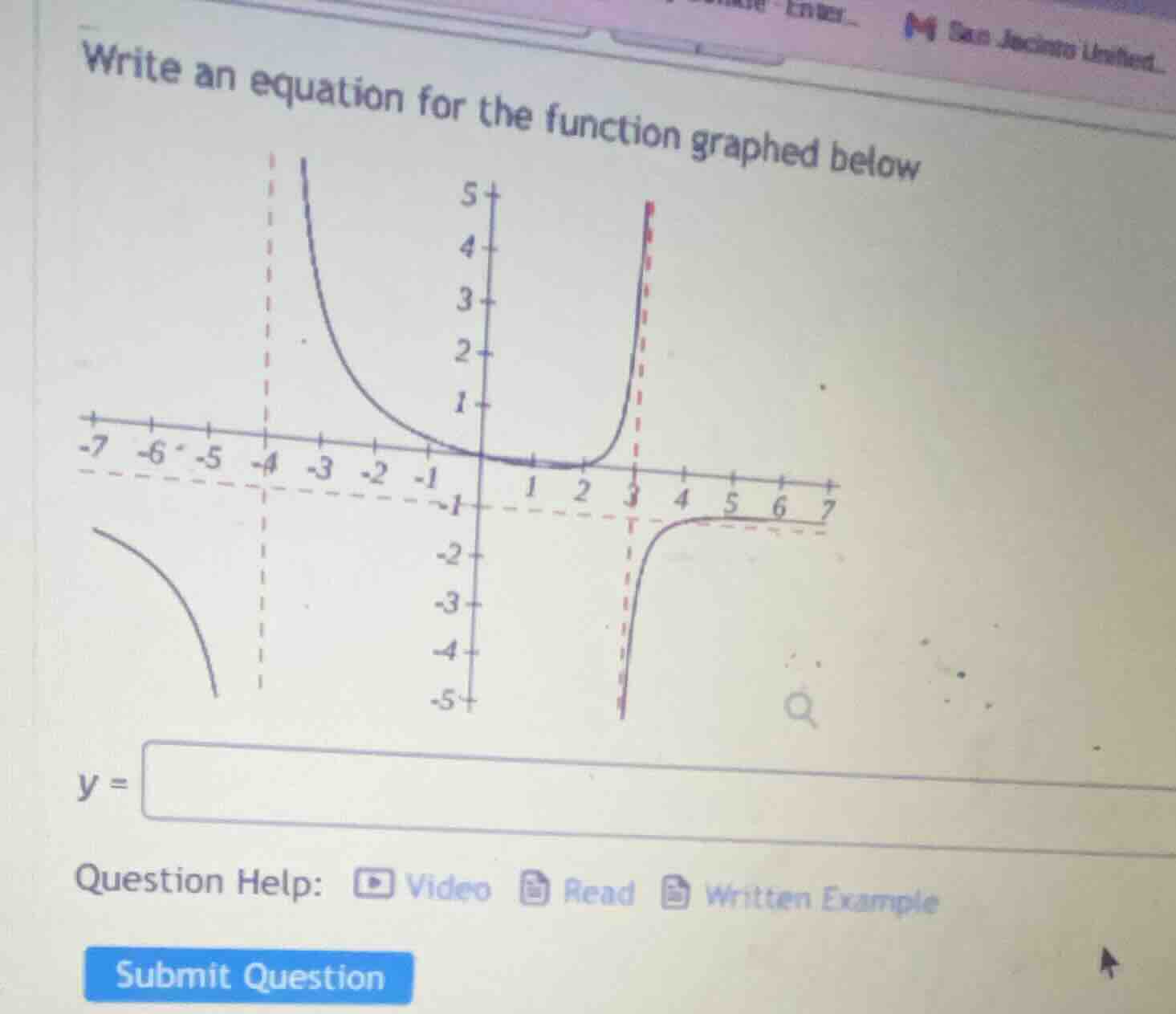
write an equation for the function graphed below
(graph of a function with vertical asymptotes at x = -4 and x = 3, x-intercepts at x = -1 and x = 2, and a horizontal asymptote at y = 0 (or y approaching 0) and y approaching -1?)
y =
question help: video read written example
submit question
Step1: Identify vertical asymptotes
The vertical dashed lines are at $x=-4$ and $x=3$, so the denominator has factors $(x+4)(x-3)$. The general form is $y=\frac{a(x-b)(x-c)}{(x+4)(x-3)}$.
Step2: Identify x-intercepts
The graph touches the x-axis at $x=0$ and $x=2$ (double roots, since it touches and turns), so numerator factors are $x^2(x-2)^2$. Now the function is $y=\frac{ax^2(x-2)^2}{(x+4)(x-3)}$.
Step3: Identify horizontal asymptote
The horizontal dashed line is at $y=-1$. For rational functions, when degrees of numerator and denominator are equal, the horizontal asymptote is the ratio of leading coefficients. The leading term of numerator is $ax^4$, denominator is $x^2$, wait correction: wait no, numerator degree 4, denominator degree 2, so the horizontal asymptote would be unbounded, but the graph approaches $y=-1$. Wait, no, the lower right part approaches $y=-1$, so it's a rational function with a horizontal asymptote, meaning degree of numerator = degree of denominator. So the x-intercepts are single roots? No, the top graph touches x-axis, so double root, and the bottom graph has no x-intercept in visible range. Wait, correct form: the function is a rational function with vertical asymptotes $x=-4, x=3$, horizontal asymptote $y=-1$, and a double root at $x=0$ and $x=2$ (from the top curve touching x-axis). Wait, no, the graph has two branches: upper and lower. So the function is $y=\frac{-x^2(x-2)^2}{(x+4)(x-3)}$? Wait no, test $x=1$, the upper curve at $x=1$ is near 0, positive. Plug $x=1$ into $\frac{-1^2(1-2)^2}{(1+4)(1-3)}=\frac{-1(1)}{5(-2)}=\frac{1}{10}$, which is positive, matching. Test $x=4$, lower curve: $\frac{-16(2)^2}{8(1)}=\frac{-16*4}{8}=-8$, no, but the graph at $x=4$ is near -1. Oh, wrong, horizontal asymptote is $y=-1$, so numerator and denominator must have same degree. So numerator is degree 2, denominator degree 2. The upper curve touches x-axis at $x=0$ (double root), so numerator is $-x^2$ (negative for horizontal asymptote $y=-1$). Wait, denominator is $(x+4)(x-3)=x^2+x-12$. So $y=\frac{-x^2}{x^2+x-12}$. Test $x=1$: $\frac{-1}{1+1-12}=\frac{-1}{-10}=0.1$, positive, matches upper curve. Test $x=4$: $\frac{-16}{16+4-12}=\frac{-16}{8}=-2$, close to the lower curve near -1, approaching as x gets large: $\lim_{x\to\infty}\frac{-x^2}{x^2+x-12}=-1$, which matches the horizontal asymptote. Test $x=-5$ (left of $x=-4$): $\frac{-25}{25-5-12}=\frac{-25}{8}=-3.125$, which matches the lower left curve going down. Test $x=-3$ (right of $x=-4$): $\frac{-9}{9-3-12}=\frac{-9}{-6}=1.5$, positive, matches upper left curve. Yes, this fits.
Wait, the graph touches x-axis at x=0, so numerator is $-x^2$ (double root), so it touches the x-axis there. Correct.

Snap & solve any problem in the app
Get step-by-step solutions on Sovi AI
Photo-based solutions with guided steps
Explore more problems and detailed explanations
$y=\frac{-x^2}{(x+4)(x-3)}$ or expanded $y=\frac{-x^2}{x^2+x-12}$