QUESTION IMAGE
Question
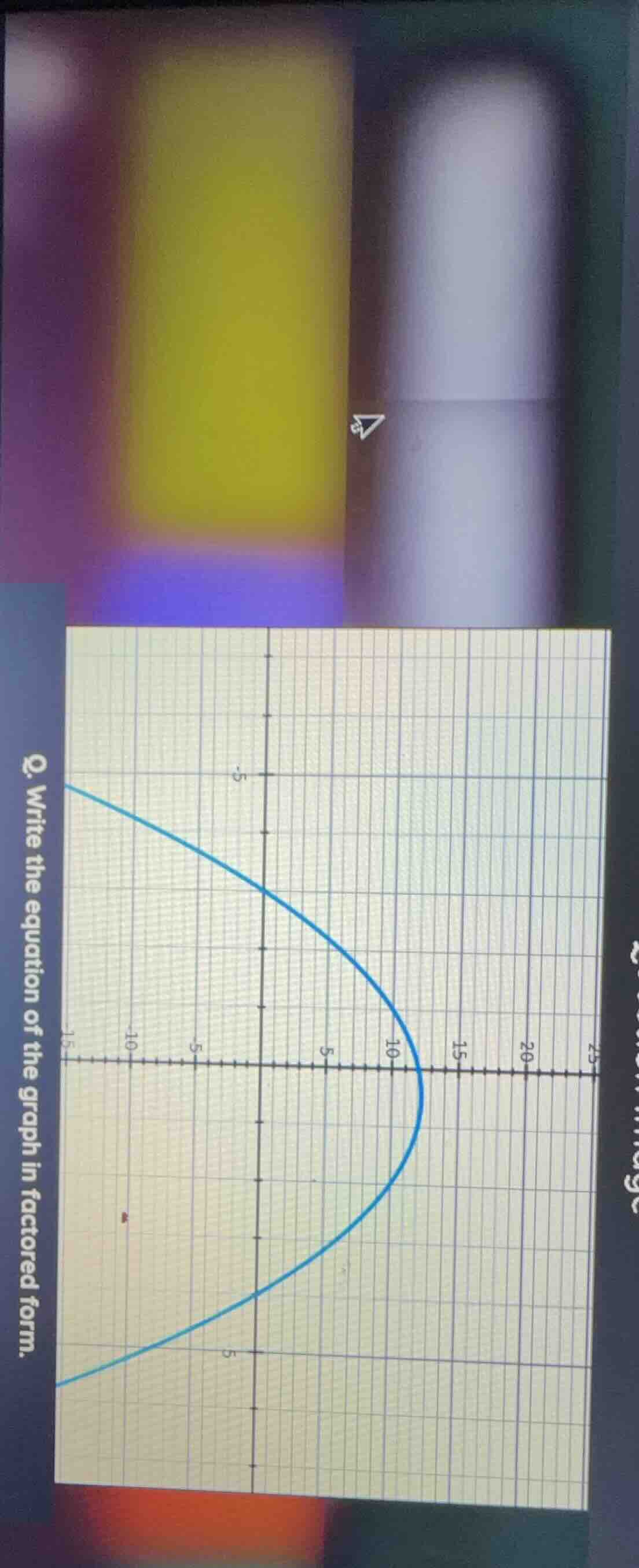
q. write the equation of the graph in factored form.
Step1: Identify the roots of the parabola
From the graph, the parabola intersects the x - axis at \(x = 10\) (a double root? Wait, no, looking at the graph, the parabola seems to open to the left (since it's a horizontal parabola). Wait, the standard form of a horizontal parabola is \((y - k)^2=4p(x - h)\) or factored form for a quadratic in \(y\) or \(x\). Wait, actually, if it's a parabola opening to the left, the equation can be written in factored form related to its roots. Wait, let's check the intercepts. The graph intersects the x - axis at \(x = 10\) (wait, no, the x - axis is the horizontal line \(y = 0\)). Wait, looking at the grid, the vertex? Wait, maybe it's a parabola that is a function of \(y\), so \(x=ay^{2}+by + c\). Let's find the roots. When \(y = 0\), \(x = 10\)? Wait, no, the graph passes through \((10,0)\) and maybe another point? Wait, no, the parabola is opening to the left, so it's a horizontal parabola. Let's assume it's a parabola with vertex at \((h,k)\) and opening left. The general factored form for a horizontal parabola (quadratic in \(y\)) is \(x=a(y - y_1)(y - y_2)\), where \(y_1\) and \(y_2\) are the \(y\) - intercepts (when \(x = 0\)). Wait, when \(x = 0\), let's find the \(y\) - values. From the graph, when \(x = 0\), the parabola passes through \(y = 5\) and \(y=-5\)? Wait, no, looking at the grid, the vertical axis (y - axis) has marks. Wait, maybe the roots (the points where \(x = 0\)) are \(y = 5\) and \(y=-5\), and it passes through \((10,0)\)? Wait, no, when \(y = 0\), \(x = 10\)? Wait, the graph at \(y = 0\) (the x - axis) touches or crosses at \(x = 10\)? Wait, no, the blue curve: when \(y = 0\), \(x = 10\), and when \(x = 0\), \(y = 5\) and \(y=-5\)? Wait, let's re - examine. The graph is a horizontal parabola (opening to the left) with \(x\) - intercept at \((10,0)\) and \(y\) - intercepts at \((0,5)\) and \((0, - 5)\). So the equation in factored form (since it's a quadratic in \(y\)) is \(x=a(y - 5)(y + 5)\). Now, we can find \(a\) by plugging in the point \((10,0)\). Wait, no, when \(y = 0\), \(x=a(0 - 5)(0 + 5)=a(-5)(5)=-25a\). We know that when \(y = 0\), \(x = 10\)? Wait, no, that can't be. Wait, maybe I got the intercepts wrong. Wait, the graph: the left - most part? No, the blue curve is a parabola opening to the left, so the vertex is at \((h,k)\), and it has two \(y\) - intercepts (when \(x = 0\)) and one \(x\) - intercept? Wait, no, a horizontal parabola (quadratic in \(y\)) has two \(y\) - intercepts (when \(x = 0\)) and is symmetric about the x - axis (if the vertex is on the x - axis). Wait, looking at the graph, it's symmetric about the x - axis (the horizontal line \(y = 0\)). So the vertex is on the x - axis, at \((h,0)\). The general equation of a horizontal parabola symmetric about the x - axis is \(x=a(y - 0)^2+h\), or in factored form, since it's a quadratic in \(y\), \(x=a y^{2}+h\). But we need factored form. Wait, if it has roots at \(y = 5\) and \(y=-5\) (when \(x = 0\)), then \(x=a(y - 5)(y + 5)\). Now, let's find a point on the parabola. Let's take the point \((0,5)\): plug \(x = 0\), \(y = 5\) into \(x=a(y - 5)(y + 5)\), we get \(0=a(5 - 5)(5 + 5)=0\), which is not helpful. Wait, take the point \((10,0)\): plug \(x = 10\), \(y = 0\) into \(x=a(y - 5)(y + 5)\), we get \(10=a(0 - 5)(0 + 5)=a(-25)\), so \(a=\frac{10}{-25}=-\frac{2}{5}\). Wait, no, that would give \(x=-\frac{2}{5}(y - 5)(y + 5)\). Let's check when \(y = 0\), \(x=-\frac{2}{5}(-5)(5)=-\frac{2}{5}\times(-25)=10\), which matches. When \(x = 0\), \(0=-\frac{2}{5}(y - 5)(y + 5)\), so \((y - 5)(y + 5)=…

Snap & solve any problem in the app
Get step-by-step solutions on Sovi AI
Photo-based solutions with guided steps
Explore more problems and detailed explanations
\(x =-\frac{2}{5}(y - 5)(y + 5)\)