QUESTION IMAGE
Question
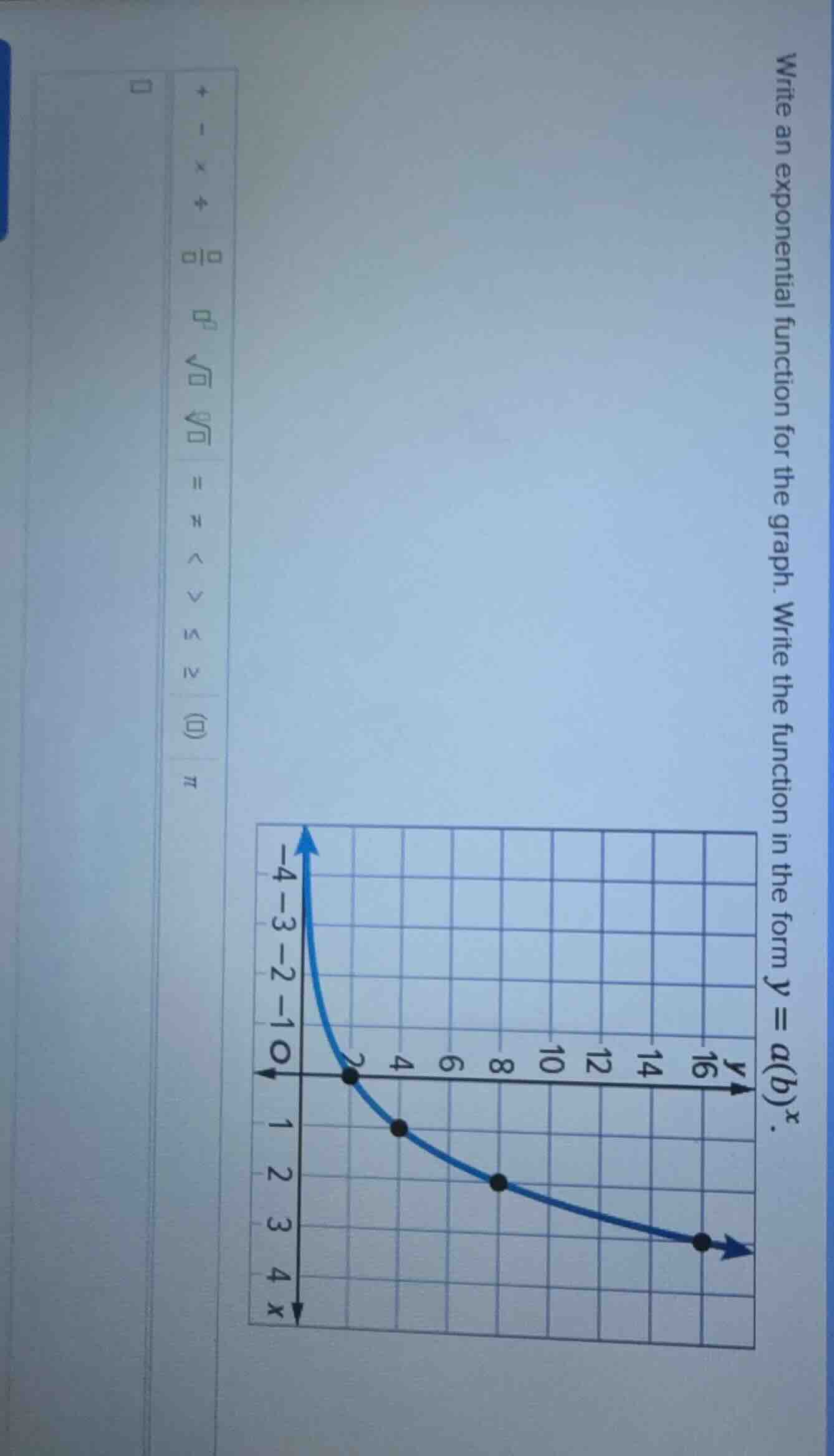
write an exponential function for the graph. write the function in the form $y = a(b)^x$.
Step1: Identify the point when \( x = 0 \)
From the graph, when \( x = 0 \), \( y = 2 \). For the exponential function \( y = a(b)^x \), when \( x = 0 \), \( y = a(b)^0 = a(1)=a \). So \( a = 2 \).
Step2: Find another point to determine \( b \)
Let's take the point \( (1, 4) \)? Wait, no, looking at the graph, when \( x = 1 \), the \( y \)-value? Wait, maybe the points are \( (0, 2) \), \( (1, 4) \)? Wait, no, the grid: let's check the coordinates. Wait, the first point is \( (0, 2) \), then when \( x = 1 \), what's \( y \)? Wait, maybe the points are \( (0, 2) \), \( (1, 4) \)? Wait, no, the graph is a curve. Wait, maybe the points are \( (0, 2) \), \( (1, 4) \)? Wait, no, let's re - examine. Wait, the \( y \)-axis is labeled with 2,4,6,8,10,12,14,16. The \( x \)-axis is - 4,-3,-2,-1,0,1,2,3,4. The first black dot is at \( (0, 2) \), the next at \( (1, 4) \)? Wait, no, maybe \( (0, 2) \), \( (1, 4) \) is not correct. Wait, maybe the points are \( (0, 2) \), \( (1, 4) \)? Wait, no, let's use the general form \( y=a(b)^x \). We know that when \( x = 0 \), \( y = 2 \), so \( a = 2 \). Now, let's find another point. Let's say when \( x = 1 \), what's \( y \)? Wait, maybe the next point is \( (1, 4) \)? Wait, no, the graph is a curve. Wait, maybe the points are \( (0, 2) \), \( (1, 4) \), so substituting \( x = 1 \), \( y = 4 \) into \( y = 2(b)^1 \), we get \( 4=2b\), so \( b = 2 \). Wait, but the graph is decreasing? Wait, no, maybe I misread the graph. Wait, the \( y \)-axis is on the right? Wait, the graph: the curve starts from the top left (when \( x \) is negative) and comes down to \( (0, 2) \), then goes to \( (1, 4) \)? No, that would be increasing. But the arrow on the \( x \)-axis: the \( x \)-axis arrow is to the right (positive \( x \) direction), and the \( y \)-axis arrow is up (positive \( y \) direction). Wait, maybe the function is increasing. So if \( a = 2 \) (from \( x = 0 \), \( y = 2 \)) and when \( x = 1 \), \( y = 4 \), then \( y = 2(2)^x \). Let's check another point. If \( x = 2 \), \( y=2(2)^2 = 8 \), which should be a point on the graph. Let's see if that makes sense. So the exponential function is \( y = 2(2)^x \).
Step3: Verify the function
The general form of an exponential function is \( y=a(b)^x \). We found that \( a = 2 \) (from the point \( (0, 2) \) since when \( x = 0 \), \( y=a(b)^0=a\)) and \( b = 2 \) (from the point \( (1, 4) \) since when \( x = 1 \), \( y = 4 \), substituting into \( y = 2(b)^x \) gives \( 4 = 2b\), so \( b = 2 \)).

Snap & solve any problem in the app
Get step-by-step solutions on Sovi AI
Photo-based solutions with guided steps
Explore more problems and detailed explanations
\( y = 2(2)^x \) (or \( y = 2^{x + 1}\), but in the form \( y=a(b)^x \), it is \( y = 2(2)^x \))