QUESTION IMAGE
Question
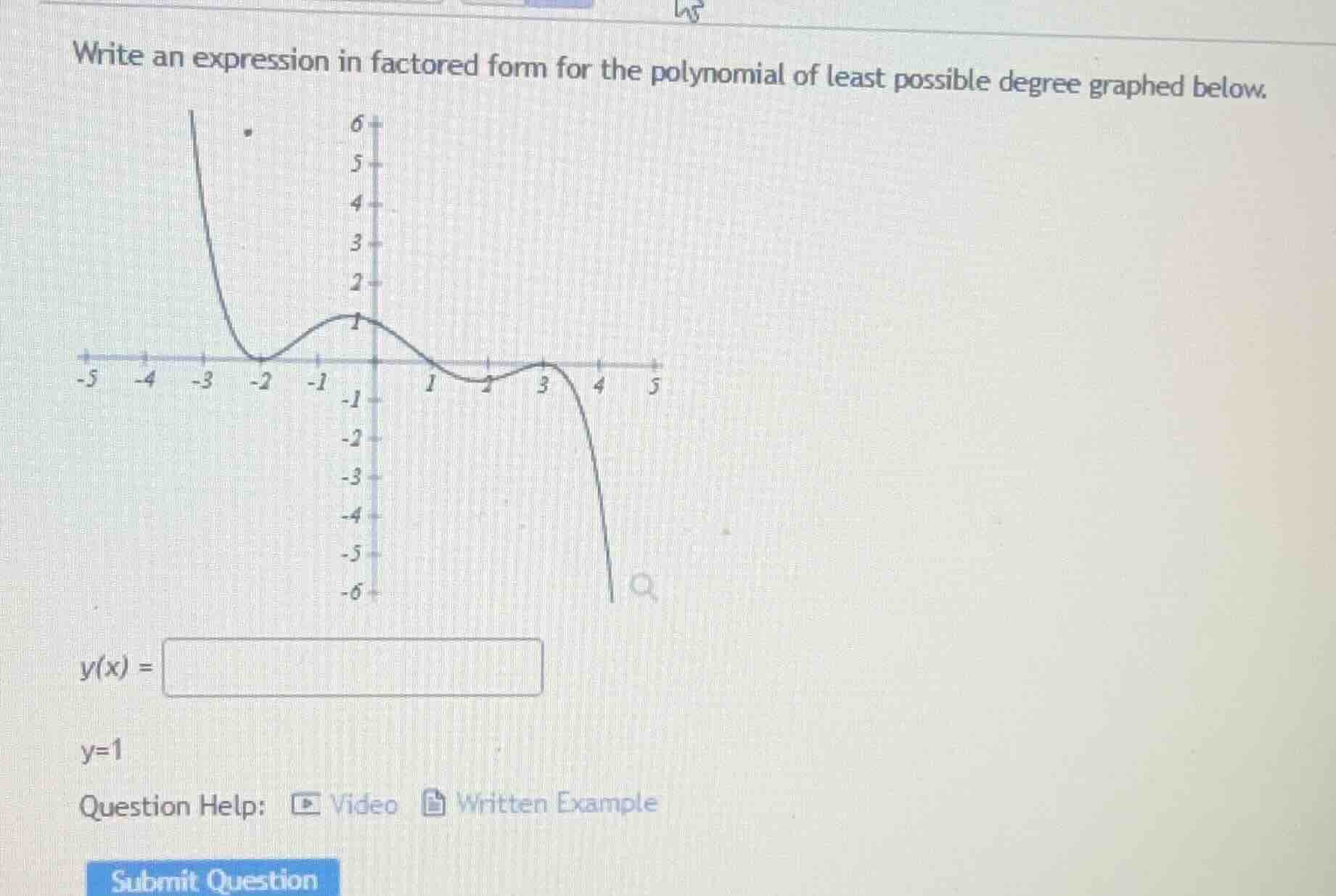
write an expression in factored form for the polynomial of least possible degree graphed below.
y(x) =
y=1
question help: video written example
submit question
Step1: Identify roots and multiplicities
The graph touches or crosses the x - axis at \(x=-2\), \(x = 1\), and \(x=3\). At \(x=-2\), the graph touches the x - axis and turns around, so the multiplicity of the root \(x=-2\) is 2. At \(x = 1\), the graph crosses the x - axis, so the multiplicity of the root \(x = 1\) is 1. At \(x=3\), the graph touches the x - axis and turns around, so the multiplicity of the root \(x = 3\) is 2.
So the factors corresponding to the roots are \((x + 2)^2\) (for root \(x=-2\)), \((x - 1)\) (for root \(x = 1\)) and \((x - 3)^2\) (for root \(x=3\)).
Step2: Determine the leading coefficient
We also know that when \(x = 0\), from the graph \(y(0)=1\). Let the polynomial be \(y(x)=a(x + 2)^2(x - 1)(x - 3)^2\).
Substitute \(x = 0\) and \(y(0)=1\) into the polynomial:
\(1=a(0 + 2)^2(0 - 1)(0 - 3)^2\)
First, calculate \((0 + 2)^2=4\), \((0 - 1)=-1\), \((0 - 3)^2 = 9\).
Then the right - hand side is \(a\times4\times(-1)\times9=-36a\).
So, \(-36a = 1\), which gives \(a=-\frac{1}{36}\)? Wait, no, maybe I made a mistake. Wait, looking at the graph again, when \(x = 0\), the y - value is 1. Wait, let's re - check the calculation.
Wait, \((x + 2)^2\) at \(x = 0\) is \(4\), \((x-1)\) at \(x = 0\) is \(-1\), \((x - 3)^2\) at \(x = 0\) is \(9\). So \(y(0)=a\times4\times(-1)\times9=-36a\). We know \(y(0) = 1\), so \(-36a=1\Rightarrow a=-\frac{1}{36}\)? But that seems odd. Wait, maybe the graph has a y - intercept of 1, but maybe my assumption about the roots is wrong. Wait, the graph also has a local maximum at \(x = 0\) with \(y = 1\). Wait, maybe the polynomial is of the form \(y(x)=k(x + 2)^2(x - 1)(x - 3)^2\). Let's check the end - behavior. As \(x
ightarrow-\infty\), \(y(x)
ightarrow+\infty\) and as \(x
ightarrow+\infty\), \(y(x)
ightarrow-\infty\). The degree of the polynomial is \(2 + 1+2=5\), which is odd. The leading term is \(k x^{2 + 1+2}=k x^{5}\). For the end - behavior, when the degree is odd, if the leading coefficient \(k\lt0\), as \(x
ightarrow+\infty\), \(y
ightarrow-\infty\) and as \(x
ightarrow-\infty\), \(y
ightarrow+\infty\), which matches the graph.
Wait, but when \(x = 0\), \(y(0)=k\times(2)^2\times(-1)\times(-3)^2=k\times4\times(-1)\times9=-36k\). We know \(y(0) = 1\), so \(-36k = 1\Rightarrow k=-\frac{1}{36}\). But that seems complicated. Wait, maybe I misread the y - intercept. Wait, the graph at \(x = 0\) is at \(y = 1\), but maybe the polynomial is \(y(x)=-\frac{1}{36}(x + 2)^2(x - 1)(x - 3)^2\)? But that seems messy. Wait, maybe there is a simpler form. Wait, maybe the roots are \(x=-2\) (multiplicity 2), \(x = 1\) (multiplicity 1), \(x = 3\) (multiplicity 2), and the leading coefficient is such that when \(x = 0\), \(y = 1\).
Wait, let's recast the polynomial:
\(y(x)=a(x + 2)^2(x - 1)(x - 3)^2\)
We can also expand the product of the factors without the leading coefficient first:
\((x + 2)^2(x - 3)^2=[(x + 2)(x - 3)]^2=(x^{2}-x - 6)^2=x^{4}-2x^{3}-11x^{2}+12x + 36\)
Then multiply by \((x - 1)\):
\((x^{4}-2x^{3}-11x^{2}+12x + 36)(x - 1)=x^{5}-2x^{4}-11x^{3}+12x^{2}+36x-x^{4}+2x^{3}+11x^{2}-12x - 36=x^{5}-3x^{4}-9x^{3}+23x^{2}+24x - 36\)
Now, \(y(x)=a(x^{5}-3x^{4}-9x^{3}+23x^{2}+24x - 36)\)
When \(x = 0\), \(y(0)=-36a\). Since \(y(0) = 1\), then \(a=-\frac{1}{36}\). So \(y(x)=-\frac{1}{36}(x + 2)^2(x - 1)(x - 3)^2\). But this seems too complicated. Wait, maybe the graph is actually \(y(x)=-\frac{1}{36}(x + 2)^2(x - 1)(x - 3)^2\), but let's check the value at \(x = 1\), \(y(1)=0\), which matches the graph. At \(x=-2\), \(y(-2)=0\), and at \(x = 3\), \(y(3)=0\), which also…

Snap & solve any problem in the app
Get step-by-step solutions on Sovi AI
Photo-based solutions with guided steps
Explore more problems and detailed explanations
\(y(x)=-\frac{1}{36}(x + 2)^2(x - 1)(x - 3)^2\) (or we can also write it as \(y(x)=\frac{-1}{36}(x + 2)^2(x - 1)(x - 3)^2\))
Wait, but maybe I made a mistake in the leading coefficient. Let's re - evaluate. Let's assume that the polynomial is \(y(x)=a(x + 2)^2(x - 1)(x - 3)^2\). We know that when \(x = 0\), \(y = 1\). So:
\(1=a(2)^2(-1)(-3)^2=a\times4\times(-1)\times9=-36a\)
So \(a =-\frac{1}{36}\). So the factored form is \(y(x)=-\frac{1}{36}(x + 2)^2(x - 1)(x - 3)^2\)