QUESTION IMAGE
Question
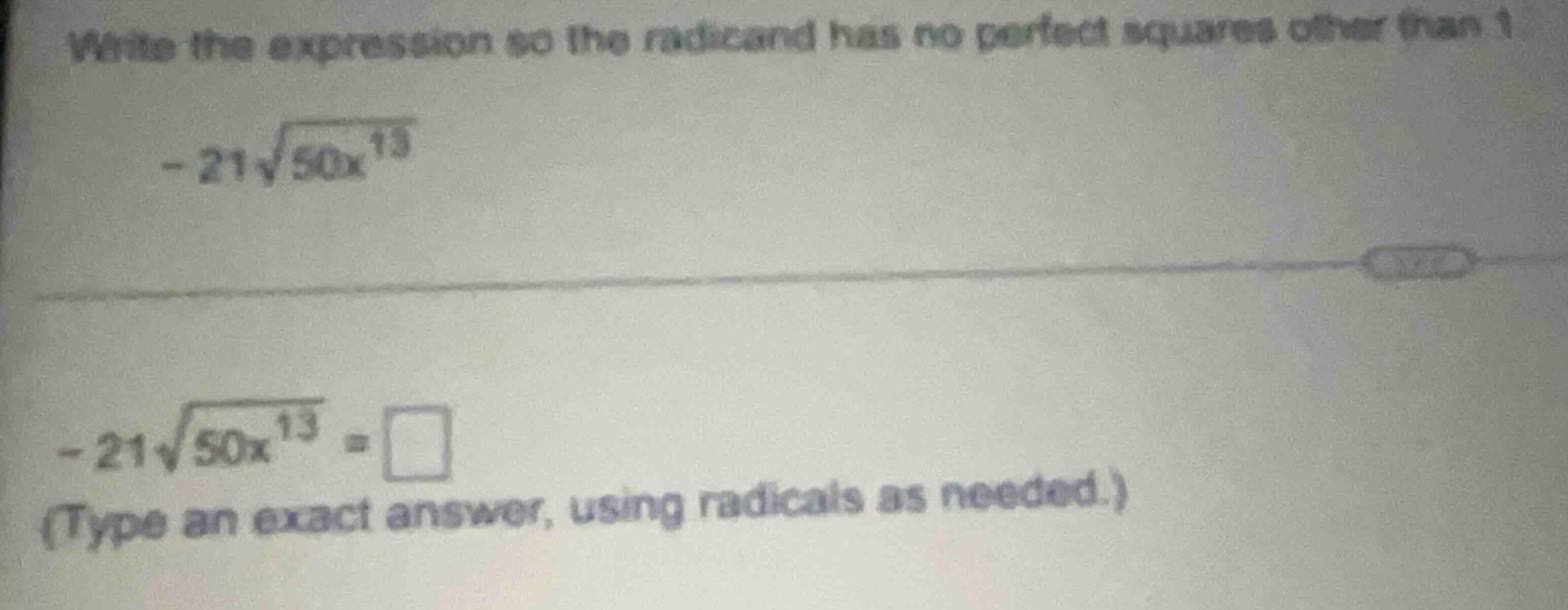
write the expression so the radicand has no perfect squares other than 1
-21√(50x¹³)
-21√(50x¹³) = □
(type an exact answer, using radicals as needed.)
Step1: Factor the radicand
We know that \(50 = 25\times2\) and \(x^{13}=x^{12}\times x\). So we can rewrite the radicand \(50x^{13}\) as \(25\times2\times x^{12}\times x\).
Step2: Use the property of square roots \(\sqrt{ab}=\sqrt{a}\times\sqrt{b}\) (\(a\geq0,b\geq0\))
\(-21\sqrt{50x^{13}}=-21\sqrt{25\times2\times x^{12}\times x}\)
Since \(\sqrt{25} = 5\) and \(\sqrt{x^{12}}=x^{6}\) (because \((x^{6})^{2}=x^{12}\)), we can further simplify:
\(-21\times\sqrt{25}\times\sqrt{x^{12}}\times\sqrt{2x}=-21\times5\times x^{6}\times\sqrt{2x}\)
Step3: Multiply the constants
\(-21\times5=-105\), so the expression becomes \(-105x^{6}\sqrt{2x}\)

Snap & solve any problem in the app
Get step-by-step solutions on Sovi AI
Photo-based solutions with guided steps
Explore more problems and detailed explanations
\(-105x^{6}\sqrt{2x}\)