QUESTION IMAGE
Question
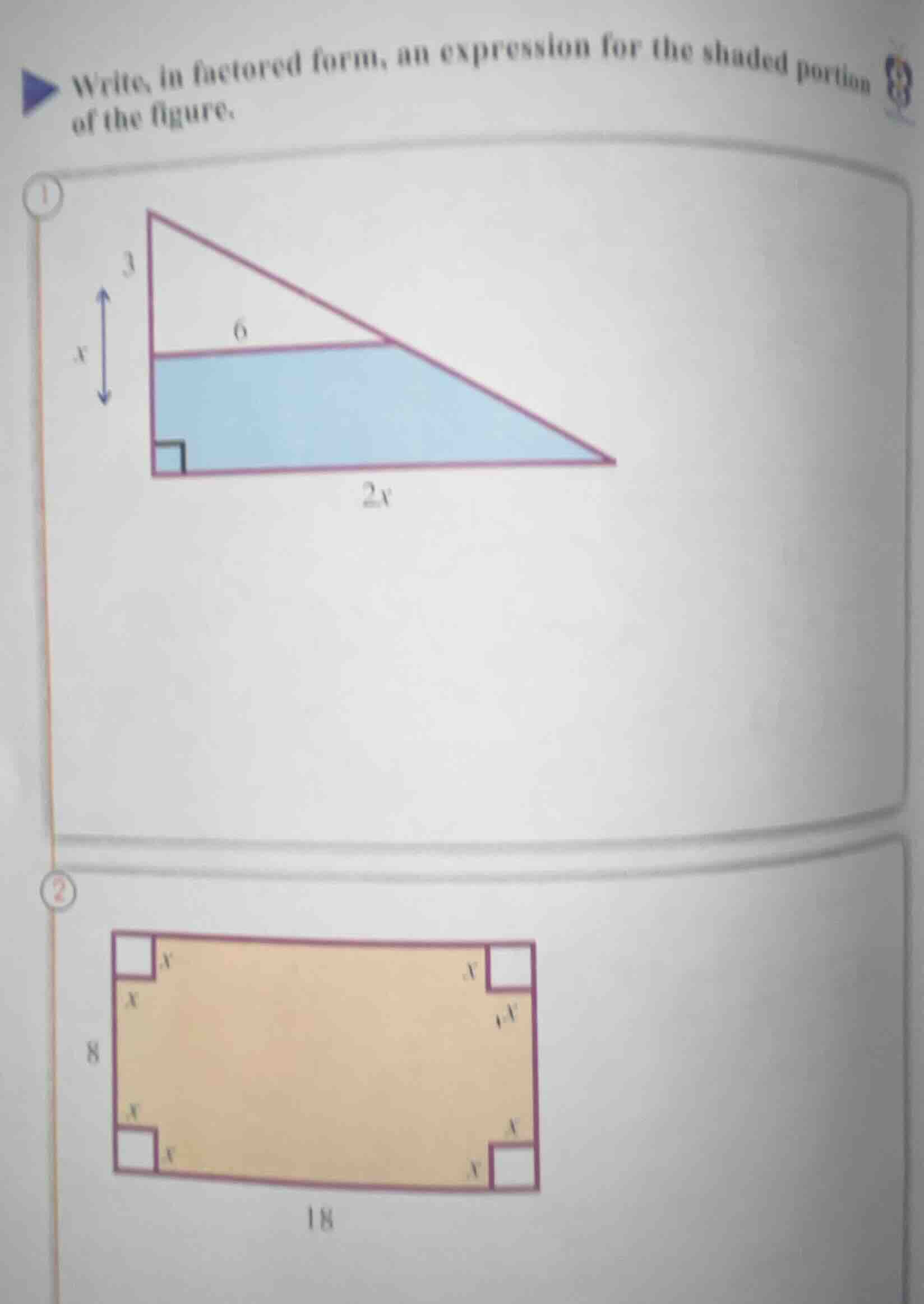
write, in factored form, an expression for the shaded portion of the figure.
1
triangle figure with height x, base 2x, smaller triangle height 3, base 6
2
rectangle figure with height 8, length 18, and x-sized squares at corners
Problem 1 (Triangle Shaded Region)
Step 1: Find area of large triangle
The area of a triangle is $\frac{1}{2} \times base \times height$. For the large triangle, base is $2x$ and height is $x$, so area is $\frac{1}{2} \times 2x \times x = x^2$.
Step 2: Find area of small triangle
For the small triangle, base is $6$ and height is $3$ (since the height of the small triangle is $x - (x - 3) = 3$? Wait, actually, the small triangle has base $6$ and height $3$ (from the diagram, the vertical segment is $3$ and the horizontal is $6$). So area is $\frac{1}{2} \times 6 \times 3 = 9$. Wait, no, maybe the triangles are similar. Let's check similarity. The large triangle has base $2x$ and height $x$, the small triangle has base $6$ and height $3$ (since $x - (x - 3) = 3$? Wait, maybe the height of the small triangle is $x - h$? No, better: the two triangles are similar because they are both right triangles and share the same angle. So the ratio of bases is $6:2x = 3:x$, and ratio of heights is $3:x$ (since the small triangle's height is $3$, large is $x$). So they are similar with ratio $3:x$. Then area of small triangle is $\frac{1}{2} \times 6 \times 3 = 9$, area of large is $\frac{1}{2} \times 2x \times x = x^2$. So shaded area is large area minus small area: $x^2 - 9$. Then factor: $x^2 - 9 = (x - 3)(x + 3)$. Wait, but maybe my initial assumption is wrong. Wait, the large triangle: base $2x$, height $x$, area $\frac{1}{2} \times 2x \times x = x^2$. Small triangle: base $6$, height $3$, area $\frac{1}{2} \times 6 \times 3 = 9$. So shaded area is $x^2 - 9 = (x - 3)(x + 3)$.
Wait, maybe another approach. The shaded region is a trapezoid. The formula for area of trapezoid is $\frac{1}{2} \times (a + b) \times h$, where $a$ and $b$ are the two parallel sides, and $h$ is the height between them. Here, $a = 6$, $b = 2x$, and $h = x - 3$ (since the total height is $x$, and the small triangle's height is $3$). So area is $\frac{1}{2} \times (6 + 2x) \times (x - 3) = \frac{1}{2} \times 2(x + 3) \times (x - 3) = (x + 3)(x - 3)$, which is the same as before. So factored form is $(x - 3)(x + 3)$ or $(x + 3)(x - 3)$.
Step 1: Find dimensions of shaded rectangle
The original rectangle has length $18$ and width $8$. Each corner has a square of side $x$, so we remove $2x$ from the length (since two squares on the length) and $2x$ from the width (two squares on the width). So the length of the shaded rectangle is $18 - 2x$, and the width is $8 - 2x$.
Step 2: Factor the expression
The area of the shaded region is $(18 - 2x)(8 - 2x)$. We can factor out a $2$ from each term: $2(9 - x) \times 2(4 - x) = 4(9 - x)(4 - x)$? Wait, no: $18 - 2x = 2(9 - x)$, $8 - 2x = 2(4 - x)$, so multiplying them: $2(9 - x) \times 2(4 - x) = 4(9 - x)(4 - x)$. Alternatively, factor out $2$ from both: $(18 - 2x)(8 - 2x) = 2(9 - x) \times 2(4 - x) = 4(9 - x)(4 - x)$, or factor as $2(9 - x) \times 2(4 - x) = 4(9 - x)(4 - x)$, or also $( -2x + 18)( -2x + 8) = 2(x - 9) \times 2(x - 4) = 4(x - 9)(x - 4)$, but usually we factor out the positive common factor. So $(18 - 2x)(8 - 2x) = 2(9 - x) \times 2(4 - x) = 4(9 - x)(4 - x)$, or factor out $2$ from each: $2(9 - x) \times 2(4 - x) = 4(9 - x)(4 - x)$. Alternatively, write as $4(x - 9)(x - 4)$ but that's with negative signs. The standard factored form would be $4(9 - x)(4 - x)$ or $4(x - 9)(x - 4)$, but let's check:
Original area of shaded: length is $18 - 2x$ (subtract $x$ from both ends), width is $8 - 2x$ (subtract $x$ from both ends). So area is $(18 - 2x)(8 - 2x) = 2(9 - x) \times 2(4 - x) = 4(9 - x)(4 - x)$. Yes, that's factored.

Snap & solve any problem in the app
Get step-by-step solutions on Sovi AI
Photo-based solutions with guided steps
Explore more problems and detailed explanations
$(x - 3)(x + 3)$