QUESTION IMAGE
Question
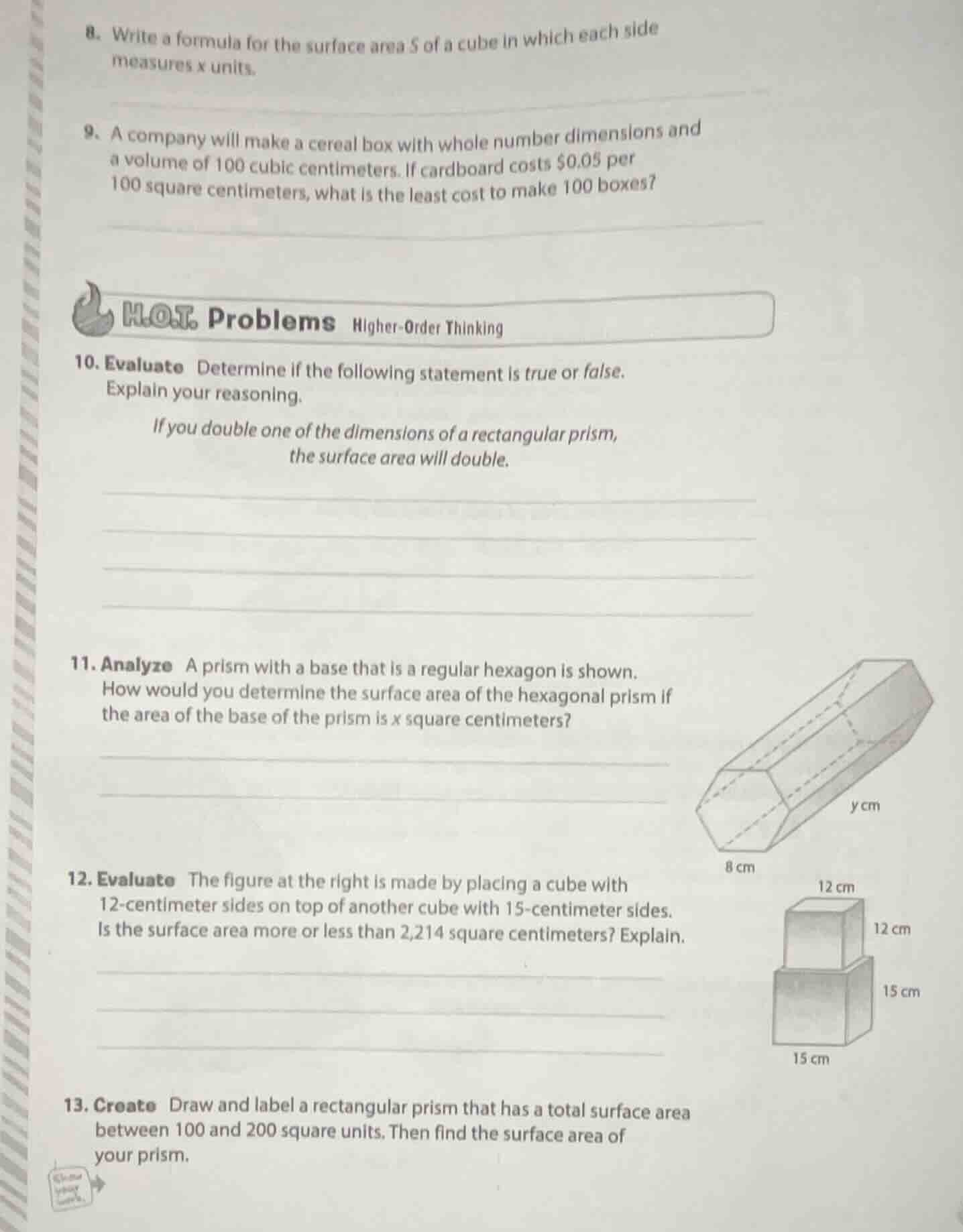
- write a formula for the surface area s of a cube in which each side measures x units.
- a company will make a cereal box with whole number dimensions and a volume of 100 cubic centimeters. if cardboard costs $0.05 per 100 square centimeters, what is the least cost to make 100 boxes?
h.o.t. problems higher - order thinking
- evaluate determine if the following statement is true or false. explain your reasoning.
if you double one of the dimensions of a rectangular prism, the surface area will double.
- analyze a prism with a base that is a regular hexagon is shown. how would you determine the surface area of the hexagonal prism if the area of the base of the prism is x square centimeters?
- evaluate the figure at the right is made by placing a cube with 12 - centimeter sides on top of another cube with 15 - centimeter sides. is the surface area more or less than 2,214 square centimeters? explain.
- create draw and label a rectangular prism that has a total surface area between 100 and 200 square units. then find the surface area of your prism.
Question 8
Step1: Recall the surface area of a cube
A cube has 6 square faces, and the area of one square face with side length \( x \) is \( x^2 \).
Step2: Calculate the total surface area
To find the total surface area \( S \) of the cube, we multiply the area of one face by 6. So the formula is \( S = 6x^2 \).
Step1: Recall the volume and surface area of a rectangular prism
The volume of a rectangular prism is \( V = l \times w \times h \), and the surface area is \( SA = 2(lw + lh + wh) \). We need to find whole - number dimensions \( l, w, h \) such that \( l\times w\times h=100 \) and the surface area is minimized.
First, factorize 100: \( 100 = 1\times1\times100=1\times2\times50 = 1\times4\times25=1\times5\times20 = 1\times10\times10=2\times2\times25 = 2\times5\times10=4\times5\times5\)
Step2: Calculate the surface area for each set of dimensions
- For \( l = 1,w = 1,h = 100 \): \( SA=2(1\times1 + 1\times100+1\times100)=2(1 + 100 + 100)=402\)
- For \( l = 1,w = 2,h = 50 \): \( SA=2(1\times2+1\times50 + 2\times50)=2(2 + 50+100)=304\)
- For \( l = 1,w = 4,h = 25 \): \( SA=2(1\times4 + 1\times25+4\times25)=2(4 + 25 + 100)=258\)
- For \( l = 1,w = 5,h = 20 \): \( SA=2(1\times5+1\times20 + 5\times20)=2(5 + 20+100)=250\)
- For \( l = 1,w = 10,h = 10 \): \( SA=2(1\times10+1\times10 + 10\times10)=2(10 + 10+100)=240\)
- For \( l = 2,w = 2,h = 25 \): \( SA=2(2\times2+2\times25 + 2\times25)=2(4 + 50+50)=208\)
- For \( l = 2,w = 5,h = 10 \): \( SA=2(2\times5+2\times10 + 5\times10)=2(10 + 20+50)=160\)
- For \( l = 4,w = 5,h = 5 \): \( SA=2(4\times5+4\times5 + 5\times5)=2(20 + 20+25)=130\)
The minimum surface area for one box is 130 square centimeters when the dimensions are \( 4\times5\times5 \).
Step3: Calculate the surface area for 100 boxes
The surface area for 100 boxes is \( 100\times130 = 13000\) square centimeters.
Step4: Calculate the cost
Cardboard costs \( \$0.05 \) per 100 square centimeters. The number of 100 - square - centimeter units in 13000 square centimeters is \( \frac{13000}{100}=130 \).
The cost is \( 130\times0.05=\$6.5\)
Step1: Recall the surface area formula of a rectangular prism
The surface area of a rectangular prism with length \( l \), width \( w \), and height \( h \) is \( SA=2(lw + lh+wh) \)
Step2: Double one dimension and calculate the new surface area
Let's double the length, so the new length is \( 2l \). The new surface area \( SA'=2((2l)w+(2l)h + wh)=2(2lw + 2lh+wh)=4lw + 4lh+2wh\)
The original surface area \( SA = 2lw+2lh + 2wh\)
Now, find the ratio of \( SA' \) to \( SA \):
\(\frac{SA'}{SA}=\frac{4lw + 4lh+2wh}{2lw + 2lh+2wh}\)
Let's take an example. Let \( l = 1,w = 1,h = 1 \)
Original surface area \( SA=2(1\times1 + 1\times1+1\times1)=6\)
Double the length: new \( l = 2 \), new surface area \( SA'=2(2\times1+2\times1 + 1\times1)=2(2 + 2+1)=10\)
\( 10
eq2\times6 \)
In general, when we double one dimension, say \( l \) to \( 2l \), the change in surface area is not a simple doubling because the cross - terms (like \( lw,lh,wh \)) do not all double. The surface area will increase, but not by a factor of 2.

Snap & solve any problem in the app
Get step-by-step solutions on Sovi AI
Photo-based solutions with guided steps
Explore more problems and detailed explanations
\( S = 6x^2 \)