QUESTION IMAGE
Question
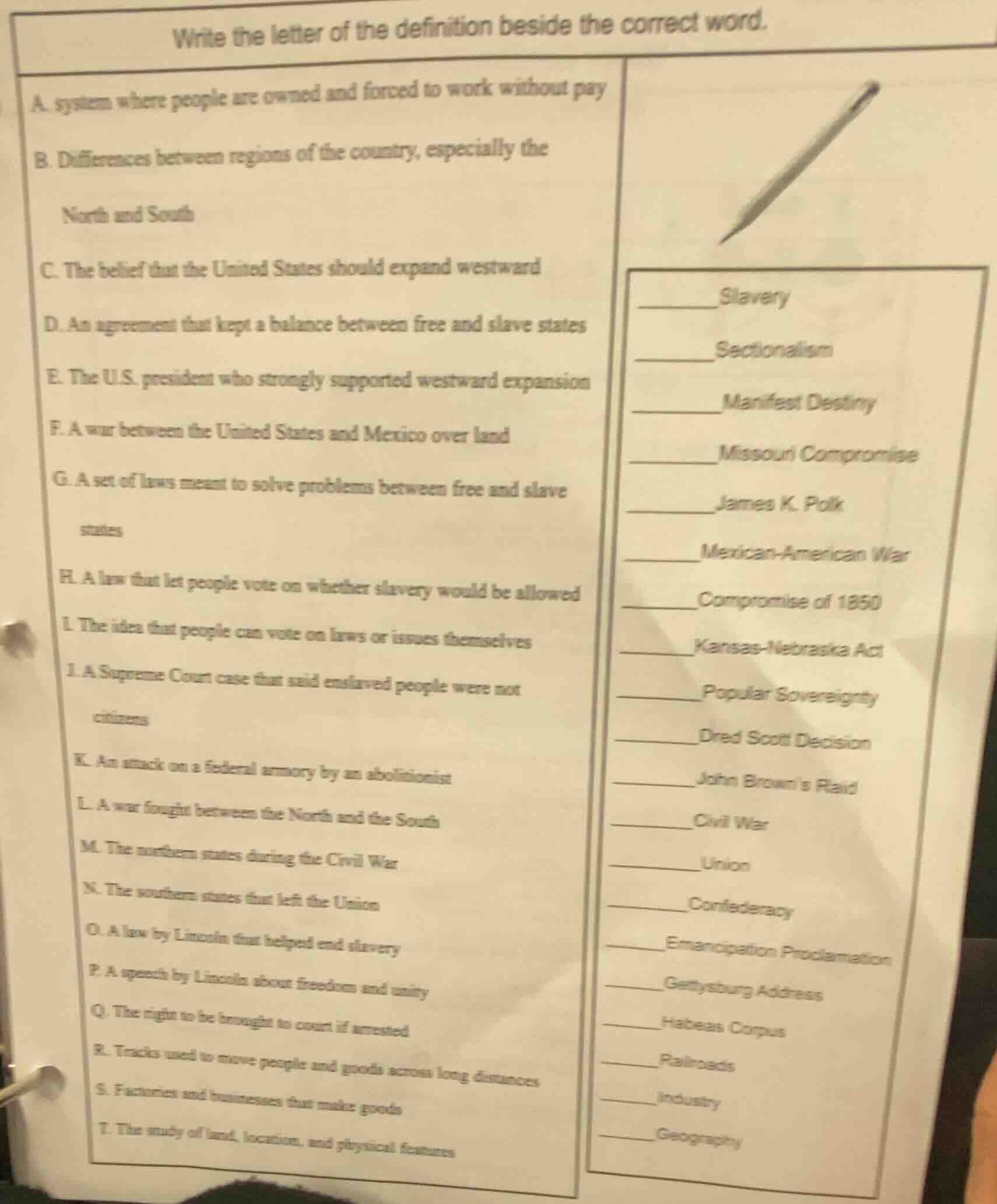
write the letter of the definition beside the correct word.
a. system where people are owned and forced to work without pay
b. differences between regions of the country, especially the
north and south
c. the belief that the united states should expand westward
d. an agreement that kept a balance between free and slave states
e. the u.s. president who strongly supported westward expansion
f. a war between the united states and mexico over land
g. a set of laws meant to solve problems between free and slave
states
h. a law that let people vote on whether slavery would be allowed
i. the idea that people can vote on laws or issues themselves
j. a supreme court case that said enslaved people were not
citizens
k. an attack on a federal armory by an abolitionist
l. a war fought between the north and the south
m. the northern states during the civil war
n. the southern states that left the union
o. a law by lincoln that helped end slavery
p. a speech by lincoln about freedom and unity
q. the right to be brought to court if arrested
r. tracks used to move people and goods across long distances
s. factories and businesses that make goods
t. the study of land, location, and physical features
______slavery
______sectionalism
______manifest destiny
______missouri compromise
______james k. polk
______mexican-american war
______compromise of 1850
______kansas-nebraska act
______popular sovereignty
______dred scott decision
______john browns raid
______civil war
______union
______confederacy
______emancipation proclamation
______gettysburg address
______habeas corpus
______railroads
______industry
______geography
Each term is matched to its corresponding definition based on U.S. history context:
- Slavery is defined as a system of forced, unpaid labor where people are owned.
- Sectionalism refers to regional differences, especially between the North and South.
- Manifest Destiny is the ideology of U.S. westward expansion.
- The Missouri Compromise was an agreement balancing free and slave states.
- James K. Polk was the president who supported westward expansion.
- The Mexican-American War was a territorial conflict between the U.S. and Mexico.
- The Compromise of 1850 was a set of laws resolving free/slave state tensions.
- The Kansas-Nebraska Act let voters decide on slavery in those territories.
- Popular Sovereignty is the idea that people vote on laws/issues directly.
- The Dred Scott Decision was a Supreme Court case ruling enslaved people were not citizens.
- John Brown's Raid was an abolitionist attack on a federal armory.
- The Civil War was the conflict between the North and South.
- The Union was the northern states during the Civil War.
- The Confederacy was the southern states that seceded from the Union.
- The Emancipation Proclamation was Lincoln's act aiding in ending slavery.
- The Gettysburg Address was Lincoln's speech about freedom and unity.
- Habeas Corpus is the right to be brought to court if arrested.
- Railroads are long-distance tracks for moving people and goods.
- Industry refers to factories and businesses that produce goods.
- Geography is the study of land, location, and physical features.

Snap & solve any problem in the app
Get step-by-step solutions on Sovi AI
Photo-based solutions with guided steps
Explore more problems and detailed explanations
A. Slavery
B. Sectionalism
C. Manifest Destiny
D. Missouri Compromise
E. James K. Polk
F. Mexican-American War
G. Compromise of 1850
H. Kansas-Nebraska Act
I. Popular Sovereignty
J. Dred Scott Decision
K. John Brown's Raid
L. Civil War
M. Union
N. Confederacy
O. Emancipation Proclamation
P. Gettysburg Address
Q. Habeas Corpus
R. Railroads
S. Industry
T. Geography