QUESTION IMAGE
Question
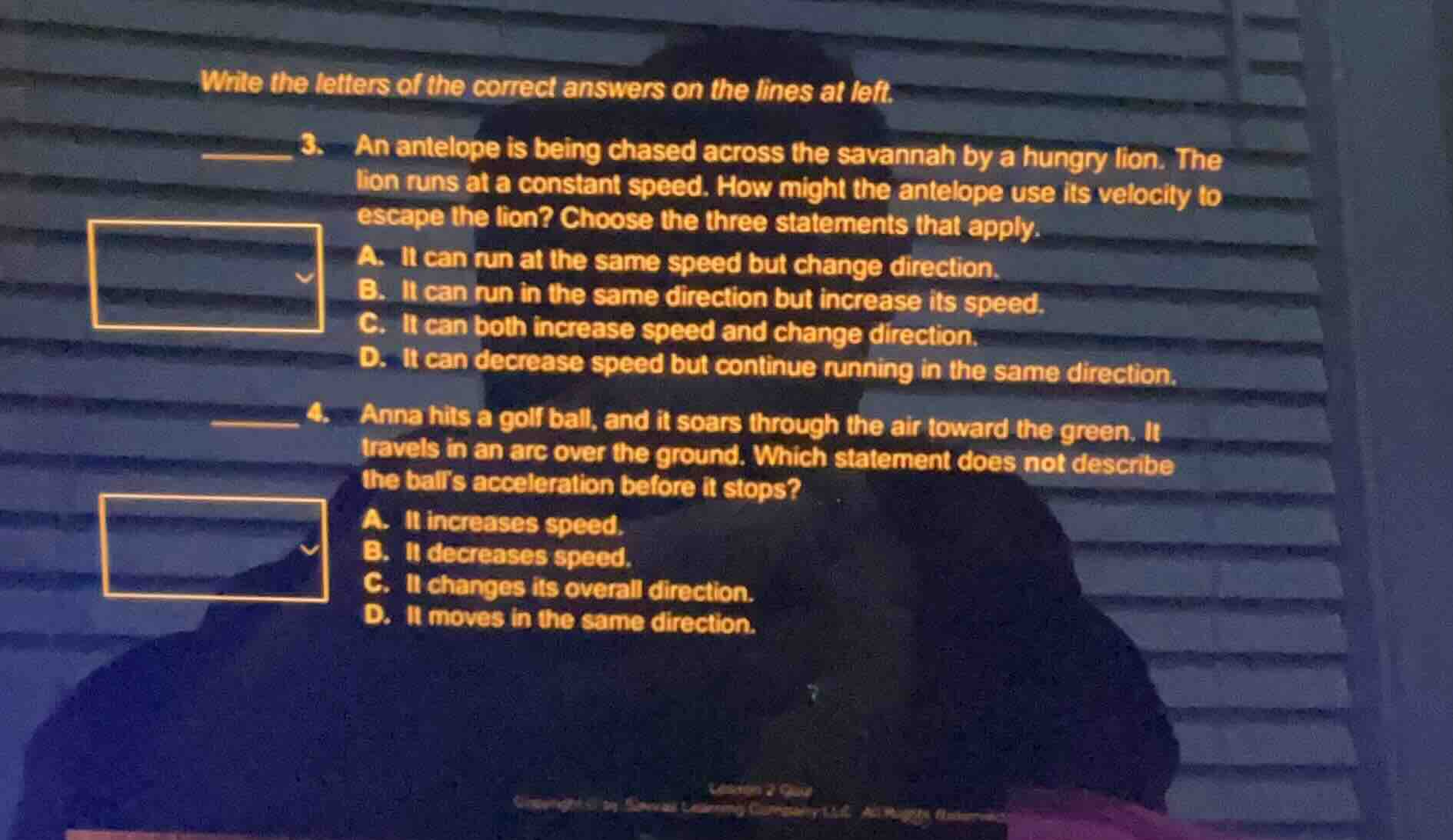
write the letters of the correct answers on the lines at left.
- an antelope is being chased across the savannah by a hungry lion. the lion runs at a constant speed. how might the antelope use its velocity to escape the lion? choose the three statements that apply.
a. it can run at the same speed but change direction.
b. it can run in the same direction but increase its speed.
c. it can both increase speed and change direction.
d. it can decrease speed but continue running in the same direction.
- anna hits a golf ball, and it soars through the air toward the green. it travels in an arc over the ground. which statement does not describe the ball’s acceleration before it stops?
a. it increases speed.
b. it decreases speed.
c. it changes its overall direction.
d. it moves in the same direction.
Question 3
To escape, the antelope can change direction (A, as lion's path is predictable), increase speed (B, outpace lion), or both (C, combine speed and direction changes). Decreasing speed (D) would not help escape.
A golf ball in flight decelerates (B) due to air resistance and gravity, changes direction (C) in its arc, and doesn't move in the same direction (D is incorrect as it arcs). It does not increase speed (A) after being hit (gravity and air resistance slow it, then speed up on descent? No, overall, after being hit, initial speed decreases then may increase on way down, but the question is about before stopping. Wait, actually, when hit, it slows (due to air), then as it falls, gravity accelerates it, but the options: "does not describe". The ball's acceleration: it decreases speed (B is true), changes direction (C is true), moves in same direction? No, it arcs (so direction changes, so D is not describing acceleration? Wait, no. Wait, acceleration is change in velocity (speed or direction). The ball: after being hit, it slows (deceleration, so B is a description of acceleration effect), changes direction (C is acceleration), and "increases speed" – when does it increase speed? On the way down, gravity accelerates it, so speed can increase. But the option A: "It increases speed" – is that a description? Wait, the question is which statement does NOT describe the ball’s acceleration before it stops. Let's re-express:
- A: Increases speed – when falling, speed increases (due to gravity), so this is a description of acceleration (since speed changes, so acceleration is present).
- B: Decreases speed – when rising, air resistance and gravity slow it, so this is a description.
- C: Changes direction – it’s moving in an arc, so direction changes (acceleration).
- D: Moves in the same direction – it’s moving in an arc, so direction changes, so "moves in same direction" does not describe its motion (and thus, since acceleration involves direction change, D is the one that does not describe acceleration? Wait, no. Wait, the question is about acceleration. The ball’s acceleration: does A (increases speed) describe acceleration? Yes, because increasing speed is a change in velocity (acceleration). B: decreasing speed is also acceleration. C: changing direction is acceleration. D: "moves in the same direction" – this is about velocity direction, not acceleration. Wait, the question is "Which statement does not describe the ball’s acceleration before it stops?" So we need to find which statement is not a description of its acceleration.
Wait, the ball’s motion: after being hit, it goes up (decelerating, speed decreases), then down (accelerating, speed increases). So during its flight, it both decreases and increases speed (so A and B are both descriptions of acceleration at different times). It changes direction (C is a description). "Moves in the same direction" (D) – the ball is moving in an arc, so its direction is changing, so "moves in the same direction" is not true (so D is a statement about velocity direction, not acceleration, but the question is about acceleration. Wait, maybe I misread. Let's check the options again.
Wait, the options are about the ball’s acceleration. So:
- A: It increases speed – this is a result of acceleration (when falling, gravity accelerates it, so speed increases). So this is a description of acceleration’s effect.
- B: It decreases speed – when rising, acceleration (deceleration) causes speed to decrease. So this is a description.
- C: It changes its overall direction – since it’s moving in an arc, direction changes (acceleration). So this is a description.
- D: It moves in the same direction – the ball is moving in an arc, so direction changes, so "moves in the same direction" is not a true statement about i…
The golf ball moves in an arc (so direction changes, eliminating C). It slows (B, due to air) and speeds up (A, due to gravity) during flight. "Moves in the same direction" (D) is false (direction changes), so it does not describe the ball’s acceleration (as acceleration involves direction change, and D implies no direction change).

Snap & solve any problem in the app
Get step-by-step solutions on Sovi AI
Photo-based solutions with guided steps
Explore more problems and detailed explanations
A. It can run at the same speed but change direction, B. It can run in the same direction but increase its speed, C. It can both increase speed and change direction