QUESTION IMAGE
Question
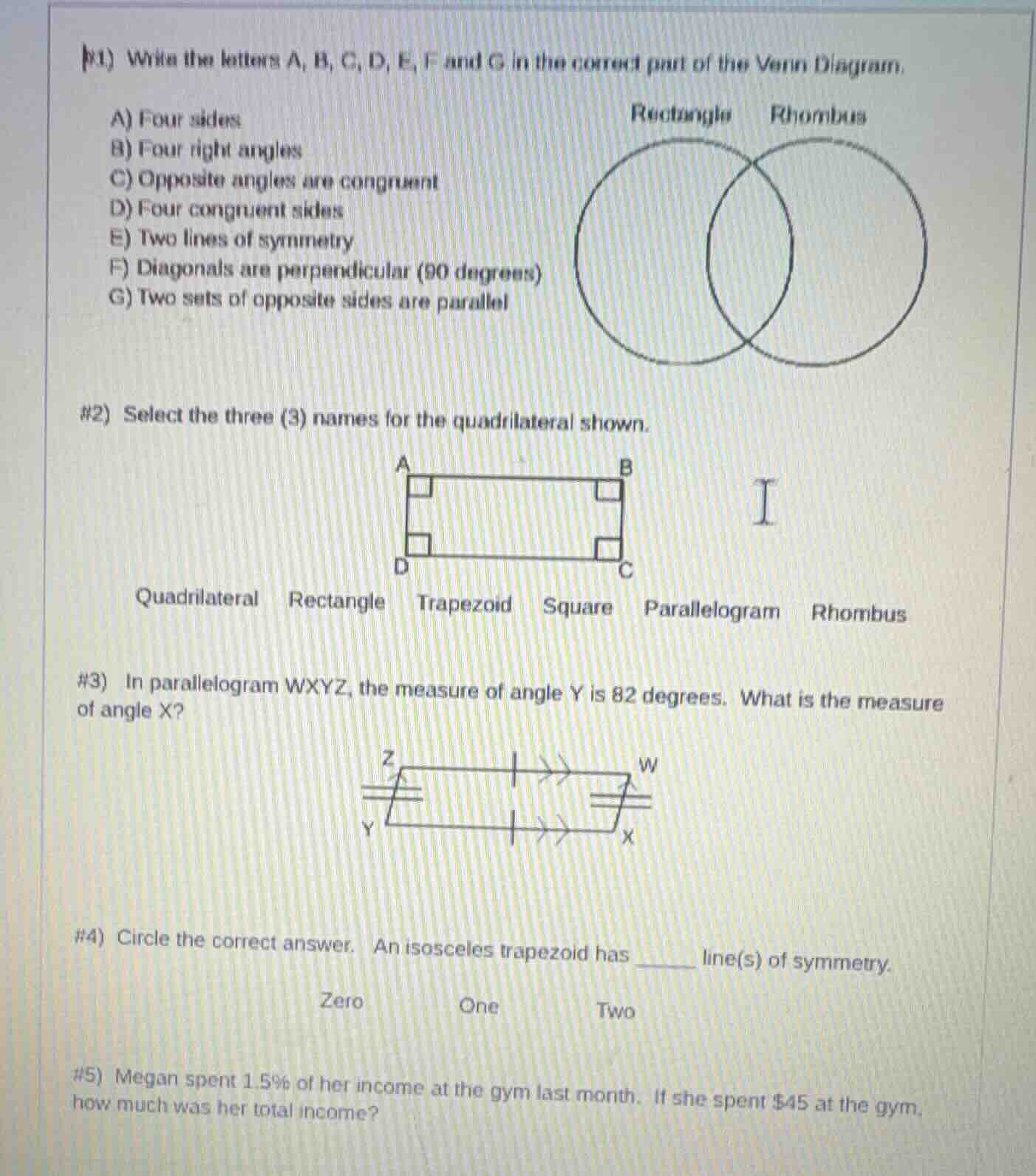
#1) write the letters a, b, c, d, e, f and g in the correct part of the venn diagram.
a) four sides
b) four right angles
c) opposite angles are congruent
d) four congruent sides
e) two lines of symmetry
f) diagonals are perpendicular (90 degrees)
g) two sets of opposite sides are parallel
#2) select the three (3) names for the quadrilateral shown.
quadrilateral rectangle trapezoid square parallelogram rhombus
#3) in parallelogram wxyz, the measure of angle y is 82 degrees. what is the measure of angle x?
#4) circle the correct answer. an isosceles trapezoid has _____ line(s) of symmetry.
zero one two
#5) megan spent 1.5% of her income at the gym last month. if she spent $45 at the gym, how much was her total income?
#1 Solution:
To solve this, we analyze the properties of rectangles, rhombuses, and their intersection (squares, since a square is both a rectangle and a rhombus):
- Only Rectangle (not Rhombus): Properties unique to rectangles (not shared by all rhombuses):
- B) Four right angles (rhombuses don’t have to have right angles).
- E) Two lines of symmetry (rhombuses have 2 or 4, but rectangles have 2; the intersection (square) has 4, so E is only for rectangles).
- Only Rhombus (not Rectangle): Properties unique to rhombuses (not shared by all rectangles):
- D) Four congruent sides (rectangles have opposite sides congruent, not all four sides unless it’s a square).
- F) Diagonals are perpendicular (rectangles’ diagonals are equal but not necessarily perpendicular unless it’s a square).
- Intersection (Rectangle and Rhombus, i.e., Square): Properties shared by both:
- A) Four sides (both are quadrilaterals with four sides).
- C) Opposite angles are congruent (both rectangles and rhombuses have this property).
- G) Two sets of opposite sides are parallel (both are parallelograms, so this holds).
- **Outside Both (but still quadrilaterals? Wait, no—rectangles and rhombuses are both parallelograms, so all these properties relate to them. Wait, actually, “four sides” (A) is a property of all quadrilaterals, but since the Venn is for Rectangle and Rhombus, A is in the intersection? Wait, no—rectangles and rhombuses are both quadrilaterals with four sides, so A is in the intersection. Let’s recheck:
- Rectangle only: B (right angles), E (2 lines of symmetry, since squares have 4, so E is for non - square rectangles).
- Rhombus only: D (4 congruent sides, non - square rhombuses), F (perpendicular diagonals, non - square rhombuses).
- Intersection (square): A (4 sides), C (opposite angles congruent), G (opposite sides parallel), and also the shared properties. Wait, actually:
- Rectangle properties: 4 right angles (B), 2 lines of symmetry (E), opposite sides parallel (G), opposite angles congruent (C), 4 sides (A). But rhombuses have G, C, A too. So:
- Only Rectangle: B, E
- Only Rhombus: D, F
- Intersection (both): A, C, G
#2 Solution:
The quadrilateral has four right angles and opposite sides parallel (it’s a rectangle). Let’s analyze the options:
- Quadrilateral: Any 4 - sided figure, so this applies.
- Rectangle: It has four right angles and opposite sides parallel, so this applies.
- Trapezoid: A trapezoid has at least one pair of parallel sides. This figure has two pairs, so it is a trapezoid (inclusive definition).
- Square: A square has four right angles and four congruent sides. The figure doesn’t show all sides congruent, so not a square.
- Parallelogram: It has two pairs of parallel sides, so this applies.
- Rhombus: A rhombus has four congruent sides, which this figure doesn’t show, so no.
Wait, the problem says “select the three names”. Let’s check again:
The figure is a rectangle (four right angles, opposite sides parallel). So:
- Quadrilateral (all 4 - sided figures are quadrilaterals).
- Rectangle (matches the right angles and parallel sides).
- Parallelogram (since it has two pairs of parallel sides).
(Note: A trapezoid, under the inclusive definition, is a quadrilateral with at least one pair of parallel sides, so it also applies, but the problem asks for three. Let’s confirm: the figure has four right angles, so it’s a rectangle, which is a parallelogram and a quadrilateral. So the three names are Quadrilateral, Rectangle, Para…
Step 1: Recall properties of a parallelogram
In a parallelogram, consecutive angles are supplementary (they add up to \(180^\circ\)). In parallelogram \(WXYZ\), \(\angle Y\) and \(\angle X\) are consecutive angles (since \(WX\parallel YZ\) and \(XY\) is a transversal).
Step 2: Calculate the measure of \(\angle X\)
We know that the sum of consecutive angles in a parallelogram is \(180^\circ\). So, if \(m\angle Y = 82^\circ\), then \(m\angle X=180^\circ - m\angle Y\).
Substitute \(m\angle Y = 82^\circ\) into the formula: \(m\angle X = 180^\circ-82^\circ = 98^\circ\).
An isosceles trapezoid has one line of symmetry. This line of symmetry is the vertical line (or horizontal, depending on orientation) that passes through the midpoints of the non - parallel sides, dividing the trapezoid into two congruent halves. It does not have zero or two lines of symmetry (zero would mean no symmetry, two would be more than an isosceles trapezoid has).
Step 1: Define the relationship
Let \(x\) be Megan’s total income. We know that \(1.5\%\) of \(x\) is equal to \(\$45\). Mathematically, this can be written as the equation \(0.015x = 45\) (since \(1.5\%=\frac{1.5}{100}=0.015\)).
Step 2: Solve for \(x\)
To find \(x\), we divide both sides of the equation \(0.015x = 45\) by \(0.015\). So, \(x=\frac{45}{0.015}\).
Calculate \(\frac{45}{0.015}\): \(45\div0.015 = 3000\).

Snap & solve any problem in the app
Get step-by-step solutions on Sovi AI
Photo-based solutions with guided steps
Explore more problems and detailed explanations
The measure of angle \(X\) is \(98^\circ\).