QUESTION IMAGE
Question
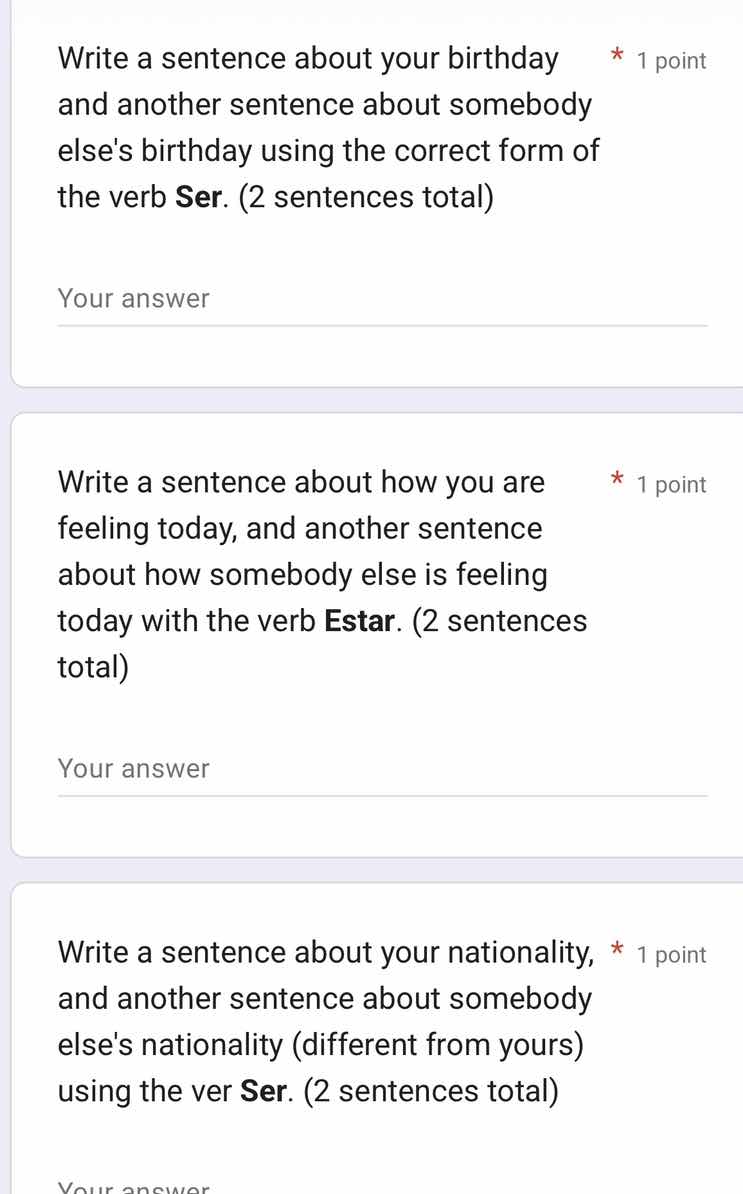
write a sentence about your birthday and another sentence about somebody elses birthday using the correct form of the verb ser. (2 sentences total)
your answer
write a sentence about how you are feeling today, and another sentence about how somebody else is feeling today with the verb estar. (2 sentences total)
your answer
write a sentence about your nationality, and another sentence about somebody elses nationality (different from yours) using the ver ser. (2 sentences total)
your answer
First Question (Using "Ser" for Birthdays)
For the first part, we use "ser" to talk about permanent or inherent characteristics like birthdays. The first sentence is about my birthday, using "soy" (first - person singular of "ser") with the date. The second sentence is about someone else's birthday, using "es" (third - person singular of "ser") with the person's name and date.
"Estar" is used for temporary states like feelings. For the first sentence, we use "estoy" (first - person singular of "estar") to describe my current feeling. For the second sentence, we use "está" (third - person singular of "estar") to describe someone else's current feeling.
Nationality is a permanent characteristic, so we use "ser". For the first sentence, we use "soy" (first - person singular of "ser") to state my nationality. For the second sentence, we use "es" (third - person singular of "ser") to state someone else's nationality.

Snap & solve any problem in the app
Get step-by-step solutions on Sovi AI
Photo-based solutions with guided steps
Explore more problems and detailed explanations
My birthday: Mi cumpleaños es el 15 de mayo. (I use "es" because the birthday is a permanent characteristic. The structure is "Mi cumpleaños + ser (es) + date".)
Someone else's birthday: El cumpleaños de María es el 20 de julio. (Here, "es" is used as María's birthday is a permanent fact. The structure is "El cumpleaños de [name] + ser (es) + date".)