QUESTION IMAGE
Question
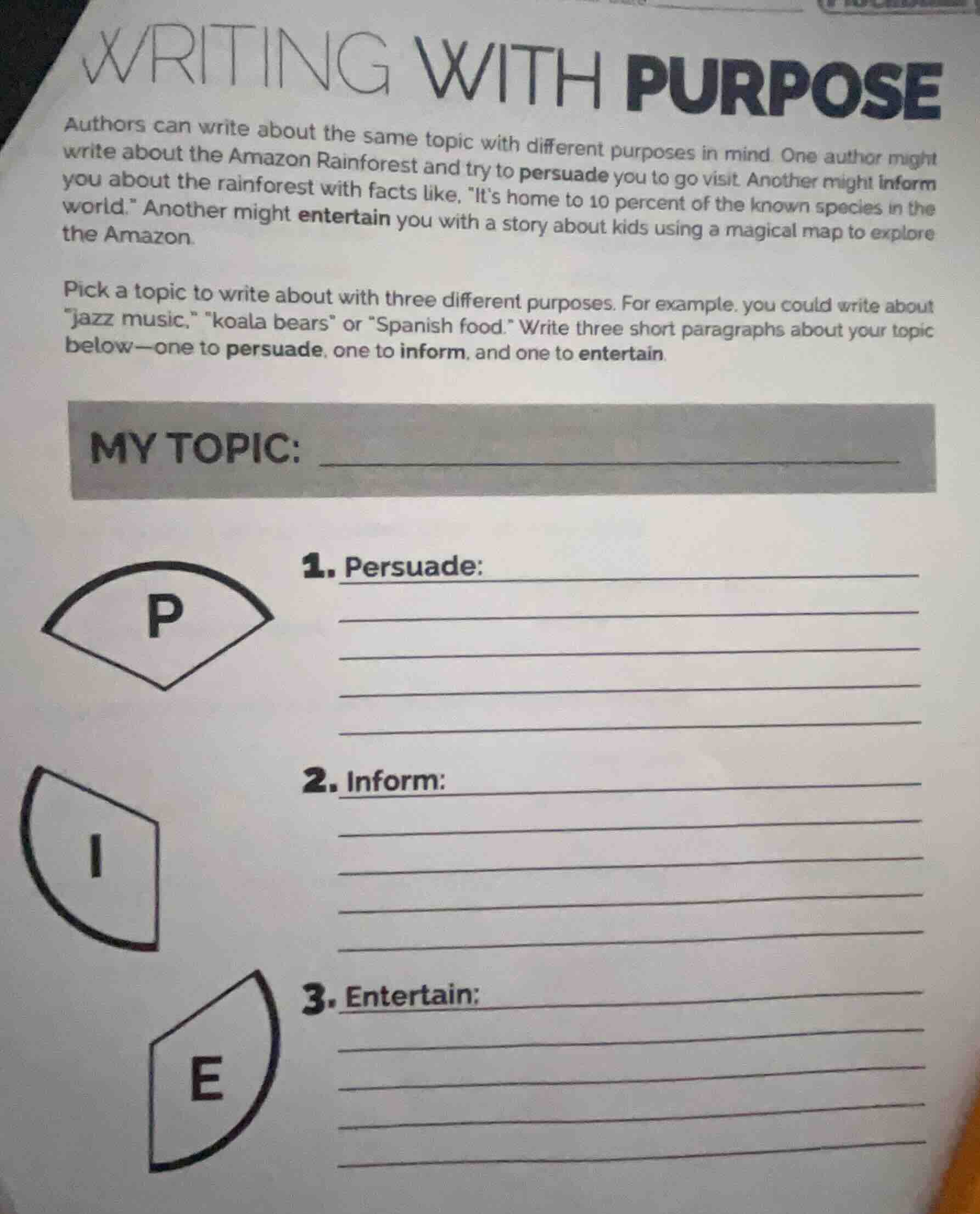
writing with purpose
authors can write about the same topic with different purposes in mind. one author might write about the amazon rainforest and try to persuade you to go visit. another might inform you about the rainforest with facts like, \its home to 10 percent of the known species in the world.\ another might entertain you with a story about kids using a magical map to explore the amazon.
pick a topic to write about with three different purposes. for example, you could write about \jazz music,\ \koala bears\ or \spanish food.\ write three short paragraphs about your topic below—one to persuade, one to inform, and one to entertain.
my topic:
- persuade:
- inform:
- entertain:
First, select a clear, accessible topic (here, "urban community gardens"). For the persuasive paragraph, focus on convincing readers to support/join, using emotional and practical appeals. For the informative paragraph, share factual details about the topic's scope, benefits, and structure. For the entertaining paragraph, craft a short, engaging story with a relatable character and light, whimsical details tied to the topic.

Snap & solve any problem in the app
Get step-by-step solutions on Sovi AI
Photo-based solutions with guided steps
Explore more problems and detailed explanations
MY TOPIC: Urban Community Gardens
- Persuade:
If you’ve ever felt disconnected from where your food comes from or craved a way to bond with your neighbors, urban community gardens are the perfect solution. By joining or supporting a local community garden, you’ll not only grow fresh, chemical-free produce for yourself and your family, but you’ll also help reduce neighborhood blight, lower local carbon footprints, and build a tight-knit network of people who care about your area. Skip the overpriced, wilted grocery store greens—invest in a space that feeds both your body and your community; visit your city’s parks department website to sign up today.
- Inform:
Urban community gardens are shared plots of land, often on repurposed vacant lots in city centers, where local residents grow fruits, vegetables, herbs, and flowers. According to the American Community Gardening Association, there are over 10,000 registered community gardens in the U.S., with many more unregistered sites. These gardens typically operate on a volunteer basis, with participants paying small annual fees to cover tools, soil, and water costs. Beyond food production, they also serve as stormwater management hubs, reducing runoff by absorbing rainwater through plant roots and mulch, and provide educational opportunities for local schools to teach students about botany and nutrition.
- Entertain:
Last Saturday, 10-year-old Lila snuck her pet hedgehog, Spike, into the Maple Street Community Garden, convinced he’d love munching on the dill she’d been tending for weeks. What she didn’t expect was for Spike to dart under a tomato trellis and knock over a stack of terracotta pots, sending a cloud of soil into the face of Mr. Henderson, the garden’s grumpy but well-meaning caretaker. Instead of scolding her, though, Mr. Henderson burst out laughing when Spike popped his head out of a sunflower, covered in dirt, and took a tiny bite out of a fallen cherry tomato. By the end of the afternoon, Lila and Mr. Henderson were planting a patch of hedgehog-safe clover, and Spike had earned the title of the garden’s official "produce taste-tester."