QUESTION IMAGE
Question
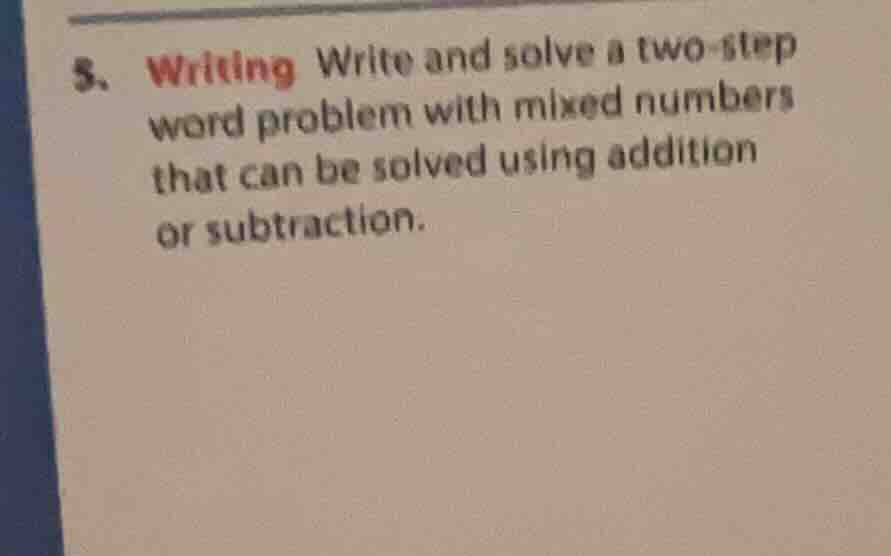
- writing write and solve a two - step word problem with mixed numbers that can be solved using addition or subtraction.
Step 1: Create the Word Problem
Let's consider a scenario with baking. Suppose: "John is making a cake. He needs \( 2\frac{1}{2} \) cups of flour for the cake batter and \( 1\frac{1}{4} \) cups of flour for the frosting. He already has \( 3\frac{3}{4} \) cups of flour. Does he have enough flour? If not, how much more does he need? If yes, how much is left?"
Step 2: Calculate Total Flour Needed
First, we need to find the total amount of flour John needs. This is the sum of the flour for the batter and the flour for the frosting.
\[
2\frac{1}{2}+ 1\frac{1}{4}
\]
Convert the mixed numbers to improper fractions: \( 2\frac{1}{2}=\frac{5}{2} \) and \( 1\frac{1}{4}=\frac{5}{4} \).
Find a common denominator, which is 4. So \( \frac{5}{2}=\frac{10}{4} \).
Now add: \( \frac{10}{4}+\frac{5}{4}=\frac{15}{4}=3\frac{3}{4} \) cups.
Step 3: Compare with Available Flour
John has \( 3\frac{3}{4} \) cups of flour. The total flour needed is also \( 3\frac{3}{4} \) cups.
To find out how much is left (or how much more is needed), we subtract the total needed from the available:
\[
3\frac{3}{4}-3\frac{3}{4} = 0
\]
So, John has exactly enough flour, and there is 0 cups left.
(Note: We could also create a problem where subtraction is more prominent. For example: "Sara has a rope that is \( 5\frac{1}{3} \) meters long. She cuts off a piece that is \( 1\frac{1}{2} \) meters long to use for a project. Then she cuts off another piece that is \( 2\frac{1}{6} \) meters long. How long is the remaining rope?"
Step 1: Calculate Total Length Cut Off
\[
1\frac{1}{2}+2\frac{1}{6}
\]
Convert to improper fractions: \( 1\frac{1}{2}=\frac{3}{2} \), \( 2\frac{1}{6}=\frac{13}{6} \)
Common denominator is 6: \( \frac{3}{2}=\frac{9}{6} \)
Add: \( \frac{9}{6}+\frac{13}{6}=\frac{22}{6}=3\frac{2}{3} \) meters.
Step 2: Subtract from Original Length
\[
5\frac{1}{3}-3\frac{2}{3}
\]
Convert \( 5\frac{1}{3} \) to \( 4\frac{4}{3} \) (borrowing 1 from the whole number part to make the fraction part larger)
Then subtract: \( 4\frac{4}{3}-3\frac{2}{3}=1\frac{2}{3} \) meters.
So the remaining rope is \( 1\frac{2}{3} \) meters long.)
For the first problem we created, the answer is that John has exactly enough flour, with 0 cups left. For the second problem, the remaining rope is \( 1\frac{2}{3} \) meters long.

Snap & solve any problem in the app
Get step-by-step solutions on Sovi AI
Photo-based solutions with guided steps
Explore more problems and detailed explanations
Step 1: Create the Word Problem
Let's consider a scenario with baking. Suppose: "John is making a cake. He needs \( 2\frac{1}{2} \) cups of flour for the cake batter and \( 1\frac{1}{4} \) cups of flour for the frosting. He already has \( 3\frac{3}{4} \) cups of flour. Does he have enough flour? If not, how much more does he need? If yes, how much is left?"
Step 2: Calculate Total Flour Needed
First, we need to find the total amount of flour John needs. This is the sum of the flour for the batter and the flour for the frosting.
\[
2\frac{1}{2}+ 1\frac{1}{4}
\]
Convert the mixed numbers to improper fractions: \( 2\frac{1}{2}=\frac{5}{2} \) and \( 1\frac{1}{4}=\frac{5}{4} \).
Find a common denominator, which is 4. So \( \frac{5}{2}=\frac{10}{4} \).
Now add: \( \frac{10}{4}+\frac{5}{4}=\frac{15}{4}=3\frac{3}{4} \) cups.
Step 3: Compare with Available Flour
John has \( 3\frac{3}{4} \) cups of flour. The total flour needed is also \( 3\frac{3}{4} \) cups.
To find out how much is left (or how much more is needed), we subtract the total needed from the available:
\[
3\frac{3}{4}-3\frac{3}{4} = 0
\]
So, John has exactly enough flour, and there is 0 cups left.
(Note: We could also create a problem where subtraction is more prominent. For example: "Sara has a rope that is \( 5\frac{1}{3} \) meters long. She cuts off a piece that is \( 1\frac{1}{2} \) meters long to use for a project. Then she cuts off another piece that is \( 2\frac{1}{6} \) meters long. How long is the remaining rope?"
Step 1: Calculate Total Length Cut Off
\[
1\frac{1}{2}+2\frac{1}{6}
\]
Convert to improper fractions: \( 1\frac{1}{2}=\frac{3}{2} \), \( 2\frac{1}{6}=\frac{13}{6} \)
Common denominator is 6: \( \frac{3}{2}=\frac{9}{6} \)
Add: \( \frac{9}{6}+\frac{13}{6}=\frac{22}{6}=3\frac{2}{3} \) meters.
Step 2: Subtract from Original Length
\[
5\frac{1}{3}-3\frac{2}{3}
\]
Convert \( 5\frac{1}{3} \) to \( 4\frac{4}{3} \) (borrowing 1 from the whole number part to make the fraction part larger)
Then subtract: \( 4\frac{4}{3}-3\frac{2}{3}=1\frac{2}{3} \) meters.
So the remaining rope is \( 1\frac{2}{3} \) meters long.)
For the first problem we created, the answer is that John has exactly enough flour, with 0 cups left. For the second problem, the remaining rope is \( 1\frac{2}{3} \) meters long.