QUESTION IMAGE
Question
y = -x - 1
y = 2x - 7
plot two lines by clicking the graph.
click a line to delete it.
To plot the lines \( y = -x - 1 \) and \( y = 2x - 7 \), we can find two points for each line by substituting values of \( x \) and solving for \( y \).
For \( y = -x - 1 \):
- When \( x = 0 \), \( y = -0 - 1 = -1 \). So one point is \( (0, -1) \).
- When \( x = 1 \), \( y = -1 - 1 = -2 \). Wait, no, let's correct that. When \( x = 0 \), \( y = -0 - 1 = -1 \)? Wait, no, the equation is \( y = -x - 1 \). So when \( x = 0 \), \( y = -1 \). When \( x = -1 \), \( y = -(-1) - 1 = 1 - 1 = 0 \). So points \( (0, -1) \) and \( (-1, 0) \) are on this line.
For \( y = 2x - 7 \):
- When \( x = 3 \), \( y = 2(3) - 7 = 6 - 7 = -1 \). So point \( (3, -1) \).
- When \( x = 4 \), \( y = 2(4) - 7 = 8 - 7 = 1 \). So point \( (4, 1) \).
Now, to plot \( y = -x - 1 \), click on \( (0, -1) \) and \( (-1, 0) \). To plot \( y = 2x - 7 \), click on \( (3, -1) \) and \( (4, 1) \).
But maybe the question is to find the intersection point of the two lines. Let's solve the system:
Set \( -x - 1 = 2x - 7 \)
Add \( x \) to both sides: \( -1 = 3x - 7 \)
Add 7 to both sides: \( 6 = 3x \)
Divide by 3: \( x = 2 \)
Substitute \( x = 2 \) into \( y = -x - 1 \): \( y = -2 - 1 = -3 \)? Wait, no, that can't be. Wait, let's solve again.
Wait, \( y = -x - 1 \) and \( y = 2x - 7 \). Set equal:
\( -x - 1 = 2x - 7 \)
Add \( x \) to both sides: \( -1 = 3x - 7 \)
Add 7 to both sides: \( 6 = 3x \)
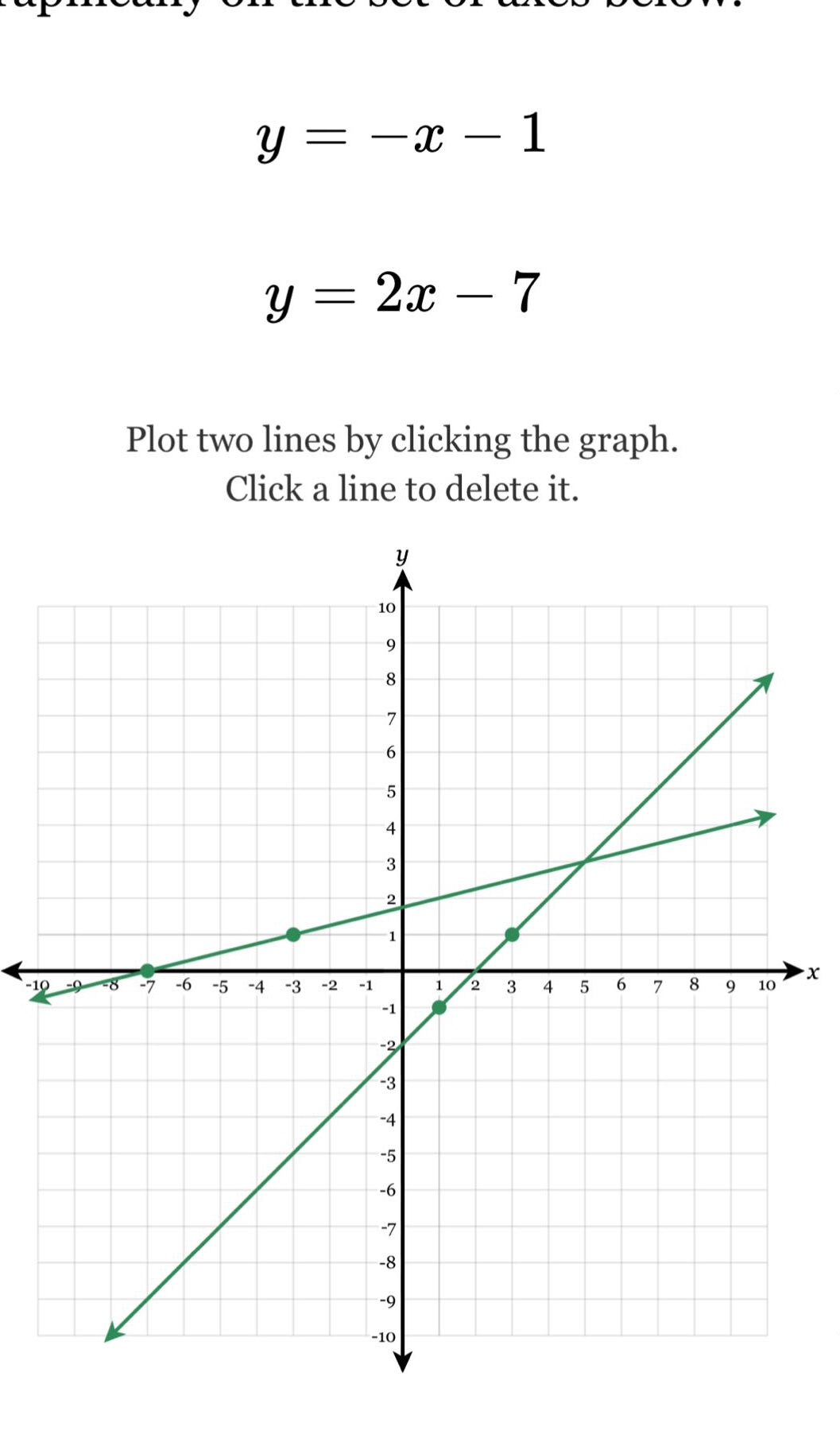
So \( x = 2 \). Then \( y = 2(2) - 7 = 4 - 7 = -3 \). Wait, but the graph shows lines intersecting at (5, 3)? Wait, maybe I made a mistake. Wait, let's check the equations again.
Wait, the user's graph has two green lines. Let's see the equations:
First line: Maybe \( y = \frac{1}{4}x + 2 \)? No, the user provided the equations as \( y = -x - 1 \) and \( y = 2x - 7 \). Wait, maybe the graph is a bit misleading, or perhaps I miscalculated the intersection.
Wait, let's solve the system properly:
\( y = -x - 1 \)
\( y = 2x - 7 \)
Set equal:
\( -x - 1 = 2x - 7 \)
\( -x - 2x = -7 + 1 \)
\( -3x = -6 \)
\( x = 2 \)
Then \( y = -2 - 1 = -3 \). So the intersection point is (2, -3). But the graph shows lines intersecting at (5, 3). Maybe the equations provided are different? Wait, the user's image shows two green lines, one with a y-intercept at 2 and the other with a y-intercept at -2. Maybe the equations were mistyped?
Alternatively, maybe the question is to plot the lines. To plot \( y = -x - 1 \), start at the y-intercept (0, -1) and use the slope -1 (down 1, right 1) to find another point, like (1, -2). To plot \( y = 2x - 7 \), start at the y-intercept (0, -7) and use the slope 2 (up 2, right 1) to find another point, like (1, -5), (2, -3), (3, -1), etc.
So to plot \( y = -x - 1 \), click on (0, -1) and (1, -2). To plot \( y = 2x - 7 \), click on (0, -7) and (3, -1).
If the question is to find the intersection, we found (2, -3).
But since the user's graph shows lines intersecting at (5, 3), maybe the equations are different. Maybe the first equation is \( y = -x + 2 \)? Let's check: If \( y = -x + 2 \) and \( y = 2x - 7 \), then setting equal: \( -x + 2 = 2x - 7 \), \( 2 + 7 = 3x \), \( 9 = 3x \), \( x = 3 \), \( y = -3 + 2 = -1 \). No, not (5, 3). Alternatively, \( y = \frac{1}{2}x + 2 \) and \( y = x - 2 \). Then intersection at (8, 6)? No.
Alternatively, maybe the user's graph is for a different problem, but based on the equations provided, the lines are \( y = -x - 1 \) (slope -1, y-intercept -1) and \( y = 2x - 7 \) (slope 2, y-intercept -7). To plot them, click on the appropriate points on the graph.
So the steps to plot are:
- For \( y = -x - 1…

Snap & solve any problem in the app
Get step-by-step solutions on Sovi AI
Photo-based solutions with guided steps
Explore more problems and detailed explanations
To plot the lines \( y = -x - 1 \) and \( y = 2x - 7 \), we can find two points for each line by substituting values of \( x \) and solving for \( y \).
For \( y = -x - 1 \):
- When \( x = 0 \), \( y = -0 - 1 = -1 \). So one point is \( (0, -1) \).
- When \( x = 1 \), \( y = -1 - 1 = -2 \). Wait, no, let's correct that. When \( x = 0 \), \( y = -0 - 1 = -1 \)? Wait, no, the equation is \( y = -x - 1 \). So when \( x = 0 \), \( y = -1 \). When \( x = -1 \), \( y = -(-1) - 1 = 1 - 1 = 0 \). So points \( (0, -1) \) and \( (-1, 0) \) are on this line.
For \( y = 2x - 7 \):
- When \( x = 3 \), \( y = 2(3) - 7 = 6 - 7 = -1 \). So point \( (3, -1) \).
- When \( x = 4 \), \( y = 2(4) - 7 = 8 - 7 = 1 \). So point \( (4, 1) \).
Now, to plot \( y = -x - 1 \), click on \( (0, -1) \) and \( (-1, 0) \). To plot \( y = 2x - 7 \), click on \( (3, -1) \) and \( (4, 1) \).
But maybe the question is to find the intersection point of the two lines. Let's solve the system:
Set \( -x - 1 = 2x - 7 \)
Add \( x \) to both sides: \( -1 = 3x - 7 \)
Add 7 to both sides: \( 6 = 3x \)
Divide by 3: \( x = 2 \)
Substitute \( x = 2 \) into \( y = -x - 1 \): \( y = -2 - 1 = -3 \)? Wait, no, that can't be. Wait, let's solve again.
Wait, \( y = -x - 1 \) and \( y = 2x - 7 \). Set equal:
\( -x - 1 = 2x - 7 \)
Add \( x \) to both sides: \( -1 = 3x - 7 \)
Add 7 to both sides: \( 6 = 3x \)
So \( x = 2 \). Then \( y = 2(2) - 7 = 4 - 7 = -3 \). Wait, but the graph shows lines intersecting at (5, 3)? Wait, maybe I made a mistake. Wait, let's check the equations again.
Wait, the user's graph has two green lines. Let's see the equations:
First line: Maybe \( y = \frac{1}{4}x + 2 \)? No, the user provided the equations as \( y = -x - 1 \) and \( y = 2x - 7 \). Wait, maybe the graph is a bit misleading, or perhaps I miscalculated the intersection.
Wait, let's solve the system properly:
\( y = -x - 1 \)
\( y = 2x - 7 \)
Set equal:
\( -x - 1 = 2x - 7 \)
\( -x - 2x = -7 + 1 \)
\( -3x = -6 \)
\( x = 2 \)
Then \( y = -2 - 1 = -3 \). So the intersection point is (2, -3). But the graph shows lines intersecting at (5, 3). Maybe the equations provided are different? Wait, the user's image shows two green lines, one with a y-intercept at 2 and the other with a y-intercept at -2. Maybe the equations were mistyped?
Alternatively, maybe the question is to plot the lines. To plot \( y = -x - 1 \), start at the y-intercept (0, -1) and use the slope -1 (down 1, right 1) to find another point, like (1, -2). To plot \( y = 2x - 7 \), start at the y-intercept (0, -7) and use the slope 2 (up 2, right 1) to find another point, like (1, -5), (2, -3), (3, -1), etc.
So to plot \( y = -x - 1 \), click on (0, -1) and (1, -2). To plot \( y = 2x - 7 \), click on (0, -7) and (3, -1).
If the question is to find the intersection, we found (2, -3).
But since the user's graph shows lines intersecting at (5, 3), maybe the equations are different. Maybe the first equation is \( y = -x + 2 \)? Let's check: If \( y = -x + 2 \) and \( y = 2x - 7 \), then setting equal: \( -x + 2 = 2x - 7 \), \( 2 + 7 = 3x \), \( 9 = 3x \), \( x = 3 \), \( y = -3 + 2 = -1 \). No, not (5, 3). Alternatively, \( y = \frac{1}{2}x + 2 \) and \( y = x - 2 \). Then intersection at (8, 6)? No.
Alternatively, maybe the user's graph is for a different problem, but based on the equations provided, the lines are \( y = -x - 1 \) (slope -1, y-intercept -1) and \( y = 2x - 7 \) (slope 2, y-intercept -7). To plot them, click on the appropriate points on the graph.
So the steps to plot are:
- For \( y = -x - 1 \):
- Find two points: (0, -1) and (1, -2).
- Click on these two points on the graph.
- For \( y = 2x - 7 \):
- Find two points: (0, -7) and (3, -1).
- Click on these two points on the graph.
If the question is to find the intersection, the answer is (2, -3).