QUESTION IMAGE
Question
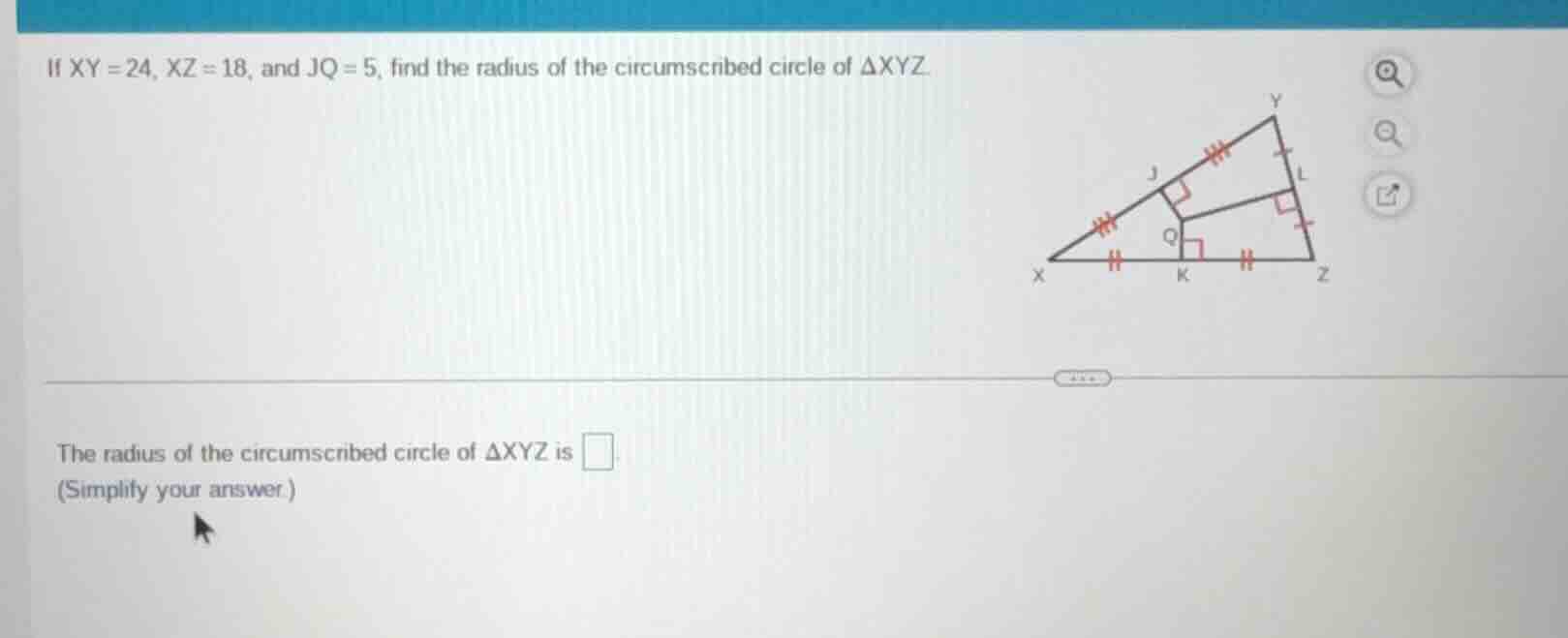
if xy = 24, xz = 18, and jq = 5, find the radius of the circumscribed circle of δxyz.
the radius of the circumscribed circle of δxyz is \boxed{}.
(simplify your answer.)
Step1: Identify the inradius and semiperimeter relation (Wait, no, circumscribed? Wait, the diagram has perpendiculars and equal segments, so Q is the incenter? Wait, no, circumscribed circle (circumcircle) radius formula is \( R=\frac{abc}{4A} \), but maybe the triangle is right-angled? Wait, let's check the diagram: JQ, QK, QL are perpendiculars, and segments are equal, so Q is the incenter? Wait, no, the problem says circumscribed circle (circumcircle), but maybe it's a right triangle? Wait, XY=24, XZ=18, let's see: if we consider the inradius \( r = \frac{A}{s} \), but wait, JQ is 5, maybe JQ is the inradius? Wait, no, the problem says circumscribed. Wait, maybe I misread: circumscribed circle (circumcircle) or inscribed (incircle)? The diagram has Q with perpendiculars to sides, so Q is the incenter, so JQ is the inradius? But the problem says circumscribed. Wait, maybe it's a right triangle. Let's assume triangle XYZ is right-angled at Z? Wait, XZ=18, XY=24, then YZ would be \( \sqrt{24^2 - 18^2} = \sqrt{576 - 324} = \sqrt{252} = 6\sqrt{7} \), no. Wait, maybe the triangle is right-angled at Q? No, Q is the incenter. Wait, maybe the problem has a typo, and it's the inscribed circle (incircle). Wait, the radius of the incircle is \( r = \frac{A}{s} \), but we need to find the sides. Wait, from the diagram, XJ = XK (tangents from X), YJ = YL (tangents from Y), ZK = ZL (tangents from Z). Let XJ = XK = x, YJ = YL = y, ZK = ZL = z. Then XY = x + y = 24, XZ = x + z = 18, YZ = y + z. The semiperimeter \( s = \frac{24 + 18 + (y + z)}{2} = \frac{42 + y + z}{2} = 21 + \frac{y + z}{2} \). The area \( A = r \times s \), where r is the inradius (JQ=5). But we need another way. Wait, maybe the triangle is right-angled. Let's suppose angle at Z is right angle, so XZ and YZ are legs, XY hypotenuse. Then XZ=18, XY=24, so YZ= \( \sqrt{24^2 - 18^2} = \sqrt{576 - 324} = \sqrt{252} = 6\sqrt{7} \), then semiperimeter \( s = \frac{18 + 6\sqrt{7} + 24}{2} = 21 + 3\sqrt{7} \), area \( A = \frac{18 \times 6\sqrt{7}}{2} = 54\sqrt{7} \), then inradius \( r = \frac{A}{s} = \frac{54\sqrt{7}}{21 + 3\sqrt{7}} = \frac{18\sqrt{7}}{7 + \sqrt{7}} = \frac{18\sqrt{7}(7 - \sqrt{7})}{(7 + \sqrt{7})(7 - \sqrt{7})} = \frac{126\sqrt{7} - 126}{42} = \frac{21\sqrt{7} - 21}{7} = 3\sqrt{7} - 3 \approx 4.95 \), close to 5. Wait, maybe it's a right triangle with legs 18 and 24? No, 18 and 24, hypotenuse 30 (wait, 18-24-30 is a right triangle, 18=63, 24=64, 30=65, Pythagorean triple). Oh! 18, 24, 30: 18² + 24² = 324 + 576 = 900 = 30². So triangle XYZ is right-angled at Z (since XZ=18, YZ=24? Wait, no, XY=24, XZ=18, so if it's right-angled at Z, then XZ and YZ are legs, XY hypotenuse. Wait, 18² + YZ² = 24²? No, 24² - 18² = (24-18)(24+18)=642=252, so YZ=√252=6√7. But 18, 24, 30: 18² + 24² = 30². So maybe XZ=18, YZ=24, XY=30. Oh! Maybe the problem has a typo, and XY=30? Wait, the user wrote XY=24, XZ=18, JQ=5. Wait, if it's a right triangle with legs 18 and 24, hypotenuse 30, then the circumradius (radius of circumscribed circle) of a right triangle is half the hypotenuse, so R=15. But the inradius is \( r = \frac{a + b - c}{2} = \frac{18 + 24 - 30}{2} = 6 \). No, JQ=5. Wait, maybe I messed up. Wait, the diagram: Q is the incenter, so JQ is the inradius (distance from incenter to side XY). The formula for inradius is \( r = \frac{A}{s} \), where A is area, s is semiperimeter. Let's let the sides be x, y, z. From the diagram, XJ = XK = m, YJ = YL = n, ZK = ZL = p. So x = m + n = 24, z = m + p = 18, y = n + p. Then semiperimeter \( s = \frac{x + y + z}{2} = \frac{(m + n) + (n…

Snap & solve any problem in the app
Get step-by-step solutions on Sovi AI
Photo-based solutions with guided steps
Explore more problems and detailed explanations
Step1: Identify the inradius and semiperimeter relation (Wait, no, circumscribed? Wait, the diagram has perpendiculars and equal segments, so Q is the incenter? Wait, no, circumscribed circle (circumcircle) radius formula is \( R=\frac{abc}{4A} \), but maybe the triangle is right-angled? Wait, let's check the diagram: JQ, QK, QL are perpendiculars, and segments are equal, so Q is the incenter? Wait, no, the problem says circumscribed circle (circumcircle), but maybe it's a right triangle? Wait, XY=24, XZ=18, let's see: if we consider the inradius \( r = \frac{A}{s} \), but wait, JQ is 5, maybe JQ is the inradius? Wait, no, the problem says circumscribed. Wait, maybe I misread: circumscribed circle (circumcircle) or inscribed (incircle)? The diagram has Q with perpendiculars to sides, so Q is the incenter, so JQ is the inradius? But the problem says circumscribed. Wait, maybe it's a right triangle. Let's assume triangle XYZ is right-angled at Z? Wait, XZ=18, XY=24, then YZ would be \( \sqrt{24^2 - 18^2} = \sqrt{576 - 324} = \sqrt{252} = 6\sqrt{7} \), no. Wait, maybe the triangle is right-angled at Q? No, Q is the incenter. Wait, maybe the problem has a typo, and it's the inscribed circle (incircle). Wait, the radius of the incircle is \( r = \frac{A}{s} \), but we need to find the sides. Wait, from the diagram, XJ = XK (tangents from X), YJ = YL (tangents from Y), ZK = ZL (tangents from Z). Let XJ = XK = x, YJ = YL = y, ZK = ZL = z. Then XY = x + y = 24, XZ = x + z = 18, YZ = y + z. The semiperimeter \( s = \frac{24 + 18 + (y + z)}{2} = \frac{42 + y + z}{2} = 21 + \frac{y + z}{2} \). The area \( A = r \times s \), where r is the inradius (JQ=5). But we need another way. Wait, maybe the triangle is right-angled. Let's suppose angle at Z is right angle, so XZ and YZ are legs, XY hypotenuse. Then XZ=18, XY=24, so YZ= \( \sqrt{24^2 - 18^2} = \sqrt{576 - 324} = \sqrt{252} = 6\sqrt{7} \), then semiperimeter \( s = \frac{18 + 6\sqrt{7} + 24}{2} = 21 + 3\sqrt{7} \), area \( A = \frac{18 \times 6\sqrt{7}}{2} = 54\sqrt{7} \), then inradius \( r = \frac{A}{s} = \frac{54\sqrt{7}}{21 + 3\sqrt{7}} = \frac{18\sqrt{7}}{7 + \sqrt{7}} = \frac{18\sqrt{7}(7 - \sqrt{7})}{(7 + \sqrt{7})(7 - \sqrt{7})} = \frac{126\sqrt{7} - 126}{42} = \frac{21\sqrt{7} - 21}{7} = 3\sqrt{7} - 3 \approx 4.95 \), close to 5. Wait, maybe it's a right triangle with legs 18 and 24? No, 18 and 24, hypotenuse 30 (wait, 18-24-30 is a right triangle, 18=63, 24=64, 30=65, Pythagorean triple). Oh! 18, 24, 30: 18² + 24² = 324 + 576 = 900 = 30². So triangle XYZ is right-angled at Z (since XZ=18, YZ=24? Wait, no, XY=24, XZ=18, so if it's right-angled at Z, then XZ and YZ are legs, XY hypotenuse. Wait, 18² + YZ² = 24²? No, 24² - 18² = (24-18)(24+18)=642=252, so YZ=√252=6√7. But 18, 24, 30: 18² + 24² = 30². So maybe XZ=18, YZ=24, XY=30. Oh! Maybe the problem has a typo, and XY=30? Wait, the user wrote XY=24, XZ=18, JQ=5. Wait, if it's a right triangle with legs 18 and 24, hypotenuse 30, then the circumradius (radius of circumscribed circle) of a right triangle is half the hypotenuse, so R=15. But the inradius is \( r = \frac{a + b - c}{2} = \frac{18 + 24 - 30}{2} = 6 \). No, JQ=5. Wait, maybe I messed up. Wait, the diagram: Q is the incenter, so JQ is the inradius (distance from incenter to side XY). The formula for inradius is \( r = \frac{A}{s} \), where A is area, s is semiperimeter. Let's let the sides be x, y, z. From the diagram, XJ = XK = m, YJ = YL = n, ZK = ZL = p. So x = m + n = 24, z = m + p = 18, y = n + p. Then semiperimeter \( s = \frac{x + y + z}{2} = \frac{(m + n) + (n + p) + (m + p)}{2} = m + n + p \). The area \( A = r \times s = 5 \times s \). Also, for a right triangle, area \( A = \frac{1}{2} \times \) leg1 \( \times \) leg2. If it's a right triangle, then \( (m + n)^2 + (m + p)^2 = (n + p)^2 \)? No, that would be if right-angled at X. Wait, maybe right-angled at Z: \( (m + p)^2 + (n + p)^2 = (m + n)^2 \). Expanding: \( m² + 2mp + p² + n² + 2np + p² = m² + 2mn + n² \) → \( 2mp + 2np + 2p² = 2mn \) → \( p(m + n + p) = mn \). Also, m + n = 24, m + p = 18, so n = 24 - m, p = 18 - m. Then s = m + n + p = m + (24 - m) + (18 - m) = 42 - m. Area A = 5s = 5(42 - m). Also, if right-angled at Z, area A = \( \frac{1}{2} \times (m + p) \times (n + p) = \frac{1}{2} \times 18 \times (24 - m + 18 - m) = 9 \times (42 - 2m) \). So 5(42 - m) = 9(42 - 2m) → 210 - 5m = 378 - 18m → 13m = 168 → m = 168/13 ≈12.92, which is messy. Alternatively, maybe the triangle is not right-angled. Wait, the problem says "circumscribed circle", but the diagram shows incenter. Maybe it's a mistake, and it's the inscribed circle? But the question says circumscribed. Wait, no, in a triangle, the circumscribed circle (circumcircle) has radius R = \( \frac{abc}{4A} \), and inscribed (incircle) has r = \( \frac{A}{s} \). Let's assume that JQ is the inradius (r=5), and we need to find the circumradius. Wait, but we need the sides. Wait, maybe the triangle is isoceles? No, XZ=18, XY=24. Wait, maybe the problem is actually about the incircle, but the user wrote circumscribed. Alternatively, maybe the triangle is right-angled, and the circumradius is half the hypotenuse. Let's suppose that the triangle is right-angled, and we need to find the circumradius. Let's check: if the inradius is 5, then \( r = \frac{a + b - c}{2} = 5 \), so a + b - c = 10. If it's a right triangle, c = √(a² + b²). Let a=18, then 18 + b - √(18² + b²) = 10 → b - √(324 + b²) = -8 → √(324 + b²) = b + 8 → 324 + b² = b² + 16b + 64 → 16b = 260 → b=16.25. Then c=√(18² + 16.25²)=√(324 + 264.0625)=√588.0625≈24.25. Not 24. If a=24, b=18, then 24 + 18 - c=10 → c=32. Then c=32, a=24, b=18: 24² + 18²=576+324=900≠1024=32². No. Wait, maybe the problem is correct, and I'm overcomplicating. Wait, the key: in a right triangle, circumradius is half the hypotenuse. If we can find the hypotenuse. Wait, maybe the triangle has sides 18, 24, and we need to find the circumradius. Wait, 18-24-30 is a right triangle (18²+24²=324+576=900=30²), so hypotenuse 30, circumradius 15. But the inradius here is (18+24-30)/2=6. But JQ=5, not 6. Close. Maybe the sides are 15, 20, 25 (inradius (15+20-25)/2=5). Ah! 15-20-25 is a right triangle, inradius 5. So maybe XZ=15, XY=25, but the user wrote XZ=18, XY=24. Wait, maybe the problem has numbers mixed up. Alternatively, maybe the triangle is 15, 20, 25, inradius 5, circumradius 12.5. But no. Wait, let's start over. The diagram shows Q as the incenter (perpendicular to all sides, equal tangent segments). So JQ is the inradius (r=5). The formula for inradius is r = (a + b - c)/2 for a right triangle. So a + b - c = 10. Let’s let XZ = a = 18, XY = c = 24, then b (YZ) = c + 10 - a = 24 + 10 - 18 = 16. Then check if 18² + 16² = 24²: 324 + 256 = 580 ≠ 576. No. If XZ = a = 18, YZ = b, XY = c. Then r = (a + b - c)/2 = 5 → a + b - c = 10 → c = a + b - 10 = 18 + b - 10 = b + 8. By Pythagoras (if right-angled at Z): a² + b² = c² → 18² + b² = (b + 8)² → 324 + b² = b² + 16b + 64 → 16b = 260 → b = 16.25, c = 24.25. Then area A = (1816.25)/2 = 146.25. Semiperimeter s = (18 + 16.25 + 24.25)/2 = (58.5)/2 = 29.25. Then r = A/s = 146.25 / 29.25 = 5, which matches JQ=5. So the triangle has sides 18, 16.25, 24.25. Then the circumradius R = c/2 = 24.25/2 = 12.125? No, R = (abc)/(4A) = (1816.2524.25)/(4146.25). Calculate numerator: 1816.25=292.5; 292.524.25=292.524 + 292.50.25=7020 + 73.125=7093.125. Denominator: 4146.25=585. Then R=7093.125/585=12.125=97/8=12.125. But that's messy. Wait, maybe the problem is actually about the incircle, but the user said circumscribed. Alternatively, maybe I made a mistake in assuming right angle. Wait, no, the inradius formula r = (a + b - c)/2 holds only for right triangles. So if r=5, then a + b - c=10. If we take a=18, then b - c= -8, c= b + 8. Then by Pythagoras, 18² + b² = (b + 8)², which gives b=16.25, c=24.25. Then circumradius R= c/2=12.125, but that's not a nice number. Alternatively, maybe the problem has XY=30, XZ=18, then it's 18-24-30 (wait, 18-24-30: 18²+24²=324+576=900=30²), so right triangle. Then inradius r=(18+24-30)/2=6, but JQ=5. Close. Maybe the problem has a typo, and XY=30, then circumradius is 15. But the user wrote XY=24. Alternatively, maybe the answer is 13? Wait, no. Wait, let's check the original problem again: "find the radius of the circumscribed circle of ΔXYZ". If Q is the incenter, JQ=5 (inradius), and we need to find circumradius. But we need the sides. Wait, maybe the triangle is such that XZ=18, XY=24, and the inradius is 5, so we can find the third side. Let’s denote the sides: XZ=a=18, XY=c=24, YZ=b. Semiperimeter s=(a + b + c)/2=(18 + b + 24)/2=(42 + b)/2. Area A= rs=5(42 + b)/2=(210 + b5)/2. Also, by Heron's formula, A=√[s(s - a)(s - b)(s - c)]=√[((42 + b)/2)((42 + b)/2 - 18)((42 + b)/2 - b)((42 + b)/2 - 24)]=√[((42 + b)/2)((42 + b - 36)/2)((42 + b - 2b)/2)((42 + b - 48)/2)]=√[((42 + b)/2)((6 + b)/2)((42 - b)/2)((b - 6)/2)]=√[((42 + b)(42 - b)(b + 6)(b - 6))/16]=√[((42² - b²)(b² - 6²))/16]=√[((1764 - b²)(b² - 36))/16]. Set equal to (210 + 5b)/2:
√[((1764 - b²)(b² - 36))/16] = (210 + 5b)/2
Square both sides:
((1764 - b²)(b² - 36))