QUESTION IMAGE
Question
- you can classify polygons by the number of sides they have.
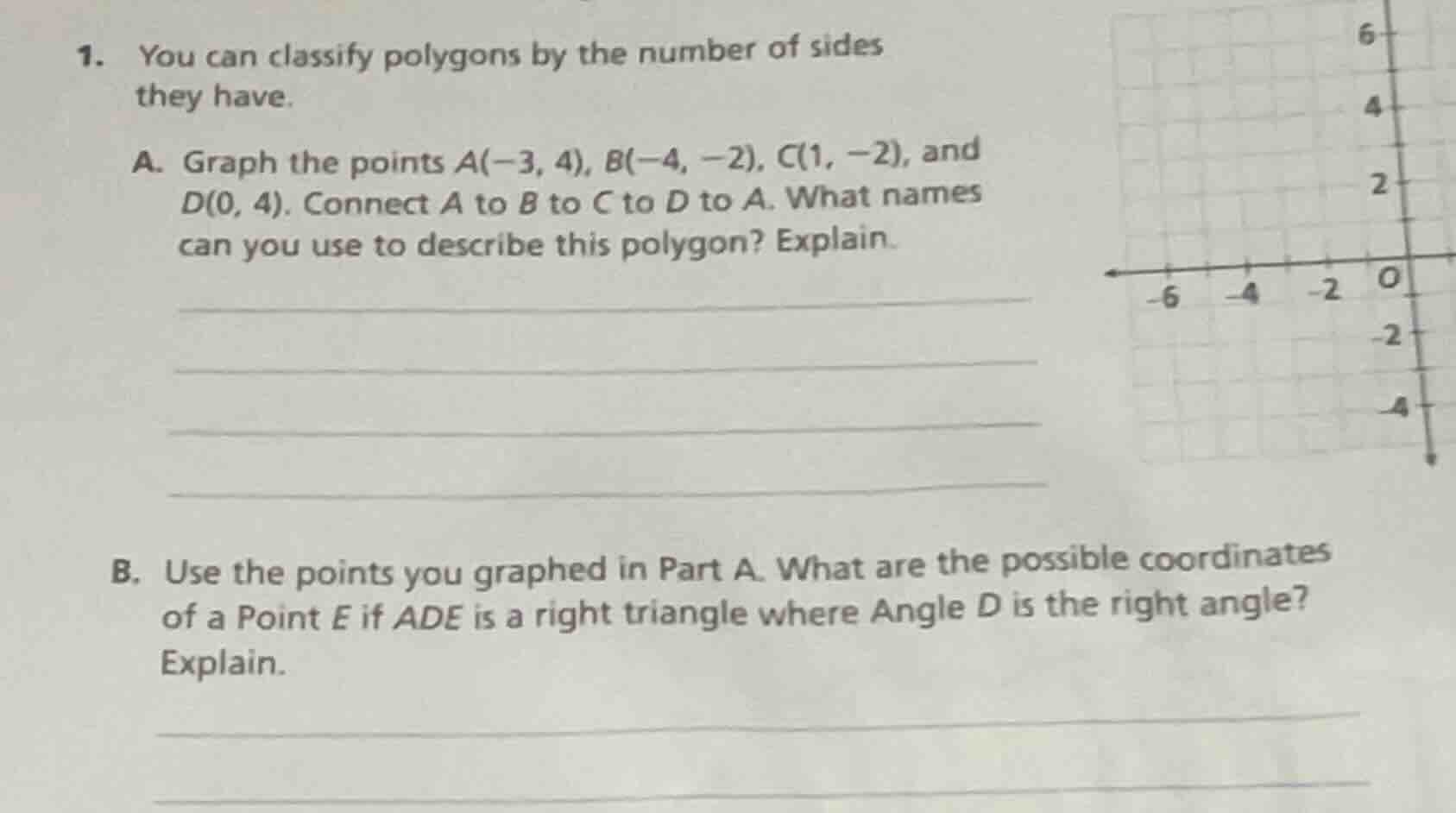
a. graph the points a(-3, 4), b(-4, -2), c(1, -2), and d(0, 4). connect a to b to c to d to a. what names can you use to describe this polygon? explain.
b. use the points you graphed in part a. what are the possible coordinates of a point e if ade is a right triangle where angle d is the right angle? explain.
Step1: Plot given points
Plot $A(-3, 4)$, $B(-4, -2)$, $C(1, -2)$, $D(0, 4)$ on the coordinate plane, then connect $A \to B \to C \to D \to A$.
Step2: Count sides & check sides/angles
Count sides: 4 sides, so it is a quadrilateral.
Calculate side lengths:
- Length of $AB$: $\sqrt{(-3+4)^2 + (4+2)^2} = \sqrt{1+36} = \sqrt{37}$
- Length of $BC$: $\sqrt{(-4-1)^2 + (-2+2)^2} = \sqrt{25+0} = 5$
- Length of $CD$: $\sqrt{(1-0)^2 + (-2-4)^2} = \sqrt{1+36} = \sqrt{37}$
- Length of $DA$: $\sqrt{(0+3)^2 + (4-4)^2} = \sqrt{9+0} = 3$
Check parallel sides: $AD$ (from $(-3,4)$ to $(0,4)$) and $BC$ (from $(-4,-2)$ to $(1,-2)$) are horizontal (same y-value), so $AD \parallel BC$. $AB = CD = \sqrt{37}$, so it is an isosceles trapezoid.
Step3: Solve for point E (Part B)
Right angle at $D(0,4)$, so $\overrightarrow{DE} \perp \overrightarrow{DA}$.
$\overrightarrow{DA} = A - D = (-3-0, 4-4) = (-3, 0)$ (horizontal left vector). A perpendicular vector is vertical (x-component 0).
Let $E=(0, y)$. For $\triangle ADE$ to be valid, $y
eq 4$.

Snap & solve any problem in the app
Get step-by-step solutions on Sovi AI
Photo-based solutions with guided steps
Explore more problems and detailed explanations
Part A:
This polygon is a quadrilateral (since it has 4 sides) and an isosceles trapezoid. It is a trapezoid because it has one pair of parallel sides ($AD$ and $BC$ are both horizontal, so they are parallel). It is isosceles because the non-parallel sides ($AB$ and $CD$) are equal in length ($\sqrt{37}$ each).
Part B:
Possible coordinates for $E$ are all points of the form $\boldsymbol{(0, y)}$ where $y$ is any real number except 4 (e.g., $(0, 5)$, $(0, -1)$). This is because $\overrightarrow{DA}$ is horizontal, so a line perpendicular to $DA$ at $D$ is the vertical line $x=0$; any point on this line (other than $D$ itself) forms a right angle at $D$ with points $A$ and $D$.