QUESTION IMAGE
Question
can you conclude that \\(\overline{kn}\\) and \\(\overline{rs}\\) are congruent?\
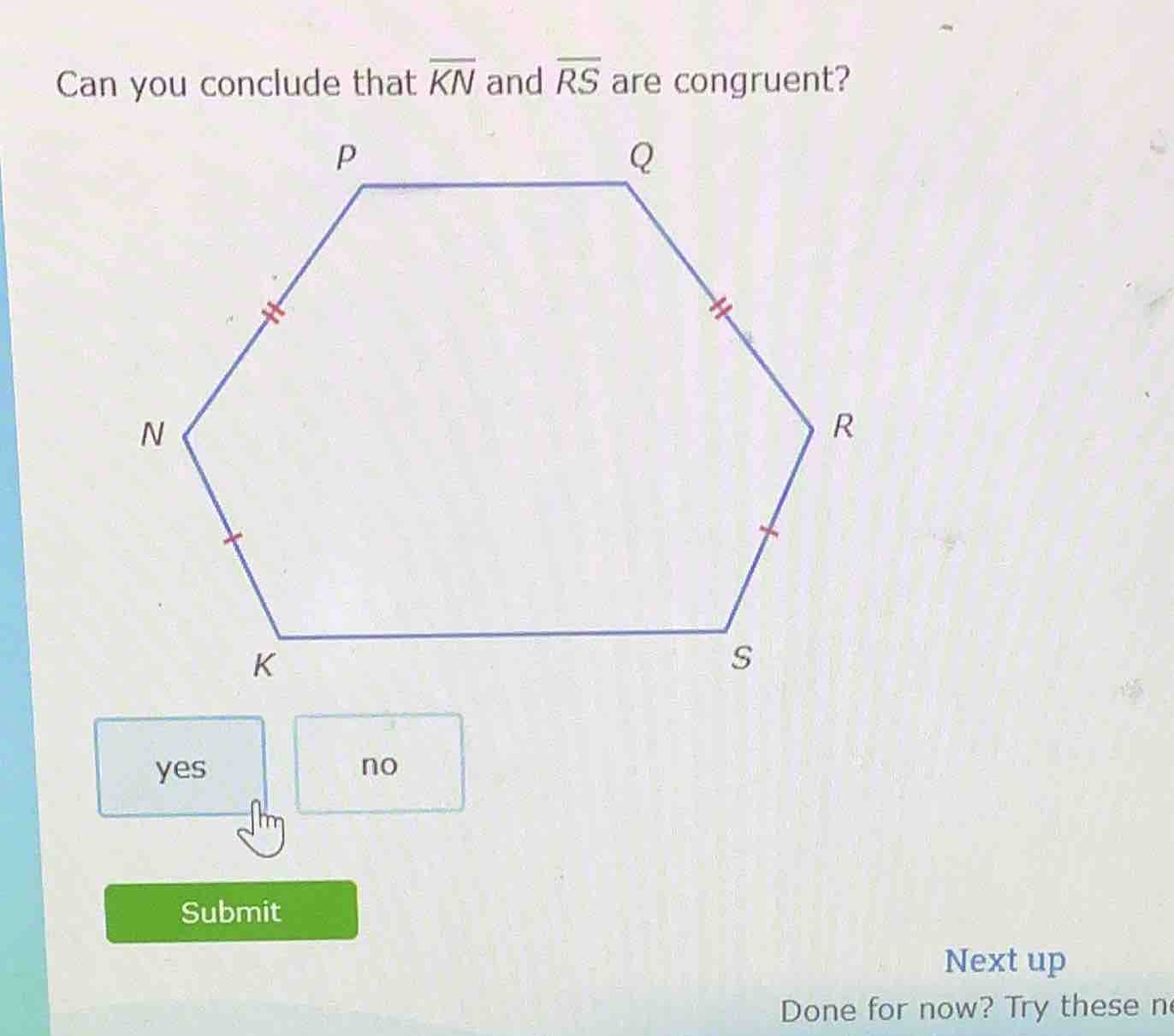
(there is a hexagon with vertices labeled p, q, r, s, k, n. sides pn and qr have two red tick marks, sides nk and rs have one red tick mark.)\
options: yes, no\
submit
Step1: Analyze the figure
The figure is a hexagon. In a regular hexagon, all sides are congruent, but here we look at the tick marks. The side \( \overline{KN} \) has one tick, and \( \overline{RS} \) has one tick? Wait, no, wait: Wait, \( \overline{PN} \) has two ticks, \( \overline{QR} \) has two ticks; \( \overline{NK} \) has one tick, \( \overline{SR} \) has one tick? Wait, no, the markings: \( \overline{PN} \) (from P to N) has two red ticks, \( \overline{QR} \) (from Q to R) has two red ticks. \( \overline{NK} \) (from N to K) has one red tick, \( \overline{SR} \) (from S to R) has one red tick. Wait, but in a regular hexagon, all sides are equal, but the tick marks: the single tick on \( \overline{KN} \) (wait, \( \overline{NK} \) is same as \( \overline{KN} \)) and single tick on \( \overline{RS} \) (wait, \( \overline{SR} \) is same as \( \overline{RS} \))? Wait, no, the figure: PQ, QR, RS, SK, KN, NP? Wait, no, the vertices are P, Q, R, S, K, N? Wait, the hexagon is P-Q-R-S-K-N-P? So sides: PQ, QR, RS, SK, KN, NP. Now, \( \overline{PN} \) (NP) has two ticks, \( \overline{QR} \) has two ticks. \( \overline{KN} \) (NK) has one tick, \( \overline{RS} \) (SR) has one tick. Wait, but in a regular hexagon, all sides are congruent, but the tick marks: the single tick on \( \overline{KN} \) and single tick on \( \overline{RS} \) – but wait, no, maybe the figure is a regular hexagon? Wait, no, the key is: in a polygon, sides with the same number of tick marks are congruent. So \( \overline{KN} \) has one tick, \( \overline{RS} \) has one tick? Wait, no, looking at the figure: \( \overline{NK} \) (KN) has one red tick, \( \overline{SR} \) (RS) has one red tick. \( \overline{PN} \) (NP) has two red ticks, \( \overline{QR} \) has two red ticks. So sides with the same number of ticks are congruent. So \( \overline{KN} \) (one tick) and \( \overline{RS} \) (one tick) – wait, no, wait: \( \overline{KN} \) is from K to N, \( \overline{RS} \) is from R to S. Wait, the side \( \overline{KN} \) (NK) has one tick, \( \overline{RS} \) (SR) has one tick. So since they have the same number of ticks, they are congruent? Wait, but wait, maybe the hexagon is regular, so all sides are congruent, but the tick marks: the single tick on \( \overline{KN} \) and single tick on \( \overline{RS} \) – but actually, in a regular hexagon, all sides are equal, so \( \overline{KN} \) and \( \overline{RS} \) should be congruent. Wait, but the tick marks: \( \overline{PN} \) (NP) has two ticks, \( \overline{QR} \) has two ticks (so those are congruent). \( \overline{KN} \) (NK) has one tick, \( \overline{RS} \) (SR) has one tick (so those are congruent). So yes, because sides with the same number of tick marks are congruent. So we can conclude they are congruent.
Step2: Conclusion
Since \( \overline{KN} \) and \( \overline{RS} \) have the same number of tick marks (one tick each), by the definition of congruent segments (segments with the same length, indicated by equal tick marks), they are congruent.

Snap & solve any problem in the app
Get step-by-step solutions on Sovi AI
Photo-based solutions with guided steps
Explore more problems and detailed explanations
yes