QUESTION IMAGE
Question
can you explain it?
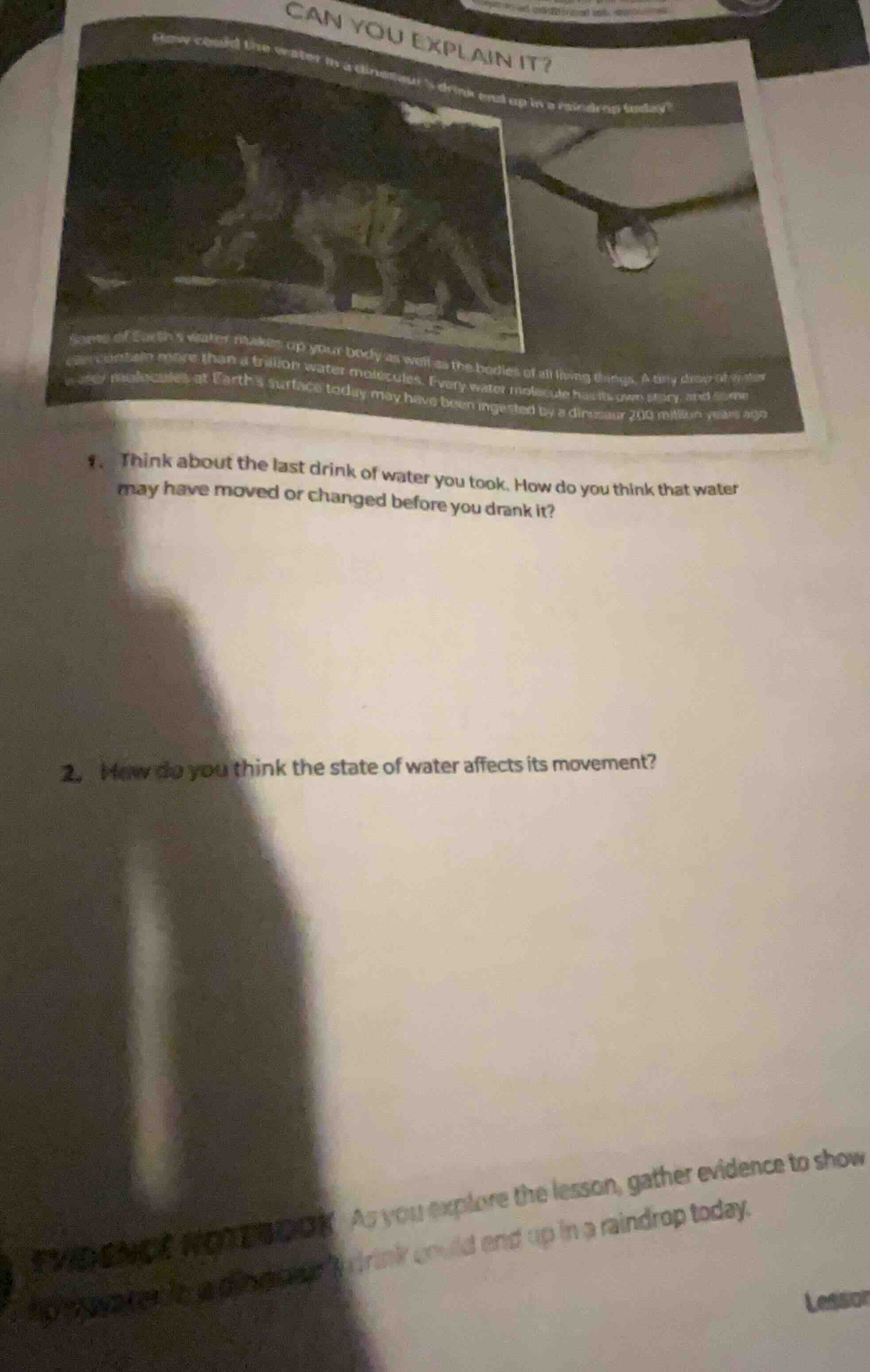
how could the water in a dinosaur’s drink end up in a raindrop today?
some of earth’s water makes up your body as well as the bodies of all living things. a tiny drop of water can contain more than a trillion water molecules. every water molecule has its own story, and some water molecules at earth’s surface today may have been ingested by a dinosaur 200 million years ago
- think about the last drink of water you took. how do you think that water may have moved or changed before you drank it?
- how do you think the state of water affects its movement?
as you explore the lesson, gather evidence to show how the water in a dinosaur’s drink could end up in a raindrop today.
Brief Explanations
- For the first question, the water likely followed the water cycle: it evaporated from a large body of water (like an ocean or lake) into water vapor (gas), condensed into clouds, fell as precipitation (rain/snow) onto land, flowed into a reservoir or groundwater system, was treated at a water plant to remove impurities, then traveled through pipes to your tap.
- For the second question, water's state (solid, liquid, gas) dictates its movement speed and path: solid ice moves very slowly via glacial flow; liquid water flows freely downhill through rivers, pipes, or as runoff; gaseous water vapor moves quickly with air currents, can travel long distances through the atmosphere.

Snap & solve any problem in the app
Get step-by-step solutions on Sovi AI
Photo-based solutions with guided steps
Explore more problems and detailed explanations
- The water likely went through the water cycle: it evaporated from a large water body into vapor, condensed into clouds, fell as precipitation, entered a water source (reservoir/groundwater), was treated, and traveled through pipes to my tap.
- Solid water (ice) moves slowly (e.g., glacial flow); liquid water flows freely downhill/through channels; gaseous water vapor moves quickly with air currents over long distances.