QUESTION IMAGE
Question
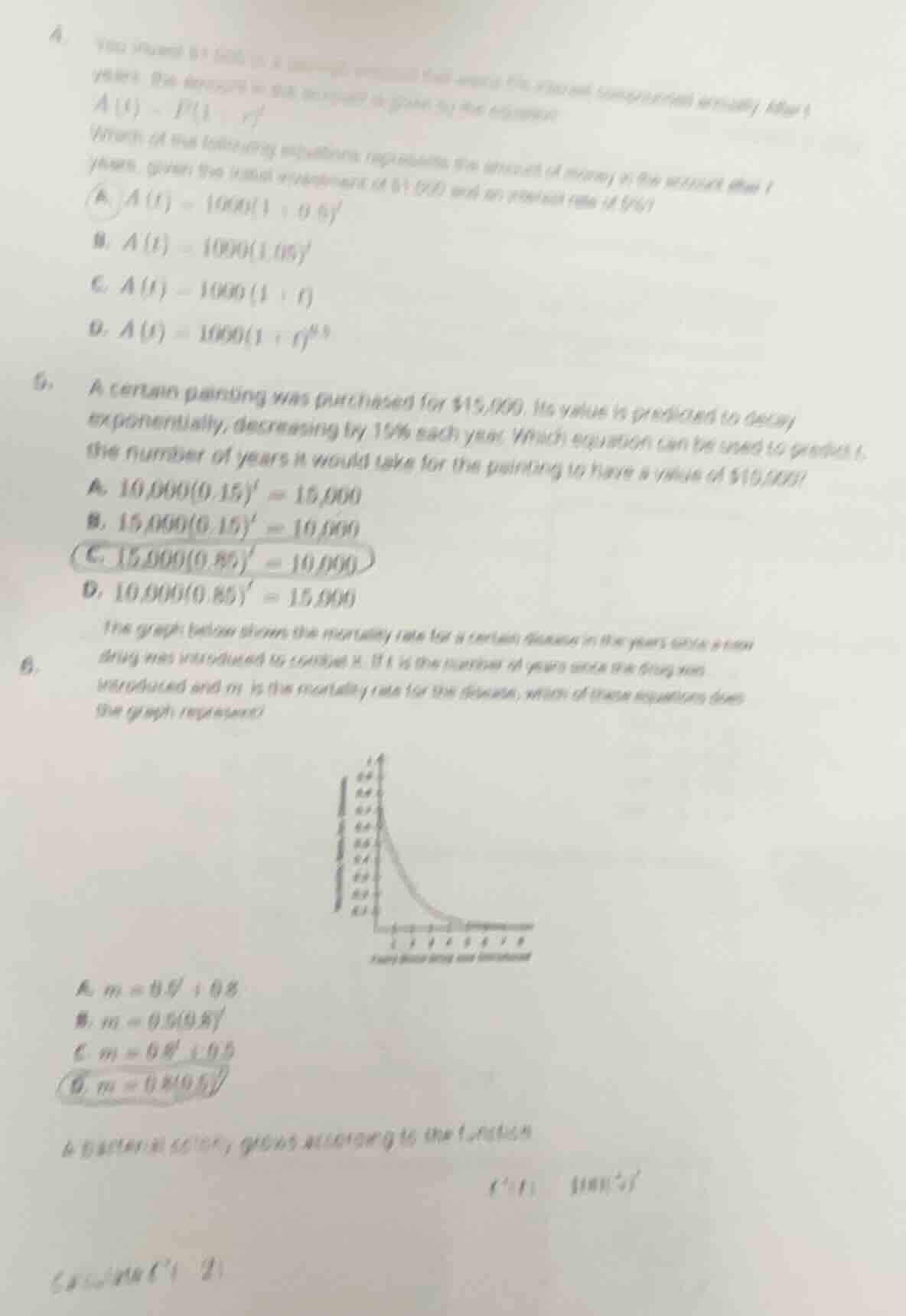
a. you invest $1000 in a savings account that earns 5% annual compounded annually after t years. the amount of money in the account is given by the formula ( a(t) = p(1 + r)^t ). which of the following equations represents the amount of money in the account after t years, given the initial investment of $1000 and an annual rate of 5%?
a. ( a(t) = 1000(1 + 0.5)^t )
b. ( a(t) = 1000(1.05)^t )
c. ( a(t) = 1000(1 + t) )
d. ( a(t) = 1000(1 + t)^{0.5} )
g. a certain painting was purchased for $15,000. its value is predicted to decay exponentially, decreasing by 15% each year. which equation can be used to predict t, the number of years it would take for the painting to have a value of $10,000?
a. ( 10,000(0.15)^t = 15,000 )
b. ( 15,000(0.15)^t = 10,000 )
c. ( 15,000(0.85)^t = 10,000 )
d. ( 10,000(0.85)^t = 15,000 )
h. the graph below shows the mortality rate for a certain disease in the years after a new drug was introduced to treat it. if t is the number of years since the drug was introduced and m is the mortality rate for the disease, which of these equations does the graph represent?
graph omitted
a. ( m = 0.5^t + 0.8 )
b. ( m = 0.5(0.8)^t )
c. ( m = 0.8^t + 0.5 )
d. ( m = 0.8(0.5)^t )
a bacterial colony grows according to the function ( c(t) = 1000 cdot 2^t )
evaluate ( c(2) )
Question 5 (Painting Value Decay)
The painting's value decays exponentially. The initial value \( P = 15000 \). A 15% decrease means the remaining value each year is \( 1 - 0.15 = 0.85 \). The exponential decay formula is \( V = P(1 - r)^t \), where \( V \) is the final value, \( P \) is initial, \( r \) is the decay rate, and \( t \) is time. Here, we want \( V = 10000 \), so substituting gives \( 15000(0.85)^t = 10000 \), which matches option C.
The graph shows exponential decay (decreasing rapidly then slowing). The general form for exponential decay is \( y = ab^t \) with \( 0 < b < 1 \). Let's analyze options:
- Option A: \( m = 0.8^t + 0.8 \) is a sum of exponential and constant, not pure decay.
- Option B: \( m = 0.5(0.8)^t \): \( 0.8 \) is the decay factor (less than 1), and \( 0.5 \) is the initial coefficient. As \( t \) increases, \( (0.8)^t \) decreases, so \( m \) decays exponentially.
- Option C: \( m = 0.8^t + 0.5 \) is a sum, not pure decay.
- Option D: \( m = 0.8(0.5)^t \): While it decays, the graph's shape (starting higher and decaying) matches \( 0.5(0.8)^t \) better? Wait, no—wait, the initial value (at \( t = 0 \)): for B, \( t = 0 \) gives \( m = 0.5(1) = 0.5 \)? Wait, maybe I misread. Wait the graph's y-axis starts around 0.8? Wait, maybe the correct form is \( m = 0.5(0.8)^t \) or \( 0.8(0.5)^t \). Wait, at \( t = 0 \), if the graph starts at 0.5, B: \( t=0 \), \( m=0.5 \); D: \( t=0 \), \( m=0.8 \). The graph's initial value (at \( t=0 \)) looks like around 0.8? Wait, no, the graph's y-axis has marks. Wait, the key is exponential decay with base <1. Both B and D have bases 0.8 and 0.5 (both <1). But the graph's shape: let's see the rate. If the base is 0.8, it decays slower than base 0.5. The graph seems to decay rapidly at first, which would be a smaller base (0.5) or larger? Wait, no—wait, the coefficient: B has 0.5 as the initial multiplier, D has 0.8. Wait, maybe the correct answer is B? Wait, the boxed option in the image is D? Wait, no, the user's image shows D boxed? Wait, no, the user's image for question 6 has D boxed: \( m = 0.8(0.5)^t \). Let's check \( t = 0 \): \( m = 0.8(1) = 0.8 \), which matches the graph's initial value (around 0.8). Then as \( t \) increases, \( (0.5)^t \) decreases, so \( m \) decays exponentially. So D is correct. Wait, but earlier analysis: B has initial 0.5, D has initial 0.8. The graph's y-axis at \( t=0 \) is around 0.8, so D is correct.
The formula for compound interest is \( A(t) = P(1 + r)^t \), where \( P \) is principal, \( r \) is annual rate (as a decimal). Here, \( P = 1000 \), \( r = 5\% = 0.05 \), so \( 1 + r = 1.05 \). Thus, \( A(t) = 1000(1.05)^t \), which is option B.

Snap & solve any problem in the app
Get step-by-step solutions on Sovi AI
Photo-based solutions with guided steps
Explore more problems and detailed explanations
C. \( 15000(0.85)^t = 10000 \)